
Listing-based property ads are targeted advertisements that use individual property listings to attract investor attention and prompt lead actions. Listing-based property ads define each advertised asset as a distinct entity. Entities include property address, property type (apartment, commercial, residential), price, expected yield percentage, tenure (freehold, leasehold), agent contact, and images.
Ads pull structured data from property feeds or portals and display it in ad formats on social platforms, search engines, and display networks. Listing-level metadata enables dynamic ad creation and supports automated testing of creatives and copy. Examples: a central London apartment listed at £450,000 with expected gross yield 5.2%; a Manchester industrial unit listed at £1,200,000 with floor area 3,400 sq ft.
Listing-based ads use tracking pixels, UTM parameters, and lead capture forms to measure conversions. Conversion events include form submits, brochure downloads, viewing bookings, and direct calls. Ads integrate with CRM systems to map leads to investor records. This structure allows precise attribution of ad spend to lead value.
How does the listing-based ad process work?
The process ingests listings into an ad feed, maps listing fields to ad templates, deploys ads across channels, and captures lead events back into CRM. A property feed exports listing data as CSV, XML, or API. Mapping assigns fields—title, price, image, URL—to ad template slots. Dynamic templates render unique ads per listing. Ad platforms pull the feed at predefined intervals, typically every 4 to 24 hours, to reflect listing updates.
Ad delivery targets audiences by behaviour, demographics, and lookalike profiles. Retargeting lists include site visitors, engaged users, and previous enquirers. Ads call a conversion pixel on view and a separate pixel on lead form submission. Conversion values attach monetary estimates based on historical lead-to-sale rates. Example workflow: feed update at 6:00 UTC, template renders ads for five new Manchester flats, ads launch at 08:00 UTC, pixel tracks 120 impressions and 8 leads within 48 hours.
Ad creative tests run continuously. Tests vary headlines (price-led vs. yield-led), images (interior vs. exterior), and CTA text (enquire vs. book viewing). Effective campaigns iterate using conversion rate and cost-per-lead metrics. Typical optimisation cycle equals 7 to 14 days for statistically significant results when sample sizes exceed 500 impressions.
What components make listing-based ads effective?
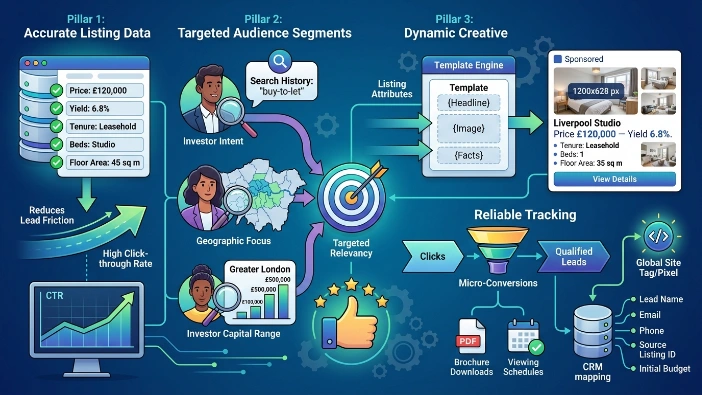
Effective listing-based ads combine accurate listing data, targeted audience segments, dynamic creative, and reliable tracking into a cohesive funnel. Accurate listing data reduces lead friction. Missing or inconsistent fields lower click-through rates by measurable percentages. Targeted audience segments ensure relevance. Segments include investor intent (search history for “buy-to-let”), geographic focus (greater London), and investor capital range (£100,000–£500,000). Dynamic creative uses templates to personalise headlines and images to listing attributes. Reliable tracking captures micro-conversions such as brochure downloads and viewing schedules.
Creative assets include a primary image (minimum 1200×628 px), secondary images showing interiors, and a PDF brochure. Copy includes headline with price, subheadline with yield or rental estimate, and a short body with three facts: tenure, beds, and floor area. Tracking requires a global site tag or pixel and event definitions for lead actions. CRM mapping requires at least five fields: lead name, email, phone, source listing ID, and initial budget. Example components: a Liverpool studio ad using targeted audience “first-time investors” with a dynamic headline showing “Price £120,000 — Yield 6.8%.”
What benefits do listing-based ads deliver for investor acquisition?
Listing-based ads increase relevance, lower cost-per-lead, speed up lead qualification, and improve attribution between ad spend and closed deals. Relevance increases click-through rates because ads show exact properties aligned with investor criteria. Cost-per-lead falls where targeting excludes non-investor traffic. Speed of qualification improves because ads drive visitors directly to listing-level detail and lead forms with targeted qualification questions. Attribution tightens since each lead links to a listing ID and campaign parameters, enabling ROI calculations at the asset level.
Performance metrics include CTR, conversion rate, cost-per-lead, time-to-contact, and lead-to-sale conversion rate. Benchmarks: CTR range 0.8%–2.5% for display and 2.5%–6.0% for social when ads use listing data; conversion rates vary from 1.5%–5.0% depending on targeting sophistication. Lead-to-sale conversion rates for investor-focused campaigns range 2%–12% depending on market and asset class. Example result: a regional campaign reduced CPL from £150 to £95 after switching to listing-based creatives and tightened targeting.
How do listing-based ads integrate with retargeting and nurturing?
Listing-based ads feed retargeting audiences with personalised ads and trigger nurture sequences that move investors from interest to decision. Retargeting uses behavioural signals: viewed listing detail, downloaded brochure, or started booking. Each signal adds users to tiered lists. Tier 1 equals viewed listing but no contact; Tier 2 equals downloaded brochure; Tier 3 equals scheduling a viewing. Ads tailor messaging per tier, e.g., Tier 1 shows price and yield, Tier 2 offers virtual tour, Tier 3 prompts direct call with agent.
Nurture sequences use email and CRM tasks. Email content links back to the original listing and shows similar properties. CRM tasks schedule follow-up calls based on lead score. Lead scoring assigns points: page view 1, brochure download 3, viewing booked 7, site visit longer than 3 minutes 2. Leads with score ≥12 move to sales outreach. Example nurture: a lead downloads a brochure for a Bristol property, receives a virtual tour email 24 hours later, and then a sales call when score reaches 12.
Explore More Expert Insights:
Mid-Funnel Property Ads That Turn Intent Into Booking Requests
Retargeting Real Estate Campaigns That Convert Warm Leads Into Deal Inquiries
What components measure ROI and lead quality?
Measure ROI with revenue-per-lead, lead-to-sale rate, average time-to-close, and cost-per-acquisition; measure lead quality with qualification rate and projected deal value. Revenue-per-lead equals total attributable sales value divided by number of leads from a campaign. Lead-to-sale rate equals closed sales divided by leads. Average time-to-close equals days between first contact and contract signature. Cost-per-acquisition equals ad spend divided by closed deals attributed to the campaign.
Qualification rate equals leads passing qualification questions divided by total leads. Projected deal value equals expected sale price multiplied by lead probability. Use UTM parameters and listing IDs to attribute closed deals back to specific ads. Example KPI set: CPL £95, lead-to-sale 6%, average time-to-close 58 days, revenue-per-lead £3,800.
Read:
How Real Estate Companies Improve Conversions Using Retargeting Ads
What use cases exist for listing-based ads in the UK investor market?
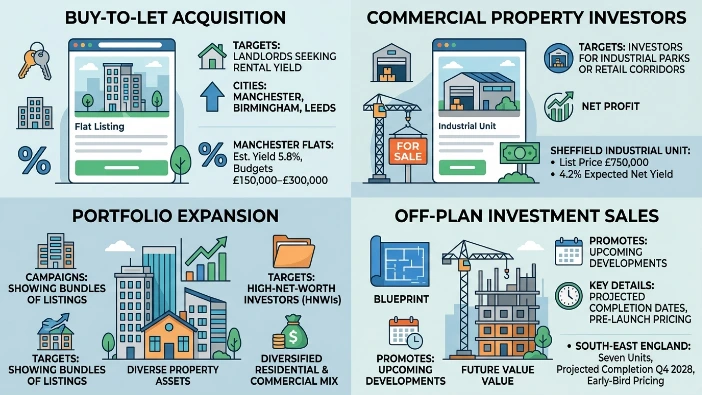
Use cases include buy-to-let acquisition, commercial property investors, portfolio expansion, and off-plan investment sales. Buy-to-let acquisition targets landlords seeking rental yield in cities such as Manchester, Birmingham, and Leeds. Commercial property ads target investors seeking units in industrial parks or retail corridors. Portfolio expansion campaigns show bundles of listings to high-net-worth investors. Off-plan sales promote upcoming developments with projected completion dates and pre-launch pricing.
Examples: a buy-to-let campaign for Manchester flats with yields listed at 5.8% targets investors with budgets £150,000–£300,000; a commercial campaign lists an industrial unit in Sheffield at £750,000 with 4.2% expected net yield; an off-plan campaign in South-East England lists seven units with projected completion Q4 2028 and early-bird pricing.
Explore:
How Property Portals Nurture Investors Using Listing-Based Ads