
Retargeting campaigns deliver targeted ads to users who previously interacted with a property brand, using tracked signals and CRM data to re-engage warm leads and drive direct deal inquiries. Retargeting in real estate uses tracking pixels, mobile identifiers, or uploaded contact lists to reconnect with prospects. Important entities include the tracking pixel, audience segment, CRM record, ad creative, and conversion event.
The campaign defines warm leads as users who viewed listings, requested information, or engaged with valuation tools within a defined recency window. Campaigns aim to increase direct inquiries such as phone calls, form submissions, and booked viewings. Retargeting focuses spend on users with prior intent to improve lead quality and shorten sales cycles.
How do you structure a retargeting campaign to convert warm leads?
Structure campaigns by defining intent-based segments, mapping tailored creatives to each segment, setting conversion-focused bid strategies, and measuring offline and online outcomes. Begin with a clear segmentation plan. Create 0–7 day high-intent lists for recent listing viewers, 8–30 day lists for warm nurtures, and 31–90 day lists for longer-term prospects.
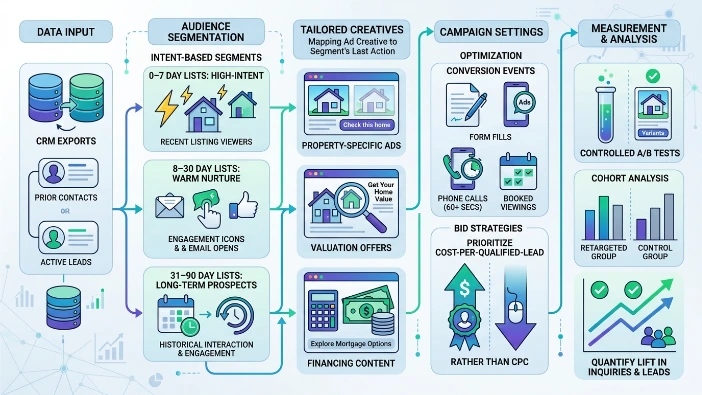
Use CRM exports to form lists of prior contacts and active leads. Match ad creative to the segment’s last action: property-specific creative for listing viewers, valuation offers for appraisal seekers, and financing content for mortgage-involved users. Set conversion events for form fills, phone calls lasting 60+ seconds, and booked viewings. Use bid strategies that prioritise cost-per-qualified-lead rather than cost-per-click. Run controlled A/B tests and compare cohorts with and without retargeting to quantify lift in inquiries and qualified leads.
Which campaign components deliver higher conversion rates?
High-quality creative, accurate audience signals, dynamic listing feeds, and precise conversion tracking deliver higher conversion rates by aligning message with user intent.
Creative must reference the user’s prior interaction, using the exact property image, price, and a single clear action. Audience signals include page depth, frequency of visits, and CRM lead score. Dynamic feeds synchronise live property data to ads to avoid advertising unavailable listings.
Conversion tracking must capture online form submissions, phone calls with duration, and booked viewings logged in the CRM. Use server-side tracking when possible to reduce signal loss from browser restrictions. Combine these components to reduce irrelevant clicks and increase the ratio of enquiries that progress to site visits and appointments.
How do you use CRM data to increase conversion likelihood?
Upload CRM segments directly to ad platforms, enrich lists with behavioural signals, and close the loop by importing offline conversions back into the CRM for optimisation.
Export lists of recent enquirers, high-net-worth prospects, and prior clients and upload to the ad platform in hashed format. Enrich these lists with recent site behaviour such as viewed floorplans or downloaded guides. Use lookalike audiences derived from top-scoring CRM contacts to expand reach to similar investors or buyers. After campaigns run, import offline conversions—viewings, offers, and completions—into ad platforms to optimise delivery toward audiences that generate actual deals. Maintain a clear retention policy and lawful basis for processing in line with UK GDPR when handling CRM data.
What messaging and creative convert warm leads into inquiries?
Use direct, factual messaging that references prior activity, highlights a specific next step, and provides measurable details such as price, availability, and viewing slots.
If a user viewed a 2-bedroom flat in Manchester, serve the same property image with its asking price, tenure, and a call to action: “Book viewing.” If a prospect downloaded an investment guide, present yield figures, recent comparable sales, and a “Request investor briefing” CTA. Use short headlines, one-sentence supporting copy, and a single-button CTA. Include trust signals such as EPC rating or a verified listing badge when available. Test different CTAs with clear conversion events tied to them, and measure which creative yields higher contact rates and longer call durations.
How does attribution justify budget for retargeting?
Multi-touch attribution and controlled cohort testing demonstrate retargeting’s assist role and its effect on direct inquiries, allowing data-driven budget shifts toward higher-performing segments.
Implement multi-touch attribution that credits all touchpoints across 7-, 14-, and 30-day windows. Run experiments where matched cohorts receive retargeting while control cohorts do not. Measure lift in key metrics: contact rate, qualified-lead rate, booked viewings, and offer submissions. Use these results to calculate cost-per-qualified-lead and return on ad spend for retargeting. Allocate budget to segments that show the highest elevation in conversion rates and decrease spend on segments that produce low qualified-lead yield. Document findings in monthly reports to guide ongoing allocation.
What compliance steps ensure lawful retargeting in the UK?
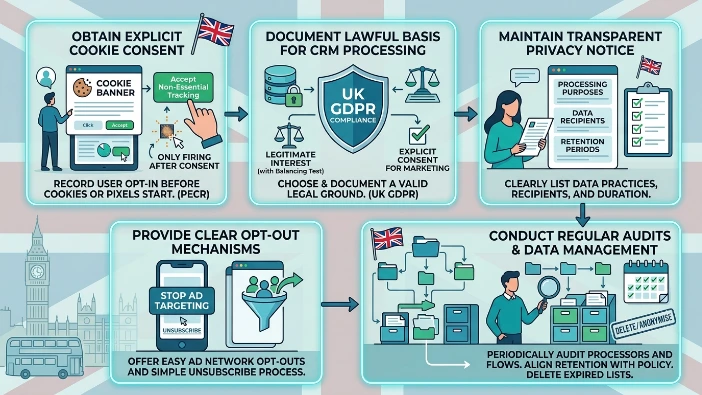
Obtain explicit cookie consent for non-essential tracking, document lawful basis for CRM processing, and provide clear opt-out mechanisms for ad targeting to comply with UK GDPR and the Privacy and Electronic Communications Regulations.
Ensure cookie banners record consent before firing pixels. Maintain a privacy notice that lists processing purposes, data recipients, and retention periods. For CRM-based targeting use either documented legitimate interest with a balancing test or explicit consent for marketing communications. Offer an easy unsubscribe process and honour ad network opt-outs. Conduct periodic audits of data flows and processors and maintain records of processing activities. Keep retention periods aligned with stated policy and delete or anonymise lists when retention expires.
Explore More Expert Insights:
Property Comparison Ads That Turn Browsers Into Serious Buyers
Visual Property Ads That Convert Consideration Into Buyer Shortlists
What performance metrics confirm conversion of warm leads?
Confirm conversion with contact rate, qualified-lead rate, booked viewing rate, phone call duration, and deal progression metrics tracked across online and offline systems. Contact rate measures the percentage of retargeted users who initiate contact. Qualified-lead rate measures leads that meet pre-set qualification criteria such as budget and readiness to transact.
Booked viewing rate tracks scheduled property visits per 100 enquiries. Phone call duration filters calls longer than 60 seconds as higher-quality contacts. Deal progression tracks leads that move from enquiry to offer and completion. Use CRM stages to map progression and report on conversion rates across stages to validate campaign effectiveness.
Explore:
How Real Estate Brands Improve Lead Quality Using Retargeting Campaigns
What use cases show clear ROI from retargeting campaigns?
Use cases with measurable ROI include prime-residential listings, investor prospecting, and valuation-to-sale journeys where retargeting shortens time-to-contact and increases qualified enquiry rates. For prime-residential listings, targeted retargeting to high-intent segments increased viewing bookings within 14 days. For investor prospecting, retargeting users who downloaded investment reports generated higher-quality enquiries with clearer budget windows.
For valuation-to-sale journeys, retargeting users who requested valuations converted to listings with higher appointment-to-signed-agreement ratios. Measure ROI by comparing campaign cost to value of qualified leads generated and by tracking conversion velocity from first ad exposure to accepted offer.