
A listing-based ad is an online advertisement generated directly from a property listing that highlights key attributes (price, yield, location, tenure) and targets users based on browsing and intent signals. Listing-based ads reuse listing data fields to create consistent, updated adverts that sync with portal inventory and metadata.
Listing-based ads are structured repetitions of a property’s core data. Entities include property listing (address, price, size), listing feed (API or CSV), ad creative (title, image, CTA), and targeting rules (behavioural, geographic, demographic). Portals ingest listing feeds from agents and developers. Portals map feed fields to ad templates. Portals refresh creatives automatically when listing fields change. This process ensures ads reflect current availability and price. Listing-based ads remove manual creative assembly for each campaign.
How do property portals generate listing-based ads from feeds?
Portals parse structured listing feeds, map fields to ad templates, and auto-create ads via template engines that populate images, headlines, and specifications. The feed ingestion process enforces field validation, deduplication, and enrichment before ad generation.
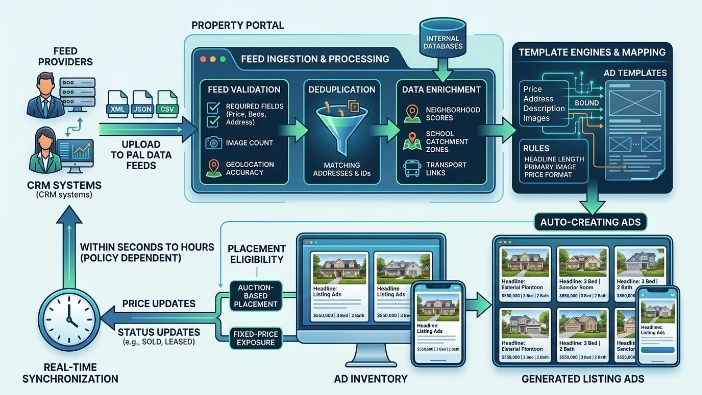
Feed ingestion begins with a provider uploading an XML, JSON, or CSV feed. Portals run validation checks: required fields, image count, and geolocation accuracy. Portals deduplicate by matching addresses and IDs. Enrichment adds neighbourhood scores, school catchment zones, and transport links from internal databases. Template engines bind feed fields to ad layouts. Rules assign headline length, primary image, and price format. Ads enter inventory and are eligible for auction-based placement or fixed-price exposure. Real-time sync ensures price or status updates propagate to live ads within seconds to hours depending on portal policies.
Which targeting methods do portals use to reach investor audiences?
Portals combine behavioural retargeting, lookalike audiences, geo-targeting, and query-based contextual targeting to reach investor profiles. Each method maps user signals—search queries, page views, saved searches—into segments that receive listing-based ads.
Behavioural retargeting tracks users who viewed investor-relevant listing types (HMO, buy-to-let, new-build blocks). Portals set time windows—typically 7, 14, 30, and 90 days—to sequence ads. Lookalike segments derive from known investor profiles using features: frequent portfolio listings, mortgage calculator use, or landlord information. Geo-targeting targets users by postcode or travel-time isochrones around city centres. Query-based contextual targeting places ads on pages where users search phrases like “rental yield,” “gross yield calculator,” or “student lets.” Portals layer targeting: a user who searched “Birmingham buy-to-let” and viewed multiple HMO listings receives ads for similarly tagged properties within a 30-mile radius.
How do portals sequence ads to nurture investor intent?
Portals implement staged ad sequencing that progresses from awareness to evaluation by changing creative, message, and call-to-action across time and interaction events. Sequencing uses time-based windows, interaction triggers, and funnel-stage signals to escalate content specificity.
Initial touchpoints show broad market data and investment filters, for example average yields in a zone. After the second interaction, creatives highlight property financials: price, projected gross yield, and tenancy type. After a property-specific visit and saved search, the ad shifts to performance metrics: rental comparables, occupancy rates, and recent sale prices nearby. If a user downloads a brochure or requests details, the portal surfaces ads promoting valuation appointments, site visits, or investor packs. Portals log sequence state per user and per listing. Deliverability optimises for frequency caps: typically 3–5 impressions per user per day and 15–30 over a 14–day campaign window to avoid fatigue.
Read & Explore:
How Real Estate Companies Improve Conversions Using Retargeting Ads
What key components must listing-based ads include for investors?
Ads must include price, rent estimate or yield, tenure, location specificity, and at least one high-quality image or floorplan. Accurate financial metrics and location granularity form decision-relevant signals for investor audiences.
Price field shows currency and numeric value; use full figures rather than ranges when available. Rent estimate presents monthly or annual gross rent and a derived gross yield percentage. Tenure indicates freehold, leasehold, or shared ownership and remaining lease years for flats. Location includes full postcode, local authority, and proximity to transport hubs (minutes walk). Visuals include primary exterior image and floorplan or site plan when available. Optional components: EPC rating, service charge, expected management service, and historic vacancy rate for comparable units. Portals flag missing or inconsistent data to providers and block ads that lack mandatory investor fields.
How do portals measure performance and optimise listing-based ads for investor conversion?
Portals track click-through rate, lead conversion rate, cost per lead, and time-to-contact, and use A/B tests and automated bid rules to optimise performance. Measurement ties ad impressions to downstream investor actions: brochure downloads, contact form submissions, valuation requests, and direct offers.
Portals attribute clicks to unique ad creative and listing IDs. They record micro-conversions: saved listing, brochure download, mortgage-calculator use, and contact initiation. Lead conversion tracks the percentage of ad viewers who submit contact details. Cost per lead divides ad spend by confirmed leads attributed to listing-based ads. Time-to-contact measures hours from lead submission to agent response; portals report medians and percentiles. Optimisation uses A/B tests on headlines, primary images, and yield displays. Automated bid rules increase bids for listings with high lead rates or for users demonstrating higher intent signals, such as repeated visits to yield-related pages.
What are the benefits of listing-based ads for property investors?
Listing-based ads deliver up-to-date information at scale, improve targeting precision, reduce creative latency, and increase qualified lead rates for investor segments. These ads reduce manual errors, accelerate time-to-market for new stock, and surface high-intent opportunities to investors quickly.
Up-to-date information prevents mispriced or unavailable properties from generating leads. Scale means portals can create thousands of ads from existing feeds without extra design resources. Precision targeting reduces wasted impressions and increases qualified lead share. Reduced creative latency shortens campaign setup from days to minutes. Portals report lead-quality improvements when financial metrics and floorplans appear in ad creatives. Investors receive consistent data across discovery touchpoints, lowering time spent verifying basic facts. Portals also improve compliance by displaying mandatory disclosures such as EPC and energy labels directly in ads.
Read & Explore:
Listing-Based Property Ads That Convert Investors Into High-Value Leads
Which use cases show listing-based ads converting investors into high-value leads?
Use cases include buy-to-let campaigns, new-build off-plan launches, portfolio disposals, and auction-property promotion where structured listing data aligns with investor decision criteria. Each case relies on specific ad attributes: yield for buy-to-let, phased completion dates for off-plan, bulk pricing for portfolio disposals, and bidding deadlines for auctions.
Buy-to-let campaigns emphasise gross yield, tenant demand metrics, and rent comparables. New-build off-plan ads highlight completion dates, developer warranties, and early-buyer incentives. Portfolio disposals present aggregated yields, unit mix, and NAV per unit. Auction-property ads display guide price, auction date, and registration requirements. Portals segment audiences by investor type—individual landlords, institutional buyers, and property funds—and tailor creatives accordingly. Reported outcomes show faster lead qualification where ads include explicit financial indicators and downloadable investor packs.
Explore More Expert Insights:
How Developers Increase Booking Intent Using Mid-Funnel Banner Ads
How Real Estate Brands Improve Lead Quality Using Retargeting Campaigns
How do portals ensure data quality and compliance in listing-based ads?
Portals validate feed schemas, enforce mandatory investor fields, run automated checks for price and availability consistency, and require documentation for sensitive investor claims. Compliance includes consumer protection rules, advertisement regulations, and local property disclosure requirements.
Validation rejects feeds missing required fields: price, tenure, full postcode, and primary image. Portals implement business rules: reject listings with price changes exceeding a threshold without justification and flag listings with lease years below regulatory minimums. For investment claims—projected yields, occupancy rates—portals require source references or allow only portal-computed standardised metrics. Portals maintain audit logs of changes, timestamps, and provider IDs. Compliance teams review flagged listings and issue removal notices for non-compliant entries. These controls maintain buyer trust and reduce regulatory risk.
How do listing-based ads integrate with broader investor marketing funnels?
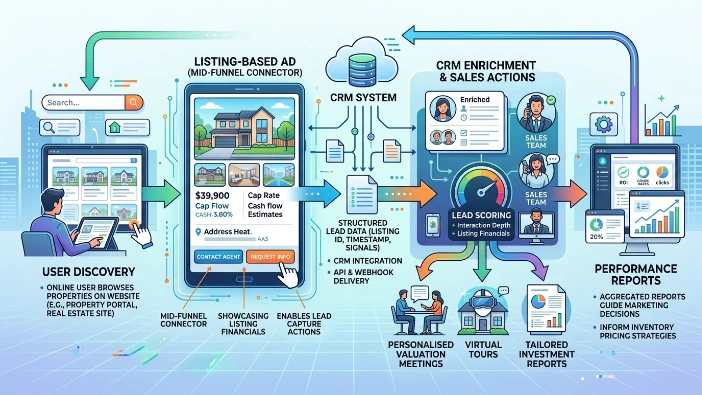
Listing-based ads act as mid-funnel connectors that move users from discovery to evaluation by supplying listing-level financials and enabling lead capture actions. They feed CRM systems with structured leads and provide signals for remarketing and sales outreach.
When a user clicks an ad and submits contact details, portals pass structured lead data (listing ID, timestamp, user signals) to CRM endpoints via APIs or webhooks. Sales teams receive enriched lead profiles including recent ad interactions and sequence history. Portals expose APIs for lead scoring based on interaction depth and listing financials. These signals inform follow-up actions: personalised valuation meetings, virtual tours, or tailored investment reports. Portals also export aggregated performance reports that guide portfolio-level marketing decisions and inventory pricing strategies.