
Retargeting advertising is a digital marketing technique that shows ads to users who previously visited a website or interacted with content, using cookies or device IDs to reconnect and drive conversions.
Retargeting uses tracking pixels, cookies, and user identifiers to record visitor actions. Real estate websites place pixels on listing pages, search results, mortgage calculators, and contact forms. When a user leaves without converting, ad platforms use that recorded activity to serve follow-up ads across websites, social feeds, and video platforms. This process re-exposes prospects to properties and services. Important entities: tracking pixel (small code snippet), cookie (browser-stored identifier), device ID (mobile identifier), ad platform (publisher that serves ads).
How tracking works
Real estate sites embed a tracking pixel or tag in page code. The pixel records page URL, property ID, and timestamp. Ad platforms match pixel data to user profiles and deliver ads to those profiles for a defined duration.
How do real estate companies use retargeting to increase lead conversion?
Real estate companies create targeted ad sets based on user behavior, show property-specific creative, and sequence ads to move users from awareness to contact, increasing conversion likelihood.
Companies segment visitors by behavior: listing views, search filters used, saved properties, contact form starts, and mortgage-calculator use. Each segment receives tailored creative. For example, users who viewed three-bedroom listings in London see ads for similar three-bedroom listings. Ads include multiple touchpoints: static images, carousel ads showing several listings, and video walkthroughs. Sequenced ads guide prospects: first ad reintroduces the property, second delivers social proof or price change, third presents contact options or viewing slots.
Retargeting increases conversion by raising contact attempts per visitor. Data shows follow-up exposure increases conversion probability because the user already expressed intent through site behavior. Retargeting reduces wasted spend by excluding converted users and focusing budget on high-intent visitors.
Common retargeting sequences
- View listing → carousel showing similar listings
- Save listing → ad with price update or virtual tour
- Start contact form → lead-form ad reminding to complete inquiry
What components form an effective retargeting campaign for property companies?
An effective retargeting campaign uses precise audience segmentation, property-level creative, conversion tracking, frequency caps, and an attribution model to measure performance.
Segmentation defines audiences by action and timeframe. Property-level creative matches the listing viewed. Conversion tracking records leads, form completions, phone calls, and booked viewings. Frequency caps set maximum ad impressions per user per day to prevent ad fatigue. Attribution models assign credit to retargeting touchpoints within a conversion path.
What components form an effective retargeting campaign for property companies?
An effective retargeting campaign uses precise audience segmentation, property-level creative, conversion tracking, frequency caps, and an attribution model to measure performance.
Segmentation defines audiences by action and timeframe. Property-level creative matches the listing viewed. Conversion tracking records leads, form completions, phone calls, and booked viewings. Frequency caps set maximum ad impressions per user per day to prevent ad fatigue. Attribution models assign credit to retargeting touchpoints within a conversion path.
- Audience lists: recorded by pixel, grouped by behavior and recency (examples: 7-day listing viewers, 30-day saved-list users).
- Creative assets: listing images, floor plans, 30-second videos, pricing overlays.
- Ad copy: concise, property-specific facts (location, beds, price).
- Landing pages: pre-filled contact forms or listing pages matching the ad.
- Measurement: conversion pixel, call-tracking number, CRM lead import.
Example segmentation buckets
- Viewed listing in last 7 days
- Searched within postcode X in last 14 days
- Started but did not submit contact form in last 3 days
How do companies define and measure conversions for retargeting ads?
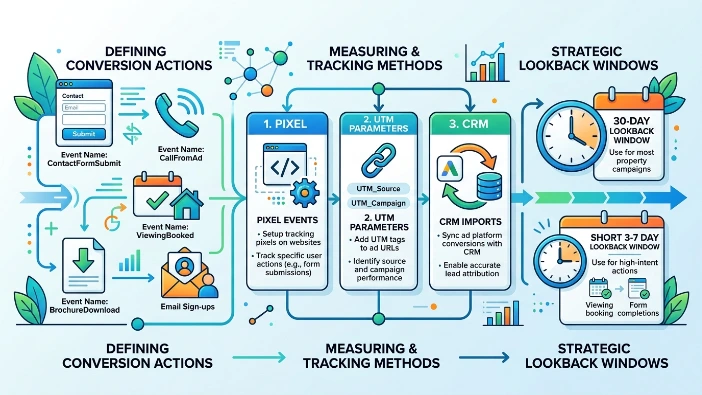
Conversions include completed contact forms, phone calls, booked viewings, property brochure downloads, and email sign-ups; companies measure conversions with pixel events, UTM parameters, and CRM imports.
Define conversion actions clearly in analytics and ad platforms. Use event names: ContactFormSubmit, CallFromAd, BrochureDownload, ViewingBooked. Add UTM tags on ad URLs to track source and campaign. Sync ad platform conversions with the CRM to attribute leads accurately. Use a 30-day lookback window for most property campaigns; use shorter windows (3–7 days) for high-intent actions like viewing booking.
Measurement methods:
- Pixel event triggers for online form submissions.
- Click-to-call with unique tracking numbers for phone attribution.
- CRM lead import matched to ad click IDs for end-to-end attribution.
What targeting strategies improve retargeting performance for property listings?
Targeting strategies include dynamic listing ads, geo-fencing audiences around specific postcodes, prioritising recent visitors, and layering demographics or income segments to refine reach.
Dynamic listing ads automatically populate creative with the exact property viewed. Geo-fencing creates audiences who visited physical locations such as estate agent offices or open houses. Prioritise recent visitors: clients who visited in the past 7 days convert at higher rates than 90-day visitors. Layer additional filters like household income, family status, and investor interests where available. Exclude low-intent pages such as blog pages to concentrate budget on high-intent behaviors.
Examples of layered targeting:
- Dynamic ad to users who viewed a specific property in last 7 days + household income in top 30%
- Geo-fence around new development for visitors who attended an open house in last 14 days
How do creative and messaging change across retargeting stages?
Creative shifts from broad property recall (images, basic facts) to specific prompts (price change, limited viewing slots) and finally to direct contact invitations, using progressive specificity and stronger incentives.
Early-stage retargeting uses the exact listing image with headline and key facts: address, beds, price. Mid-stage ads include social proof, local market data, and virtual-tour CTAs. Late-stage ads highlight urgency: newly reduced price, limited viewing slots, or an exclusive viewing event. Always match ad destination to intent: listing page for discovery, pre-filled contact form for near-conversion.
Creative examples:
- Stage 1: Carousel of similar two-bedroom flats in Manchester
- Stage 2: Video walkthrough of the exact property with agent details
- Stage 3: Ad showing “Price reduced by £15,000” with booking link
What budget and frequency rules maximise conversion efficiency?
Allocate budget based on audience value, set frequency caps between 3 and 7 impressions per week, and use bid adjustments for high-intent audiences to maximise efficient conversions.
Assign higher daily budgets to 7-day and saved-list audiences. Use lower bids for cold retargeting cohorts like 60–90 day viewers. Frequency caps prevent ad fatigue: aim for 3–7 impressions weekly per user. Use bid multipliers for users who started contact forms or requested brochures. Pause ads for users who converted to avoid wasted spend.
Budget allocation example:
- 50% to 7-day high-intent viewers
- 30% to 8–30 day mid-intent viewers
- 20% to 31–90 day lower-intent viewers
What technologies and integrations are necessary for effective retargeting?
Effective retargeting requires a tracking pixel, ad platform account, CRM integration, dynamic feed for listing data, and server-to-server conversion syncing.
Tracking pixel captures onsite behavior. Ad platform (display and social) serves ads. CRM stores leads and matching identifiers. Listing feed (CSV or API) supplies property images, prices, and status for dynamic ads. Server-to-server syncing reduces attribution loss by sending conversion events directly to ad platforms. Use consent management tools to ensure compliance with UK data protection rules and to record consent states.
Critical integrations:
- Pixel to CRM matching for lead attribution
- Dynamic feed for ad creative population
- Call-tracking for offline conversions
- Consent management platform for GDPR compliance
What benefits do real estate companies realise from retargeting ads?
Retargeting increases lead conversion rate, reduces cost per lead, shortens time-to-contact, and improves return on ad spend through targeted follow-up to known-interest users.
Retargeting converts users who already expressed interest. It lowers cost per lead by focusing spend on audiences with demonstrated intent. Retargeting reduces average time from first visit to contact because it keeps properties top of mind and prompts action. It increases ROI by excluding low-intent users and concentrating impressions on segments that show higher conversion probability.
Measured benefits:
- Higher conversion rates on retargeted audiences vs. non-retargeted audiences
- Lower cost per lead for 7-day viewers compared to cold audiences
- Shorter median days-to-contact for retargeted leads
Explore More Expert Insights:
How Property Portals Increase Traffic Using Banner Ads
How Realtors Generate Investment Leads Using Banner Advertising
What use cases demonstrate retargeting effectiveness for property listings?
Use cases include residential sales conversions, buy-to-let investor nurture, new development launch follow-ups, and rental application completions; each uses listing-level creative and sequenced messaging.
Residential sales: Users view a property, receive dynamic ads, then book viewings. Buy-to-let investor nurture: Users view returns or yield pages and receive ads highlighting rental yield and tenant demand. New development launches: Attendees of virtual launches receive follow-up ads with exclusive floor-plan offers. Rental applications: Prospects who started applications receive reminder ads prompting completion.
Explore: Listing-Based Property Ads That Convert Investors Into High-Value Leads
Real example sets:
- Residential: User views a three-bedroom in Leeds, sees a video tour ad, and books a viewing within 5 days.
- Investor: Visitor reads rental-yield page, receives listing-based ads showing gross yield, and signs for a portfolio viewing.
How Property Portals Nurture Investors Using Listing-Based Ads for deeper discussion on listing-based ad nurturing strategies.
What legal and privacy rules apply in the UK for retargeting?
UK retargeting requires user consent under privacy law for non-essential cookies and transparent data processing notices; companies must document consent and provide opt-outs.
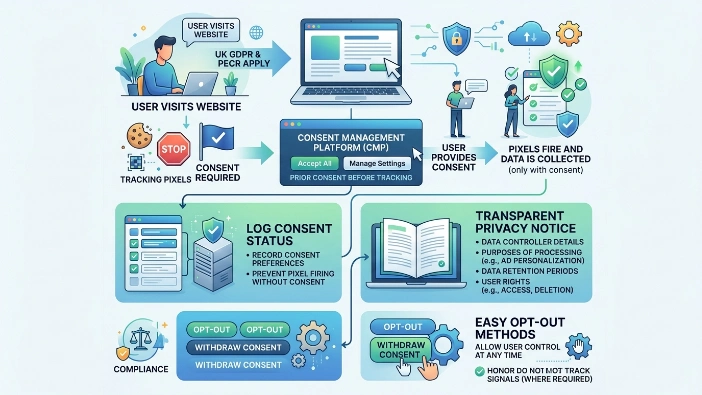
The UK GDPR and PECR require prior consent for most tracking cookies. Implement a consent management platform that logs consent status and prevents pixel firing until consent exists. Maintain a privacy notice that explains data controllers, purposes, retention periods, and user rights. Provide clear opt-out methods and honor Do Not Track signals where required.
Key obligations:
- Obtain explicit cookie consent for marketing pixels
- Provide a lawful basis and retention timeline
- Enable data subject access, rectification, and erasure requests
Retargeting advertising reconnects property-interested users to listings and drives higher conversion by using pixel-based tracking, audience segmentation, property-level creative, and precise measurement. Essential elements include dynamic listing feeds, CRM integration, consent management, and staged creative that moves users from awareness to contact. Retargeting reduces cost per lead and shortens time-to-contact when campaigns target recent and high-intent audiences with tailored messaging.