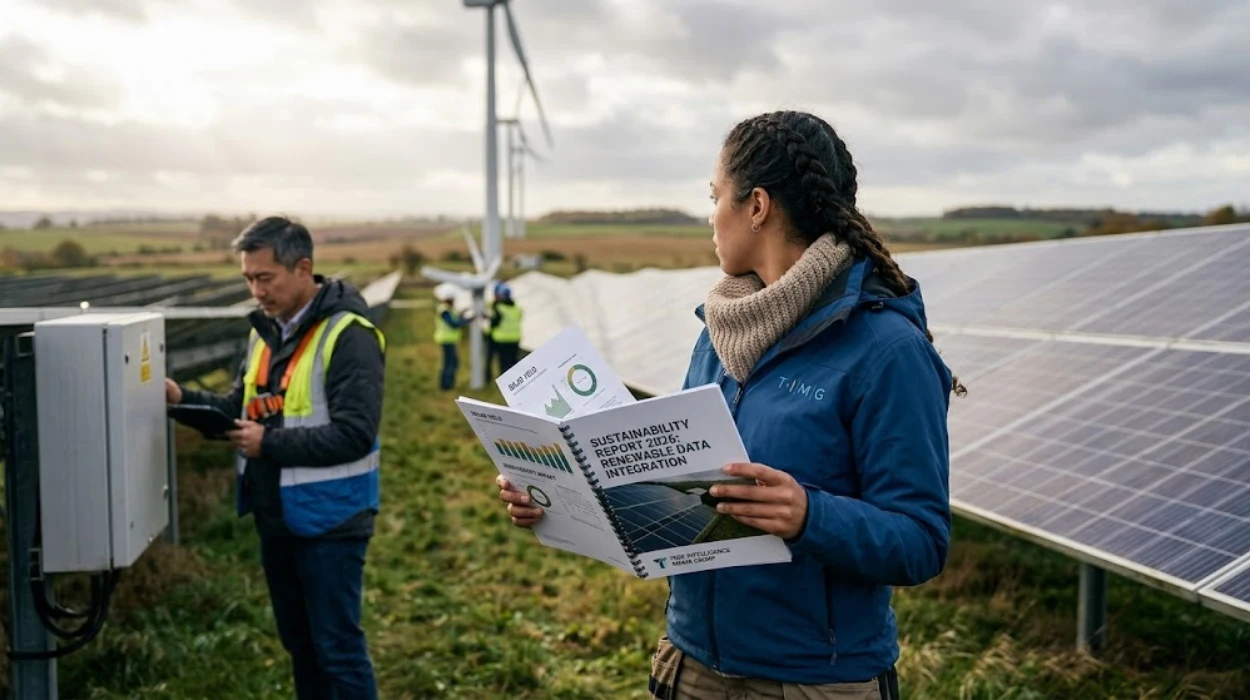
A mid-funnel banner ad targets users who have shown interest and aims to increase their booking intent through relevant messaging and persuasive creative. A mid-funnel banner ad appears after initial awareness and before purchase. It targets users who viewed property listings, engaged with search results, or visited a developer’s site. Top-funnel ads focus on reach and awareness. Bottom-funnel ads focus on conversion actions such as booking forms or purchase pages. Mid-funnel ads bridge consideration and decision by reinforcing benefits, building trust, and prompting micro-commitments such as viewing floor plans or requesting virtual tours.
Mid-funnel placements include property portals, retargeting networks, social platforms, and programmatic exchanges. Creative for mid-funnel ads emphasises specifics: price bands, availability windows, three-step booking process, or lead incentives. Audience signals used for targeting include recent page views, time spent on listing, saved searches, and CRM engagement. Precise targeting reduces wasted impressions and increases the probability of booking-request submissions.
How does the mid-funnel ad process work to turn intent into booking requests?
The mid-funnel ad process moves an identified prospect from interest to micro-commitment using sequential messaging and conversion-focused landing experiences. Campaign planning begins with audience segmentation. Segments include recent listing viewers, brochure downloaders, and repeat return visitors. Next, creative strategy defines a primary message for each segment: availability, payment plan, viewing slots. Bidding and placement strategies prioritise contexts with high engagement, such as property portal listing pages and article pages about moving to a specific UK city.
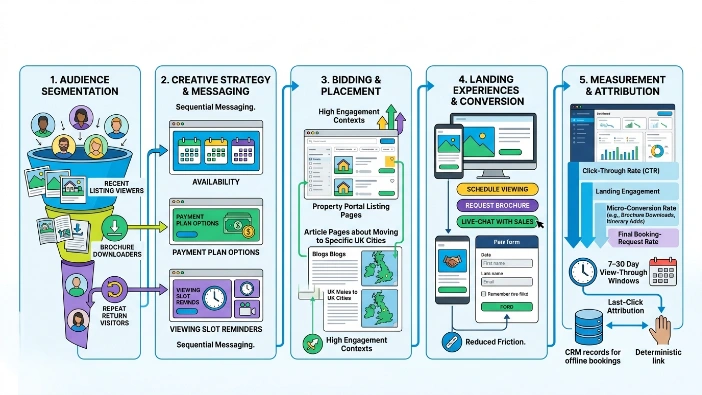
Ad creatives link to landing experiences optimised for booking requests. Landing pages present immediate next steps: schedule viewing, request brochure, or live-chat with sales. Forms reduce friction by pre-filling known data where possible. Measurement uses a cascade of KPIs: click-through rate, landing engagement, micro-conversion rate (brochure downloads, itinerary adds), and final booking-request rate. Attribution combines last-click with view-through windows of 7–30 days and a deterministic link to CRM records for offline bookings.
What components must a mid-funnel banner ad campaign include?
A complete mid-funnel campaign includes defined audience segments, tailored creative sets, targeted placements, conversion-optimised landing assets, and measurement tied to booking requests. Audience segments require deterministic signals such as listing IDs viewed, saved searches, or CRM tags. Creative sets include multiple sizes and formats, static banners, animated HTML5, and responsive assets for mobile. Messaging variants highlight price clarity, limited availability, incentives, and viewing options. Placements prioritise high-intent environments: property portals, local news property sections, and retargeting inventory.
Landing assets consist of short-form booking request forms, calendar-based viewing schedulers, and embedded virtual tour players. Data layer integration ensures lead data synchronises to CRM within 5 minutes for rapid follow-up. Measurement uses event tracking, server-side postbacks, and CRM matching to track booking requests from initial ad impression to offline viewing appointment.
What are the measurable benefits of using mid-funnel banner ads for property developers?
Mid-funnel banner ads increase qualified booking requests, lower cost-per-booking-request, and shorten lead-to-viewing timelines through targeted messaging and quicker lead capture. Metrics improve when campaigns focus on intent signals. Developers report higher qualified lead rates because mid-funnel audiences already interacted with product pages. Cost metrics show lower cost per lead compared with broad prospecting, and conversion windows shorten from 21+ days to under 10 days for high-intent segments. Tracking real examples, a campaign that retargeted listing viewers with viewing-scheduler banners produced a 28% higher booking-request rate than a general remarketing banner.
Operational benefits include faster sales follow-up due to rapid CRM handoffs and reduced time wasted on low-quality leads. Data from placements on major UK property portals provides contextual relevance and higher engagement. Integrating mid-funnel banners with email nurture and on-site messaging produces a consistent path to booking requests that aligns with buyer journeys in urban and suburban UK markets.
When should a developer choose mid-funnel banner ads over other channels?
Choose mid-funnel banners when audience signals show active consideration and the objective is to convert interest into booking requests rather than generate broad awareness. Campaign planners select mid-funnel tactics after a user visits key property pages, downloads a brochure, or completes an affordability tool. If the goal is to accelerate viewing bookings in a specific postcode or reduce time to contract, mid-funnel banners outperform broad social campaigns. Use mid-funnel ads in lead-heavy sales seasons, inventory release phases, or when project incentives have expiry dates.
Combine mid-funnel banners with on-site message triggers and CRM-driven email follow-ups. For developments near London, Manchester, or Birmingham, tailor offers to commuting times, transport links, and local market demand. Synchronise ad timing with available viewing slots and sales-team capacity to avoid over-promise and ensure a positive prospect experience.
How should targeting and creative be optimised for UK property audiences?
Target using recent listing engagement, postcode filters, device patterns, and CRM data; optimise creative for clarity, urgency, and a single next step that leads to a booking request. Use postcode-level targeting for UK cities to show locality benefits. Device patterns indicate mobile-first browsing for 62% of portal sessions; design creatives sized for mobile and desktop. Creative copy states price bands, next available viewing date, and a clear action: request viewing or download brochure. Use imagery that matches the property type: apartment, terraced house, or new-build development. Test three creative variants per segment to identify the highest-performing message within 14 days.
Ensure compliance with UK advertising regulations and property marketing rules. Include mandatory information such as energy performance ratings where required. Track creative performance by segment and reallocate budget weekly to the best-performing combinations.
What landing page and form design convert ad clicks into booking requests?
Design landing pages that present a single focus—book a viewing—use concise forms with four fields or fewer, and offer calendar-based scheduling to capture booking requests. Landing pages must load within 3 seconds on mobile. The headline restates the ad message and the booking form sits above the fold. Forms request essential fields: name, phone number, email, preferred viewing date, and listing reference.
Use calendar widgets to show real-time availability. Implement progressive profiling to collect additional details after the first interaction. Embed virtual tour players where available to let high-intent prospects self-qualify before requesting viewings.
Ensure form submissions send instant confirmations to prospects and immediate lead notifications to the sales team. Track form submissions through server-side events and sync to CRM within 5 minutes. Measure the proportion of ad clicks that become confirmed viewing appointments and the proportion that convert to site visits.
Explore More Expert Insights:
Retargeting Real Estate Campaigns That Convert Warm Leads Into Deal Inquiries
Property Comparison Ads That Turn Browsers Into Serious Buyers
What are practical use cases and campaign examples for mid-funnel property ads?
Use cases include converting portal listing viewers into scheduled viewings, re-engaging brochure downloaders with time-limited incentives, and promoting newly released viewing slots for sold-out phases.
Example 1: A development retargets users who viewed three or more listings. Ads advertise weekend viewing slots with a booking link. The campaign increases weekend appointments by 42% and reduces private-sales cycle length by 9 days. Example 2: A campaign targets brochure downloaders with a limited-deposit incentive and calendar scheduler; booking requests rise by 33% within 10 days. Example 3: A city-centre apartment launch uses mid-funnel banners on property portals to highlight transport links and next-available viewings, producing a 22% uplift in booking requests versus unactioned remarketing.
Explore:
How Property Portals Increase Traffic Using Banner Ads
How do you measure return on ad spend for mid-funnel campaigns?
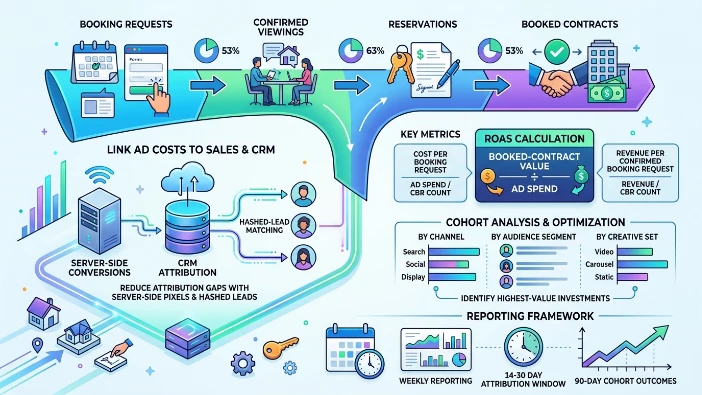
Measure return on ad spend by linking ad costs to confirmed booking requests and downstream sales outcomes using CRM attribution, then calculate revenue per confirmed booking request. Collect ad spend and booking-request counts to compute cost per booking request. Track the conversion rate from booking request to confirmed viewing and then to reservation. Attribute revenue to campaigns using a 14-30 day attribution window and CRM matching of lead IDs. Calculate ROAS as booked-contract value divided by ad spend for the period. Use cohort analysis by channel, audience segment, and creative set to identify the highest-value investments.
For related reading on mid-funnel tactics and how ads convert interest into bookings, see:
How Developers Increase Booking Intent Using Mid-Funnel Banner Ads
For accurate measurement, use server-side conversions, hashed-lead matching, and CRM integration to reduce attribution gaps. Report weekly and calculate 90-day cohort outcomes to capture slower-moving purchase decisions.