Banner advertising is a digital display ad format that shows visual promotions on websites and apps to reach target audiences and drive awareness of property projects. Banner ads include static images, animated GIFs, HTML5 creatives, and rich media that display on desktop, mobile, and tablet environments.
Banner advertising is a defined subset of digital display advertising. Entities involved include advertisers (property developers), publishers (websites and apps), ad networks, demand-side platforms (DSPs), supply-side platforms (SSPs), and ad exchanges. Ad placements use standard sizes such as 300×250, 728×90, 160×600, and 320×50. Campaign buying methods include real-time bidding (RTB), programmatic direct, and guaranteed placements. Measurement uses impressions, click-through rate (CTR), viewable impressions, and conversions such as enquiry form submissions or brochure downloads.
How do developers plan a banner advertising campaign?
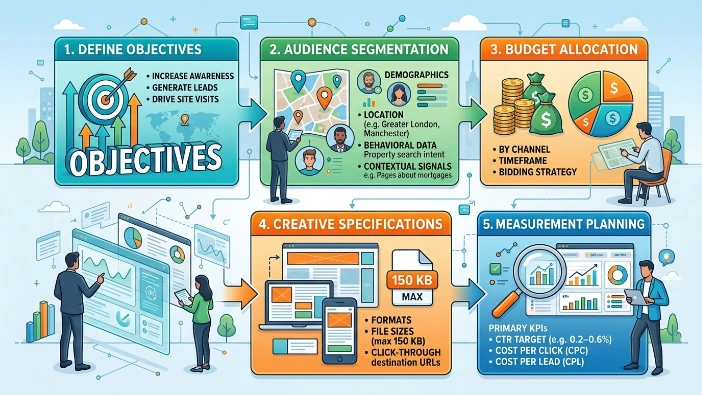
Campaign planning defines objectives, target audience segments, creative specs, budget, and measurement metrics to align banner ads with sales goals. Planning begins with a clear objective: increase awareness, generate leads, or drive site visits.
Audience segmentation uses demographics, location (for example, Greater London or Manchester), behavioural data (property search intent), and contextual signals (pages about mortgages). Budget allocation splits funds by channel, timeframe, and bidding strategy. Creative specifications include formats, file sizes (max 150 KB for most networks), and click-through destination URLs. Measurement planning sets primary KPIs such as CTR target (e.g., 0.2–0.6% for display), cost per click (CPC), and cost per lead (CPL).
Define a 12-week campaign timeline with these phases: week 1–2 setup and creative production, week 3–8 active flighting and optimisation, week 9–12 performance review and reporting. Assign weekly checkpoints to evaluate delivery, viewability, and conversion events.
What audience targeting methods do developers use with banner ads?
Developers use location, demographic, interest, intent, and retargeting signals to target potential buyers precisely. Location targeting narrows delivery to postal districts, cities, or regions. Demographic targeting includes age bands (e.g., 30–45 years), household income bands, and family status. Interest targeting uses browser behaviour and content categories such as “property search” or “home improvement.” Intent targeting uses search keywords and recent site visits to infer purchase intent. Retargeting shows banner ads to users who previously visited a developer’s project page or viewed floorplans.
Target 1: London professionals aged 28–40 with high-affluence browsing history who visited property listing pages in the last 30 days. Target 2: Commuters searching for “2-bedroom flat near train station” in Birmingham within the last 14 days.
How do creatives and messaging increase ad effectiveness?
Creative design and messaging focus on clear visuals, concise value statements, and a single call-to-action to improve engagement and recall. Creatives use high-resolution photos of the project, key specifications (price range, bedroom counts), and visual cues such as floorplan thumbnails. Messaging highlights differentiators: proximity to transport links, completion date, or available incentives. Text follows strict hierarchy: headline (6–8 words), subhead (8–12 words), and a short CTA label.
Animated formats rotate between images, floorplans, and testimonial blurbs to raise engagement. Ensure brand and project names are legible and consistent across ad sizes. Use A/B tests with 2–4 creative variants per ad size. Track CTR and landing page bounce rate. Replace lowest-performing creative after 7–10 days.
What targeting and delivery technologies optimise banner campaigns?
Programmatic platforms, frequency capping, viewability filters, and conversion tracking improve delivery efficiency and reduce wasted spend. Programmatic DSPs purchase inventory across multiple exchanges using audience data and bidding logic. Frequency capping limits exposures per user to prevent ad fatigue; common caps range from 3–7 impressions per week. Viewability filters limit delivery to ads meeting viewability standards (for example, 50% of pixels in view for 1 second for display). Conversion tracking uses pixels or server-to-server events to attribute leads to banner impressions and clicks.
Track viewable impressions, CTR, conversion rate, CPL, and return on ad spend (ROAS). Use last-click and view-through attribution windows (for example, 7-day click, 14-day view) to capture direct and assisted conversions.
How do developers measure campaign success?
Success measurement uses predefined KPIs: impressions for reach, CTR for engagement, conversion rate for lead generation, and CPL for cost efficiency. Reach uses unique users exposed to the campaign. Engagement uses CTR and interaction rate for rich media. Lead generation measures the number of qualified enquiries, brochure downloads, or booked site visits. CPL divides media spend by the number of leads. Quality metrics include lead-to-site-visit rate and lead-to-sale rate. Compare CPL against expected customer lifetime value (CLV) and sales conversion benchmarks to assess efficiency.
Produce weekly dashboards for optimisation and a detailed monthly report showing trends across channels, creatives, and audience segments.
What optimisation tactics increase sales outcomes from banners?
Optimize bids by audience performance, shift budget to high-converting placements, refresh creatives every 2–3 weeks, and implement sequential messaging to move prospects down the funnel. Bid adjustments increase spend on audiences with lower CPL. Placement analysis identifies publishers and environments with higher lead quality.
Creative rotations avoid banner blindness; update imagery, headlines, and offers regularly. Sequential messaging delivers a series: awareness creative, evidence creative (floorplans, specifications), and intent creative (booking prompt). Pair banners with content-rich landing pages that match the ad’s message and capture lead details with minimal fields.
Use cohort analysis to identify which acquisition paths produce the highest close rates. Reallocate budget monthly toward channels demonstrating sustainable CPL reduction.
What are the key components of a banner campaign that lead to sales?
Components include defined objectives, segmented audiences, tailored creatives, programmatic delivery, performance tracking, and optimisation processes. Objectives specify desired outcomes such as 500 qualified leads or a CPL target of £150. Audiences define geographic and behavioural profiles. Creatives provide consistent messaging across sizes and formats. Programmatic delivery ensures scale and efficiency. Tracking captures conversions and attribution. Optimisation processes include frequency capping, creative testing, and bid management.
Objective: 1,000 impressions per week in a target postcode; Budget: £10,000 flight; KPI: CPL £120; Target audience: buyers aged 30–50 within 20 km.
Explore:
Property Showcase Campaigns That Turn Leads Into Site Visit Bookings
Explore More Expert Insights:
How Real Estate Firms Generate High-Quality Leads Using Banner Ads
How Healthcare Businesses Drive Patient Growth Using Display Ads
What benefits do developers gain from banner advertising?
Banner advertising expands reach, reinforces brand and project awareness, drives qualified traffic to project pages, and produces measurable lead volumes for sales teams. Display ads enable precise geographic targeting around development sites. Visual formats show property imagery that builds project recognition. Programmatic buying delivers scale across thousands of high-relevance placements. Reporting provides measurable outcomes for budget accountability and supports iterative improvements that reduce CPL over time.
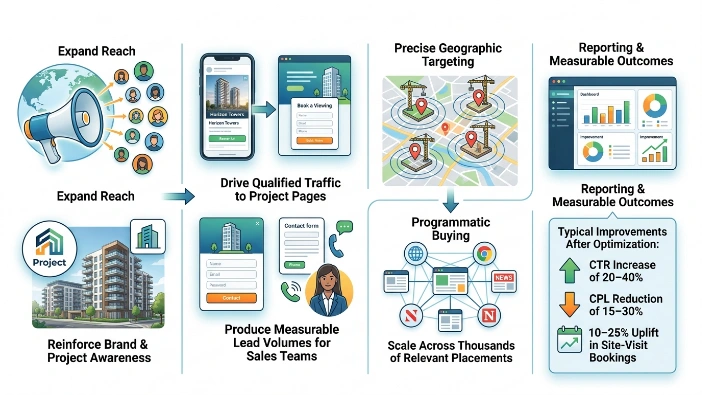
Typical improvements after optimisation: CTR increase of 20–40%, CPL reduction of 15–30%, and a 10–25% uplift in site-visit bookings originating from display channels.
How do banner ads integrate with wider marketing to convert buyers?
Banners function as the top-of-funnel touchpoint within a multi-channel ecosystem that includes search, email, social, and onsite experiences to progress prospects to viewing stages. Banners generate initial awareness and drive prospects to landing pages and email sign-ups.
Retargeting keeps users engaged and delivers project details. Email marketing nurtures captured leads with floorplans and availability. Sales teams use lead data to book site visits and close sales. Integration uses shared tracking and CRM ingestion to maintain consistent attribution and follow-up sequences.
For readers exploring next-stage tactics, see:
How Property Developers Nurture Leads Using Project Showcase Campaigns