Real estate banner ads are graphical display ads that present a property’s key details—image, price, location, and a direct contact prompt—and drive users to take inquiry actions via clicks, calls, or form submissions.
Real estate banner ads appear across websites and mobile apps. They use standard sizes such as 300×250, 728×90, and 300×600 pixels. Advertisers create image assets, short headlines, and call-to-action text. Ads run on publisher inventory, programmatic exchanges, and social placements. Campaigns use targeting parameters including geo-fencing, demographic filters, in-market intent segments, and CRM retargeting lists. Tracking uses UTM parameters, conversion pixels, and server-side events to attribute inquiries to specific banners. Measurement tracks impressions, click-through rate (CTR), conversion rate, and cost per lead (CPL).
How do firms structure a banner campaign to convert interest into inquiries?
Firms design campaigns with phased objectives: awareness for reach, interest for engagement, and conversion for inquiries, using sequential targeting, tailored creatives, and landing pages aligned to ad messaging.
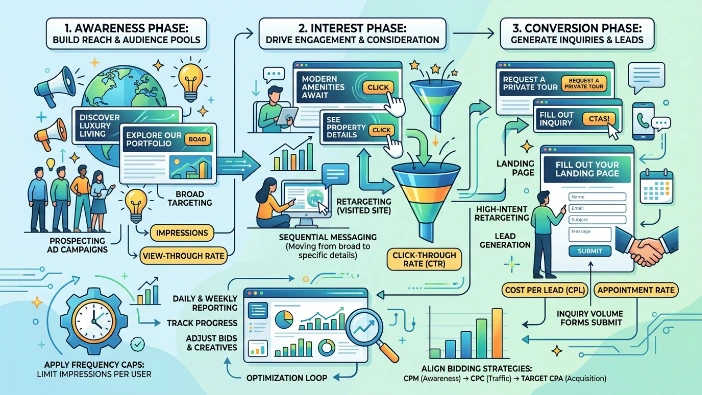
Campaign structure begins with defined KPIs: impressions and view-through rate for awareness, CTR for interest, and CPL and appointment rate for conversion. Run prospecting to build audience pools, then apply retargeting to users who viewed listings. Use sequential messaging that moves users from broad benefits to specific property details. Align bidding strategy to objectives: CPM for awareness, CPC for traffic, and target CPA for inquiry acquisition. Implement frequency caps to limit impressions per user. Schedule daily and weekly reporting to track progress against KPIs and adjust bids and creatives based on performance.
What creative components produce direct inquiry actions?
Effective creatives show a high-resolution hero image, a clear headline with price or USP, concise supporting copy, a visible CTA such as “Book Viewing,” and trust signals like accreditation or recent viewing counts.
Hero images must display the primary selling point: façade, living room, kitchen, or view. Use images optimised for small screens and include alt text for accessibility. Headlines include explicit facts such as “2-Bed Apartment, Zone 2, £450,000.” Supporting copy lists one or two concrete benefits: commute time and local amenities. CTAs use imperative verbs: “Request Viewing,” “Call Agent,” or “Download Brochure.” Include small trust elements where space permits: “Energy Rating: B” or “10 viewings booked.” For dynamic remarketing, swap images to the exact unit the user viewed on the website. Test variants to determine which combination yields the highest inquiry rate.
How do landing pages and form design convert ad clicks into qualified inquiries?
Landing pages must mirror ad content, load under 3 seconds, present a single clear lead action, and gather four or fewer essential fields to maximise completed inquiries.
Consistency reduces drop-off when users click the banner. The landing page headline should repeat the ad headline and lead with the same hero image. Place the lead form above the fold with fields for name, email, phone, and preferred viewing time. Offer click-to-call and calendar booking buttons for immediate contact.
Display key facts: price, tenure, council tax band, and floorplan link. Add social proof such as verified agent contact and recent viewing counts. Implement server-side conversions and UTM tracking to attribute each lead. Monitor form abandonment and use session recordings to identify friction points for iterative optimisation.
Which targeting tactics produce the most qualified buyer inquiries in the UK market?
Combine first-party CRM lists, geo-fencing of postcodes within 5–20 kilometres, in-market buyer segments, and lookalike audiences seeded from past qualified leads to reach high-intent buyers.
First-party data includes applicants on waiting lists, past enquirers, and newsletter subscribers. Geo-fencing targets users near the property, local transport hubs, or catchment areas for schools. Use in-market segments from data providers that indicate active property searches. Create lookalike audiences using high-value leads from the CRM as seeds.
Retarget users who viewed specific listings with tailored ads within 7–30 days. Prioritise device targeting based on historical performance; for example, schedule click-to-call CTAs for mobile heavy audiences. Track appointment-to-inquiry ratios by segment to identify the highest-quality sources.
What bidding and budget allocation drives efficient CPLs for BOFU campaigns?
Allocate 30–50% of budget to retargeting and 50–70% to direct-conversion tactics; use target CPA bidding for inquiry acquisition and manual high bids for priority postcodes and premium units.
Set a target CPL based on lifetime value and sales cycle metrics. Apply automated target CPA bidding where conversion volume exceeds 50 leads per month. Use manual bid adjustments for high-value micro-markets and premium developments to secure top placements. Shift budget to retargeting when retargeting conversion rate exceeds prospecting conversion rate by over 2x. Implement daypart bid modifiers to increase bids during peak engagement windows, for example weekday evenings 18:00–21:00. Pause underperforming placements that drive high impressions and low conversions.
How does testing and optimisation improve conversion rates over a 30–90 day window?
Run A/B tests on headline, image, and CTA variants, evaluate results after 7–14 days or 500+ clicks, and scale winners while iterating creatives every 30 days to sustain performance.
Test individual variables to isolate impact. For example, test “Request Viewing” versus “Book Viewing” with the same image and headline. Use statistical thresholds such as 95% confidence and minimum sample sizes of 500 clicks. Monitor device-specific performance and tailor creatives accordingly. Rotate creatives monthly for campaigns longer than six weeks to prevent ad fatigue.
Apply learnings to landing pages, adjusting form fields and CTAs based on abandonment metrics. Document test outcomes and funnel metrics to refine targeting, creative, and bidding strategies.
Read:
How Real Estate Firms Generate High-Quality Leads Using Banner Ads
What measurement and attribution practices prove ROI for banner-driven inquiries?
Use multi-touch attribution, server-side conversion tracking, and CRM match-back to link banner impressions to enquiries and completed viewings; report CPL, lead quality, appointment rate, and sales conversion rate.
Capture session identifiers and pass them to CRM with UTM parameters. Implement server-to-server conversion events to ensure accurate attribution across browsers. Use multi-touch models to allocate credit across awareness and retargeting touchpoints. Match leads in CRM back to ad exposures to calculate CPL and appointment-to-sale ratios. Track downstream metrics such as percent of leads progressing to offer and percent closing a sale. Report weekly on CPL and monthly on lead quality and sales conversion to determine campaign ROI and justify ongoing spend.
Explore More Expert Insights:
How Healthcare Brands Turn Service Consideration Into Confirmed Appointments Using Display Ads
How Telemedicine Platforms Convert Trust Signals Into Active Patient Signups Using Banner Ads
What legal and compliance steps ensure lawful use of data in UK campaigns?
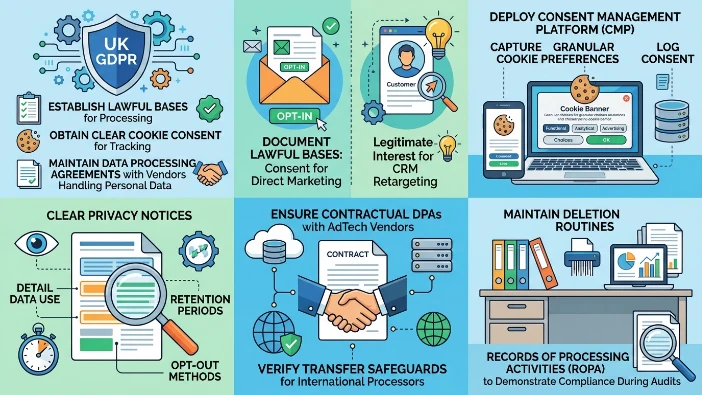
Comply with UK GDPR by establishing lawful bases for processing, obtaining clear cookie consent for tracking, and maintaining data processing agreements with vendors handling personal data.
Document lawful bases such as consent for direct marketing or legitimate interest for CRM retargeting. Deploy a consent management platform that captures granular cookie preferences and logs consent. Provide clear privacy notices detailing data use, retention periods, and opt-out methods. Ensure contractual data processing agreements with adtech vendors and verify transfer safeguards for any international processors. Maintain deletion routines and records of processing activities to demonstrate compliance during audits.
How do firms convert increased inquiry volume into measurable sales outcomes?
Convert volume into sales by qualifying leads quickly, scheduling viewings within 48 hours, assigning leads to sales agents by territory, and tracking conversion timelines from inquiry to offer.
Use lead scoring to prioritise enquiries based on intent signals such as budget, move timeline, and ownership status. Route high-score leads to senior agents with target response times under 1 hour for phone leads and under 6 hours for web leads. Book viewings through integrated calendar tools and confirm with automated reminders. Track each lead from first contact to viewing, offer, and completion in the CRM. Analyse time-to-offer and close-rate by source to optimise future budget allocation.
Real estate banner ads convert buyer interest into property inquiries when campaigns combine targeted audience selection, concise and factual creatives, landing pages that minimise friction, and rigorous measurement tied to CRM outcomes. Use targeted bidding, structured testing, and compliant data practices to scale inquiry volume while maintaining lead quality.
For campaign design and audience-building strategies, see:
How Real Estate Firms Build Buyer Interest Using Property Banner Ads