A property showcase campaign is a coordinated marketing programme that presents development assets, qualifies prospects, and drives bookings for on-site viewings using targeted offers and booking technology.
A property showcase campaign defines the project with factual assets: location, unit mix, unit sizes in square metres, pricing bands, completion date, and planning status. The campaign aggregates professional photos, floor plans, 3D walkthroughs, brochure PDFs, and short video tours into landing pages and adverts. The campaign’s objective is measurable: increase sales-qualified leads and convert a higher percentage into site visit bookings.
What entities form a campaign?
Entities include the developer, marketing team, sales team, CRM system, advertising platforms, and legal/compliance documents. The developer supplies specifications and pricing. The marketing team produces creative and manages channels. The sales team conducts viewings and records outcomes. The CRM stores leads, scores engagement, and triggers workflows. Advertising platforms deliver ads and track clicks and conversions. Privacy policies and consent records provide legal grounding.
How does the conversion process operate?
The conversion process moves a prospect from awareness to a confirmed site visit by capturing contact details, scoring intent, delivering time-sensitive offers, and automating booking confirmations. The process begins when a prospect interacts with adverts or listings. They reach a campaign landing page that presents key facts and an option to view a brochure or virtual tour in exchange for contact details.
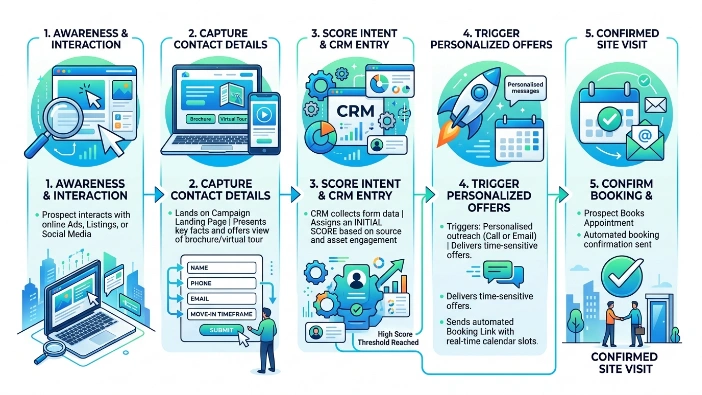
The form collects a minimum dataset: name, phone number, email, and preferred move-in timeframe. The CRM assigns an initial score based on source and asset engagement. When engagement passes a threshold, the system triggers personalised outreach or an automated booking link with real-time calendar slots.
What booking mechanics reduce friction?
Booking mechanics include embedded calendar widgets that show available viewing times, short pre-visit questionnaires to confirm intent, and instant SMS confirmations. Sales teams confirm bookings within 24 hours and send reminders 48 hours and 6 hours before the visit. Automated rescheduling links maintain a low friction experience and reduce no-shows.
What campaign components drive visits?
Components that drive visits include high-resolution photography, interactive 3D tours, floor plans with sizes, transparent pricing bands, clear booking CTAs, social proof, and limited-time incentives. High-resolution photography communicates finish quality and context. Interactive 3D tours increase dwell time and provide spatial understanding. Floor plans list gross internal area in square metres and room dimensions. Pricing bands display starting prices and available unit types.
Booking CTAs link directly to calendar widgets. Social proof includes recent buyer testimonials and reservation counts. Limited-time incentives such as reservation fee waivers for same-week bookings increase urgency.
How are assets optimised for mobile users?
Assets receive mobile-first optimisation: compressed images using modern formats, 3D viewer integration compatible with mobile browsers, and single-column landing pages that reduce scroll depth. Forms use single-field focus and telephone input masks to improve completion rates on mobile devices.
How are leads scored and handed to sales?
Lead scoring uses point allocations for actions: 10 points for brochure download, 25 points for virtual tour completion, 20 points for booking flow initiation, and 40 points for completed booking. Scores feed rules that classify leads as marketing-qualified (MQL) or sales-qualified (SQL). MQLs receive nurture sequences with financing details and neighbourhood data. SQLs trigger immediate human outreach and prioritised viewing slots.
Handover documentation includes lead source, engagement timestamps, unit preferences, and any financing notes. Sales agents receive CRM tasks with suggested scripts and confirmation templates.
What SLAs govern sales follow-up?
Service-level agreements require sales confirmation calls within 24 hours of a booking and first-contact outreach for high-score leads within 2 hours of qualifying. Failure to meet SLAs routes leads to a supervisor queue and generates automated apology messages with an alternative booking link.
What legal and compliance steps protect transactions?
Campaigns follow the Data Protection Act 2018, PECR, and FCA guidance where applicable; campaigns require documented consent, clear privacy notices, and opt-out mechanisms. Consent is captured at form submission using an explicit checkbox and a link to a privacy notice that states data retention periods, processing purposes, and contact details for data subject requests.
SMS and telephone contact preferences record separate consent flags. Where mortgage or financial product information appears, content uses factual figures and links to regulated advisers. All marketing communications include an unsubscribe link and a data controller contact.
How is consent recorded for audits?
CRMs store consent timestamps, the originating campaign ID, and the exact consent text shown to the user. Systems log IP address and user agent for each opt-in when available. Retention policies delete inactive leads after the stated retention window unless reconsent occurs.
What metrics quantify success?
Primary metrics include cost per lead (CPL), lead-to-booking conversion rate, booking-to-sale conversion rate, average time from lead to visit, and no-show rate. CPL measures acquisition efficiency across channels. Lead-to-booking conversion shows campaign quality. Booking-to-sale conversion indicates on-site sales effectiveness. Average time from lead to visit measures speed of pipeline progression. No-show rate gauges booking reliability. Secondary metrics include ad click-through rate, video completion rate, and page dwell time.
What target benchmarks apply in the UK?
Benchmarks vary by product type. For new-build apartments in urban areas, target CPL ranges between £50 and £250. Target lead-to-booking conversion rates range from 15% to 40%. Target booking-to-sale conversion ranges from 5% to 25% depending on price point and market conditions. No-show rates below 15% represent well-managed booking flows.
What technology stack supports campaigns?
A typical stack includes an ad platform, landing page builder, CRM with scoring and automation, calendar booking software, analytics platform, and a content delivery network (CDN). Ad platforms serve display, social, and search campaigns and export click and conversion data. Landing page builders create campaign pages with embedded forms and media.
CRM systems manage leads, scoring, workflows, and reporting. Calendar booking software integrates with sales diaries and provides real-time slot availability. Analytics platforms consolidate channel performance and user behaviour. CDNs ensure fast asset delivery for global and regional visitors.
How do integrations maintain data accuracy?
Integrations use server-side tracking and API-level CRM connections to prevent data loss from ad blockers. UTM parameters tag campaign sources. Webhooks pass booking confirmations instantly to CRMs. Daily reconciliation checks compare ad platform conversions with CRM bookings and flag discrepancies above 5% for investigation.
What are effective incentives and offers at BOFU?
Effective BOFU incentives include reservation fee waivers for same-week bookings, capped-time deposit discounts, conveyancing or stamp duty contributions, and guaranteed viewing slots for high-intent leads. These incentives provide measurable outcomes: increase short-term booking rates, reduce sales cycle length, and better allocate sales resources. All incentives publish clear eligibility rules, expiry dates, and unit availability to avoid regulatory issues and buyer disputes.
How are incentives communicated?
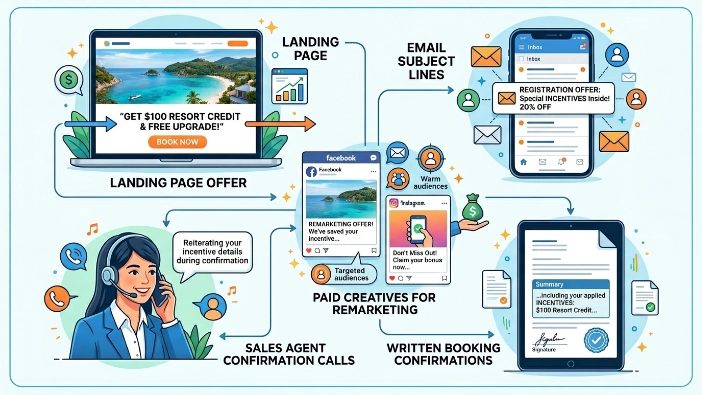
Incentives appear on landing pages as a single-line offer above the booking CTA, in email subject lines for registered leads, and in paid creatives for remarketing to warm audiences. Sales agents reiterate incentive terms during confirmation calls and in written booking confirmations.
Explore More Expert Insights:
Real Estate Banner Ads That Convert Buyer Interest Into Property Inquiries
How Healthcare Brands Turn Service Consideration Into Confirmed Appointments Using Display Ads
What post-visit actions increase conversion to sale?
Post-visit actions include immediate personalised follow-up calls, tailored offers within 48 hours, access to purchase-ready documents, and streamlined reservation processes with digital signatures. Sales agents log visit outcomes in CRM with next-step actions and a recommended follow-up date. Systems trigger an email with a tailored offer and required legal forms. Reservation flows include online deposit payment and a downloadable reservation agreement. Agents provide mortgage adviser contacts when requested.
How is feedback collected after visits?
Feedback is collected via short surveys sent 6 hours after the visit and consolidated into CRM records. Surveys capture purchase intent, objections, and feature ratings. Teams use feedback for rapid adjustments to show-home staging and messaging.
Property showcase campaigns convert leads into site visit bookings through clear assets, real-time booking mechanics, scored handovers, legal compliance, and measurable incentives. Deploy a technology stack with API integrations, set SLAs for timely follow-up, and track CPL and conversion benchmarks to evaluate success.
For guidance on awareness tactics, see:
How Property Developers Increase Sales Using Banner Advertising
For intermediate nurturing strategies, see:
How Property Developers Nurture Leads Using Project Showcase Campaigns