
Display ads are visual advertisements images, animated banners, or video served across websites and apps to reach target audiences and increase awareness. Display ads include static banners (JPEG/PNG), animated GIFs, HTML5 creatives, and short-form video files. They appear via ad exchanges, programmatic platforms, and publisher direct buys.
Display ads differ from search ads by targeting users based on attributes, behaviour, and context rather than explicit queries. In healthcare, display ads focus on awareness of services, patient education, and directing users to informational resources. Publishers include news sites, health portals, and lifestyle apps. Metrics use third-party measurement like viewability (percent of ad in view) and unique reach.
How do display ads drive patient growth for healthcare businesses?
Display ads increase visibility, deliver tailored messages to defined audiences, and drive website visits that convert into appointments or enquiries. Display ads scale impressions across high-traffic inventory and deliver personalized creatives to audience segments. Campaigns use demographic targeting (age, gender), contextual targeting (health-related pages), behavioural targeting (past site visitors), and geo-targeting (city, postcode).
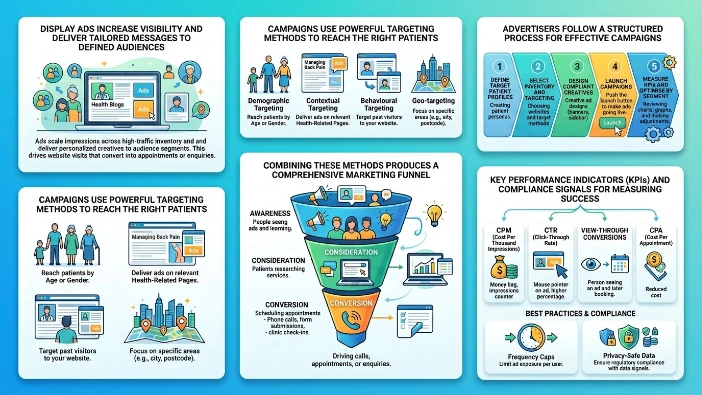
Process steps: define target patient profiles, select inventory and targeting, design compliant creatives, launch campaigns, measure KPIs, and optimise by segment. Typical KPIs include CPM (cost per thousand impressions), CTR (click-through rate), view-through conversions (users who convert after seeing an ad), and CPA (cost per appointment). Healthcare advertisers use frequency caps to limit ad exposure per user and privacy-safe data signals to comply with regulation.
What components make an effective healthcare display ad campaign?
Effective campaigns combine precise audience segmentation, compliant creatives, measurable landing pages, and ongoing optimisation based on clear KPIs. Audience segmentation specifies patient profiles by age range, health interest, condition, and location. For example, breast-screening campaigns target women aged 50–70 in specific postcodes. Creatives follow regulatory requirements: accurate claims, clear messaging, and appropriate imagery. Landing pages must contain clear service information, eligibility, and contact options. Tracking uses tags or server-side analytics to attribute visits and booked appointments.
Campaign structure typically uses prospecting (broader audiences) and retargeting (past site visitors). Prospecting uses contextual or behavioural models to reach new patients. Retargeting shows relevant creatives to users who viewed specific pages (for example, a service page or symptom checklist). Frequency and cadence control fatigue. A/B tests run on messaging, images, call-to-action text, and landing page layout to improve conversion rates. Budgets allocate to channels by performance: websites, mobile apps, connected TV where relevant, and display networks.
How do healthcare providers ensure compliance and privacy in display advertising?
Compliance requires adherence to local healthcare advertising rules, data protection laws such as UK GDPR, and platform policies for sensitive topics. Define permitted claims and factual statements before creative production. Avoid unverified medical claims, guarantee language, and sensational imagery. Use privacy-first measurement: rely on aggregated, anonymised audience signals and consent-based cookies or first-party data. Implement consent management platforms on websites. Store and process personal health information only when users explicitly submit it via secure channels.
Record keeping: keep creative approval records and target logic documentation for audits. Where targeting involves sensitive categories (for example, sexual health or mental health), apply conservative audience parameters and contextual targeting to avoid intrusive profiling. Ensure display vendors sign data processing agreements and support data deletion requests.
What targeting strategies work best for patient acquisition via display ads?
Combine contextual targeting, geo-targeting, demographic filters, and retargeting to reach high-intent and relevant patient segments. Contextual targeting places ads on webpages about related health topics, for example, cardiology articles for heart health services. Geo-targeting limits delivery to serviceable areas such as a 10-mile radius around clinics. Demographic filters refine by age groups and gender, for example, targeting men aged 45–65 for prostate screening. Retargeting uses pixel or server-side signals to re-engage users who visited a booking page but did not complete an appointment.
Example: A dental clinic targets adults aged 25–54 within postcode sectors of Rawalpindi (note: for a UK audience replace with local city postcodes) who read oral health articles. The campaign runs prospecting on health publisher sites and retargets visitors of the clinic’s treatment pages with appointment-encouraging creatives. Measure clicks, appointment form fills, and phone call events.
How should creatives and messaging be designed for healthcare display ads?
Design clear, factual creatives with prominent service names, concise benefits, eligibility details, and a single measurable call-to-action. Use short headlines of 4–8 words and supporting body text of 10–20 words. Include service elements: treatment name, accredited qualification (if applicable), and practical details like opening hours or next-available appointment timeframe. Avoid emotional or fear-based imagery. Use legible fonts and accessible contrast ratios. For video creatives keep duration at 6–15 seconds for in-banner or 15–30 seconds for richer placements.
Examples of creative variants: a static banner listing service and phone number; an animated creative that highlights three benefits sequentially; a short clip demonstrating clinic environment with on-screen text showing eligibility and phone link. Include alt text for accessibility and captions for videos.
How is performance measured and optimised in display campaigns for healthcare?
Performance tracking uses a mix of view metrics, engagement metrics, and conversion metrics linked to appointments or enquiries; optimise by iterative tests and budget reallocation. Key metrics: CPM, CTR, viewability rate, time on site, form completion rate, phone calls, and CPA per booked appointment. Use conversion windows consistent with patient decision cycles, typically 7–30 days depending on service urgency. Run A/B tests on creative variants and landing pages. Increase bids for high-performing segments and pause underperforming placements. Use lift studies or incremental measurement to estimate the causal impact of display impressions on appointments.
Attribution: when direct last-click is insufficient, complement with view-through attribution and multi-touch models. For privacy-safe environments, use aggregated conversion reporting and cohort analysis.
What benefits do healthcare businesses gain from display advertising?
Display advertising increases reach, supports tailored patient education, fills appointment schedules, and lowers acquisition cost when optimised. Reach: display ads generate large impression volumes across health and general interest inventory. Education: visual formats enable clear presentation of service steps, eligibility, and outcomes. Scheduling: campaigns that combine awareness and retargeting convert more website visitors into appointments. Cost efficiency: optimised campaigns report lower CPA versus untargeted channels due to focused audience selection and creative testing.
Quantified benefits: campaigns that segment by demographics and retarget site visitors typically produce 20–40% higher conversion rates than prospecting-only approaches in comparable healthcare contexts. Viewability improvements and message testing often reduce CPM-adjusted CPA by 15–25%.
Explore More Expert Insights:
How Telemedicine Platforms Acquire Users Using Banner Ads
How Dental Clinics Increase Bookings Using Banner Advertising
What use cases show display ads working in healthcare?
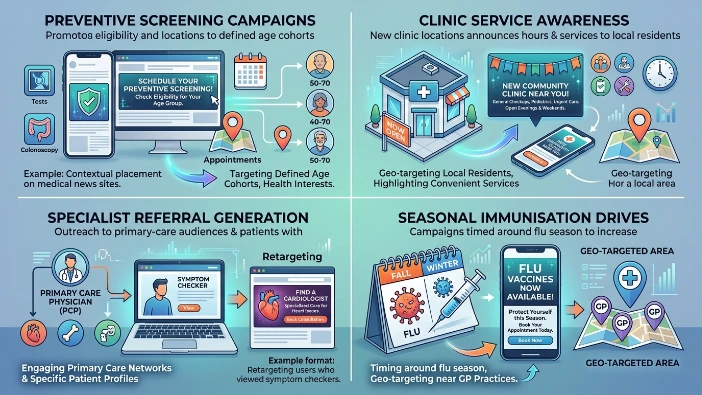
Use cases include preventive screening campaigns, clinic service awareness, specialist referral generation, and seasonal immunisation drives. Preventive screening: display ads promote eligibility criteria and screening locations to defined age cohorts. Clinic service awareness: new clinic locations announce hours and available services to local residents. Specialist referral generation: outreach to primary-care audiences and patients with relevant conditions increases referrals. Seasonal immunisation drives: campaigns timed around flu season increase bookings when combined with geo-targeted creatives.
Real example formats: a screening campaign using contextual placement on medical news sites; an immunisation campaign using geo-targeted inventory around GP practices; a specialist service campaign retargeting users who viewed symptom checkers with appointment-focused creatives.
How do display ads connect to the wider patient acquisition funnel?
Display ads create top-of-funnel awareness, support mid-funnel consideration through tailored content, and feed conversions via retargeted appointment prompts. Top-of-funnel use: broad contextual and demographic targeting to inform potential patients about conditions and services. Mid-funnel use: content-rich landing pages with FAQs, eligibility checks, and cost details to increase consideration. Bottom-of-funnel use: retargeted ads highlighting appointment availability or direct booking links to convert interested users into confirmed appointments. Integrate display data with CRM systems to track patient journeys and measure lifetime value of acquired patients.
For readers seeking deeper information on creative-to-conversion tactics and solution types, see this internal reference on:
How Healthcare Brands Improve Service Consideration Using Banner Ads
To explore converting consideration into bookings, see this internal reference on:
How Healthcare Brands Turn Service Consideration Into Confirmed Appointments Using Display Ads