
Retargeting advertising re‑engages users who previously visited a lender’s website or interacted with loan content by showing targeted display ads across the web to increase application counts.
Retargeting uses tracking pixels, cookies, or mobile identifiers to identify past visitors. Loan providers create audiences from site behaviour: pages viewed, forms started, eligibility tools used, and loan calculators accessed. Platforms match those identifiers to ad inventory on ad networks and demand‑side platforms. Ads then display relevant creative to remind users to return and complete an application.
Retargeting relies on three primary tracking mechanisms: browser cookies for desktop, mobile advertising identifiers (IDFA/GAID) for apps, and server‑side identifiers for logged‑in users. Providers build audience lists by URL rules (for example, visited /loan/eligibility), event rules (started but did not finish application), and time windows (last 7, 14, or 30 days). Audience size influences bidding and frequency controls.
Retargeting requires lawful basis under UK data protection law and ePrivacy guidelines. Providers document consent for advertising cookies, offer opt‑outs, and maintain data retention limits. Providers exclude sensitive categories and use privacy‑preserving signals where required.
How does retargeting increase loan application volume?
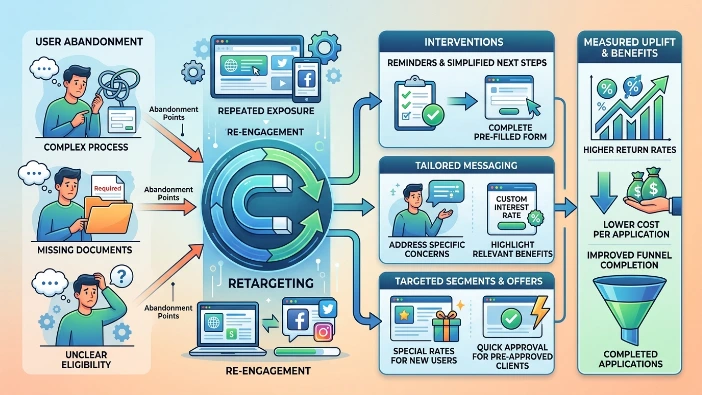
Retargeting increases application volume by addressing drop‑off points with tailored messaging, improving conversion probability through repeated exposure and segmented offers.
Users typically abandon loan processes for reasons such as complexity, missing documents, or unclear eligibility. Retargeting reduces friction by reminding, simplifying next steps, and presenting content aligned to the user’s prior interaction. Repeated ad exposure increases the likelihood that a user returns to complete an application. Measured uplift appears as higher return rates, lower cost per application, and improved overall funnel throughput.
Conversion mechanics by funnel stage
At awareness, retargeting introduces relevant content to users who viewed informational pages. At consideration, it promotes benefits, eligibility checks, and soft pre‑qualification. At decision, it nudges users who began applications with incentives like faster processing or required document lists. Each stage uses specific creatives and landing pages to improve conversion probability.
Measurement and attribution
Providers track retargeting performance with conversion events: form starts, form completions, document uploads, and signed agreements. Use last‑click plus multi‑touch attribution models and incrementality tests to isolate retargeting impact. Compare cost per application and completion rate against control groups to quantify uplift.
What are the main components of a loan retargeting campaign?
Main components include audience segmentation, creative variants, bid and frequency settings, landing page alignment, and measurement instrumentation.
Audience segmentation determines messaging relevance. Creative variants address user intent. Bids and frequency control cost and ad fatigue. Landing pages match ad promises to reduce drop‑off. Measurement instrumentation collects conversion events, builds cohorts, and runs uplift analyses.
Audience segmentation details
Segment by behaviour: loan type pages viewed (personal, auto, small business), application stage (visited quote page, started form), and engagement depth (time on page, documents viewed). Segment by demographics and region for UK‑specific targeting. Segment by intent signals such as repeated visits or calculator use within 14 days.
Creative and message structure
Create short messages that reflect the prior interaction: reminder to complete, eligibility confirmation steps, required document checklist, and time‑limited processing windows. Use multiple sizes and formats for desktop and mobile. Maintain consistent landing page language to preserve message‑match and reduce bounce.
Bid strategies and frequency caps
Use CPA‑focused bidding with bid adjustments for higher‑intent segments. Set frequency caps (for example, 3 impressions per user per day) to prevent fatigue. Expand audience with lookalike or similar audiences built from converters while keeping retargeting audiences prioritised.
Landing page and form optimisation
Align landing pages to the ad’s exact promise. Minimise form fields for re‑engagement flows, pre‑populate fields for returning users, and provide clear progress indicators for multi‑step forms. Show required documents and estimated completion time to reduce abandonment.
What technical steps set up retargeting correctly?
Technical setup requires tag placement, event tracking, audience definition, and secure data handling for compliance.
Place tracking pixels or event tags on critical pages: product pages, quote calculators, application start, and application complete. Implement server‑side event collection for logged‑in or authenticated users to increase match rates. Ensure cookie consent banners load before tags where law requires consent.
Use a tag manager to deploy and version tracking pixels. Define a clear event taxonomy: page_view, quote_view, application_start, application_complete, document_upload. Use consistent naming across platforms to simplify audience creation and reporting.
Encrypt identifiers in transit. Store minimal retention periods for audience lists, matching regulatory retention rules. Log consent timestamps and source for each tracked identifier. Provide clear opt‑out mechanisms for advertising cookies.
What targeting strategies work best for loan retargeting?
Best strategies combine intent‑based segmentation, temporal sequencing, and creative personalisation aligned to the user’s last interaction.
High‑intent segments like users who started an application require aggressive re‑engagement. Lower‑intent segments benefit from educational messaging about eligibility and benefits. Sequence ads so educational content appears first, then conversion prompts for those who re‑engage.
Temporal sequencing and cadence
Use short windows (7–14 days) for application starters and longer windows (30–60 days) for visitors to informational pages. Reduce cadence after initial engagement; use reminder bursts in the first 72 hours after abandonment when intent is fresh.
Personalisation and dynamic creative
Personalise creatives using product type, quoted amount range, or loan term. Use dynamic creative optimisation to swap headlines and calls‑to‑action based on segment. Personalisation increases relevance and improves click‑through rates.
What metrics measure retargeting success for loan providers?
Critical metrics include return rate, application start rate, application completion rate, cost per application, and incremental lift from controlled tests.
Return rate measures how many users return after an ad impression. Application start and completion rates show funnel movement. Cost per application captures efficiency. Incremental lift measures net new applications attributable to retargeting versus organic or other channels.
Set baseline targets using historical data. Typical improvements: 10–40% higher return rate and 15–30% higher completion rate for high‑intent segments. Use A/B or holdout tests to validate targets.
Report daily on audience sizes and delivery, weekly on funnel conversion rates, and monthly on cost per application and incremental lift. Archive cohorts for 90 days to support retargeting pools and performance comparisons.
What benefits do loan providers gain from retargeting ads?
Benefits include higher application volumes, lower acquisition cost per applicant, improved funnel efficiency, and better use of marketing spend through audience reuse.
Retargeting converts visitors who already know product details faster than cold channels. It reduces wasted spend by focusing on users who demonstrated interest. Providers achieve greater predictability in application pipelines and more efficient scaling by reusing effective audiences.
Providers observe improved throughput in the application pipeline. Shorter time to application completion reduces operational overhead. Better targeting decreases irrelevant inquiries and increases conversion quality.
Explore More Expert Insights:
How Banks Boost Account Openings Using Banner Ads
How Investment Firms Attract Clients Using Banner Advertising
What use cases demonstrate retargeting effectiveness for loans?
Common use cases include abandoned application recovery, pre‑qualification retargeting, cross‑sell to existing customers, and seasonal campaign boosts.
Abandoned application recovery shows the largest immediate ROI by reactivating users who started forms. Pre‑qualification retargeting nudges users who used calculators to apply. Cross‑sell retargeting reaches existing customers with new loan products. Seasonal boosts promote competitive rates during high‑demand months.
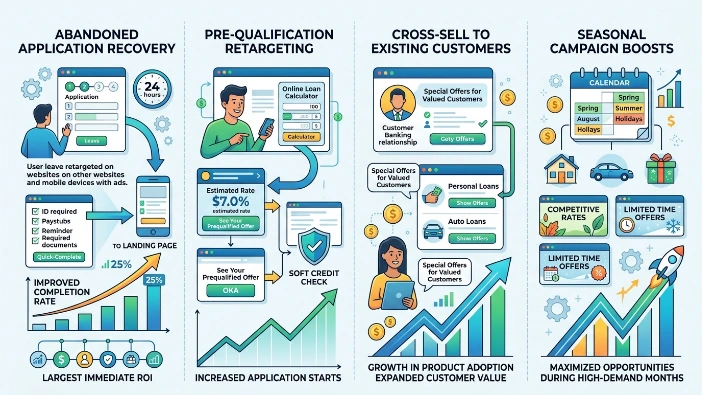
A provider tracks users who reached step two of a four‑step application but did not finish within 24 hours. A 7‑day retargeting sequence delivers reminder ads, a required‑documents checklist, and quick‑complete landing pages. The sequence improves completion rate for that cohort by a quantifiable percentage.
Users who used a loan calculator receive ads showing their estimated rate and a simplified next step to check eligibility. Ads link to pre‑qualification flows with soft credit checks to increase starts.
Read the Full Blog Here:
How Loan Providers Nurture Applicants Using Mid-Funnel Display Ads
How do retargeting campaigns interact with other channels?
Retargeting complements search, social, and email by recapturing users who left those channels and by reinforcing messages across the open web.
Search captures intent; retargeting reinforces it. Social builds awareness; retargeting converts interested audiences. Email re‑engages known contacts; retargeting reaches anonymous visitors who did not provide contact details. Cohesive cross‑channel sequencing creates consistent messaging and reduces drop‑off.
When users provide consent and contact details, combine CRM segments with ad audiences to create synced campaigns. Use CRM suppression lists to avoid redundant messaging. Use consistent creative and landing pages for seamless experiences.
Learn Everything About It Here:
Loan Funnel Ads That Turn Applicants Into Completed Submissions