
Credit card banner ads are visual display ads that promote card products and drive applicants by linking ad clicks to tailored landing pages; they track impressions, clicks, and conversions through pixels and UTM tags.
Credit card banner ads are graphic advertisements placed on websites, apps, and ad networks to present a credit card offer. They combine imagery, headline text, a concise value proposition, and a click-through link. Ad networks deliver ads by auction, using audience data and contextual signals. Advertisers set campaign objectives such as clicks, leads, or approved applications. Tracking uses conversion pixels, server-to-server postback, and UTM parameters to connect ad interactions to downstream application events. Compliance uses dynamic creative to include required regulatory copy for the United Kingdom and to prevent targeting exclusions.
How does ad delivery connect to application approval?
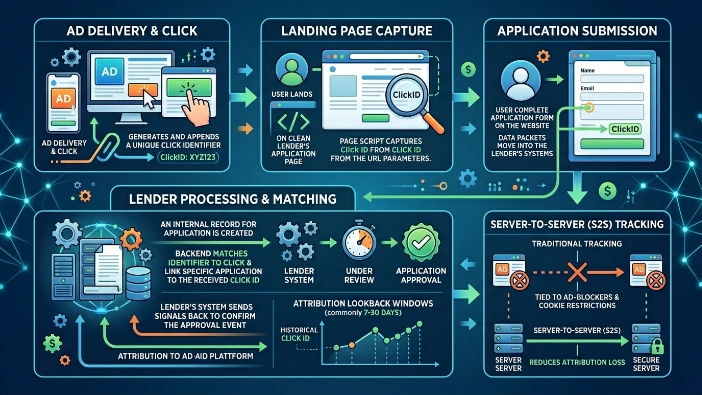
Delivery systems pass a click identifier to the landing page. The page captures the identifier during the application. Lenders match the identifier to the click and to subsequent application events, including approval. Ad platforms attribute final events using a lookback window, commonly 7–30 days. Server-to-server tracking reduces attribution loss caused by ad-blockers or third-party cookie restrictions.
How do advertisers design banners that move users from consideration to request?
Drive approved applications by reducing friction, communicating approval signals, and encouraging form starts with clear features and eligibility cues.
Design begins with a clear conversion goal and user journey mapping. Use 1 primary message per creative and a single call to action tied to an application step. Display eligibility cues such as representative APR, minimum income, and credit profile iconography to set expectations. Use progressive disclosure on landing pages: request minimal data to pre-qualify, then gather full details after pre-screening. Use secure visual cues and short microcopy that communicates speed (e.g., “Apply in 90 seconds”). Prioritise fast load times: keep assets under 150 KB and use modern formats such as WebP. Test variations with A/B split of headline, image, and CTA to find the layout that maximises approved applications rather than mere clicks.
What metrics define success for design iterations?
Track click-through rate (CTR), landing page conversion rate (form starts to completions), pre-qualification rate, application approval rate, cost per approved application (CPA-approved), and return on ad spend (ROAS). Set numeric targets: example targets include CTR > 0.15%, landing-page conversion rate > 2.5%, approval rate > 30%, and CPA-approved ≤ £150 for unsecured cards. Use cohort analysis by acquisition channel and creative version to optimise.
What targeting and audience strategies drive qualified applicants in the UK?
Targeting combines identity and intent signals: demographic filters, behavioural segments, custom intent keywords, and lookalike audiences based on previous approved applicants.
Build seed lists from existing approved customers and create 1%–5% lookalikes on major platforms. Use first-party data: email lists, hashed phone numbers, and CRM segments to run secure matched audiences. Layer intent signals such as recent searches for “credit card balance transfer” or “0% purchase card.” Apply demographic filters: ages 21–65, UK residency, and employment/income bands relevant to product underwriting criteria. Exclude high-risk cohorts such as bankruptcy records and known fraud vectors. Use sequential retargeting: show consideration creatives first, then approval-focused creatives to users who started an application but did not complete.
How to respect privacy and compliance while targeting?
Use hashed identifiers and consented datasets only. Respect UK data protection rules and platform policy restrictions for credit ads. Provide clear disclosure and an opt-out link on landing pages. Use aggregated reporting to reduce dependence on individual-level tracking where required.
What are the campaign components from ad to approved application?
Campaign components include creative assets, audience segments, bidding strategy, landing pages with tracking, pre-qualification engine, underwriting handoff, and postback attribution.
Creative assets: static banners at 300×250, 728×90, 320×50, and responsive HTML5 assets. Messaging components: headline, subhead with representative APR, and a short CTA. Audience segments: first-party matched lists, contextual placements on finance sections, and interest-based segments. Bidding: set target CPA-approved or maximise conversions with a constrained daily budget. Landing pages: fast, secure pages with progressive forms, KYC and consent capture, and a pre-qualification decisioning layer that outputs soft-decline or invite-to-apply signals. Underwriting handoff: pass completed applications via secure API to the card issuer for full credit checks. Attribution: implement server-to-server postback to record approvals and tie them back to the original click ID.
What technical integrations are necessary?
Implement a universal click ID (ucid) propagated across redirects and forms. Deploy a server-to-server conversion API and real-time postback to update campaign analytics with approved status. Use enhanced conversions (hashed email/phone) to improve attribution. Ensure TLS 1.2+ and GDPR-compliant data handling. Log events with timestamp, user agent, and lifecycle state for debugging and reconciliation.
What creative elements increase application approvals?
Effective elements include clear eligibility signals, single-step CTAs, reassurance about security, and testable social proof such as customer ratings or numeric counts.
Include representative APR and one-line benefits: 0% balance transfer for 20 months, 24-hour decision, or 0% foreign transaction fee. Place a small eligibility checklist: minimum income, age, and residency. Use a single-step CTA phrase that matches the landing page action, e.g., “Start application” or “Check eligibility.” Incorporate trust badges: FCA-regulated label or PCI DSS icon. Add measurable social proof: “Over 250,000 customers accepted” or “4.6/5 average rating (based on 15,432 reviews).” Test variations of each element to measure their impact on approval rate.
Which creatives reduce wasted applications?
Use pre-screen banners that invite users to check eligibility instead of full application. Use calculator widgets inside expandable banners that estimate chances of approval based on 2–4 input fields. Apply negative keywords and contextual exclusion to avoid placements on gambling or adult content where conversion quality drops.
What benefits do banner campaigns deliver for card issuers?
Banner campaigns deliver measurable increases in qualified application volume, lower acquisition cost per approved card, faster scale during promotional windows, and improved insight into customer segments.
Campaigns increase pipeline volume by reaching users during intent peaks and building direct response funnels. They reduce cost by optimising toward approved outcomes rather than clicks. Banners support seasonal acceleration: issuers can scale spend by 30%–200% during product launches or 0% APR windows. Banner data enriches underwriting models: click and engagement signals correlate with repayment patterns and lifetime value. Campaigns also support multi-product cross-sell by identifying high-intent users for premium card offers.
Dive Deeper Into This Topic:
How Banks Boost Account Openings Using Banner Ads
What ROI measures prove value to stakeholders?
Measure cost per approved application, approval rate, net revenue per account over 12 months, and payback period. Compare CPA-approved against lifetime value to determine portfolio profitability. Use incremental lift testing holdout groups versus exposed groups to quantify causal impact on approvals.
Explore More Expert Insights:
Investment Insight Ads That Turn Market Awareness Into Client Onboarding
Finance Display Ads That Convert Warm Leads Into High-Intent Customers
What use cases illustrate successful banner strategies?
Examples include balance-transfer launches, reward-card sign-up campaigns, and credit-limit increases where targeted banners sequence from eligibility check to application completion, increasing approvals and reducing dropouts.
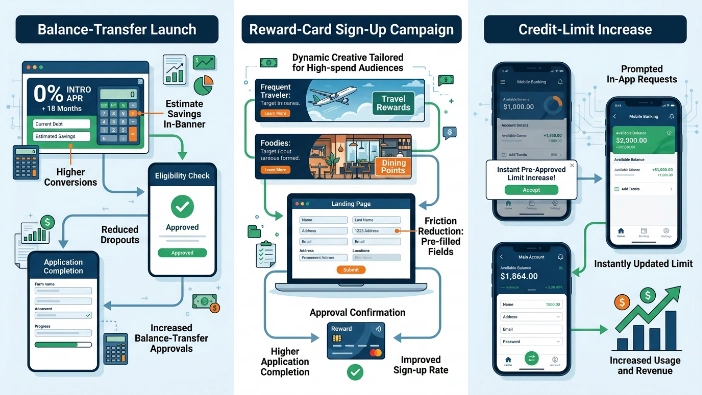
Balance-transfer launches use banners highlighting introductory balance-transfer APR and term length, combined with a calculator in the banner to estimate savings. Reward-card signup campaigns use personalised creative for high-spend audiences, linking to landing pages that pre-fill known fields for friction reduction. Credit-limit increases use in-app banners to offer instant pre-approved limits, prompting requests that convert to higher balances and increased interchange revenue.
How do advertisers measure success in each use case?
For balance-transfer campaigns, track transferred balance volume and approved accounts. For reward-card sign-ups, track spending in the first 90 days and net interchange revenue. For credit-limit increases, track incremental spend and default rates. Use control cohorts to validate lift and measure long-term credit performance.
Credit card banner ads convert consideration into approved card requests by combining targeted delivery, compliance-aware creative, fast and frictionless landing experiences, and technical attribution that links clicks to approvals. Optimise for approved outcomes with clear eligibility messages, progressive form flows, secure tracking, and cohort-based measurement to demonstrate ROI.
Learn More Here:
How Banks Increase Credit Card Consideration Using Banner Advertising