A loan funnel ad that converts applicants is a targeted advertising sequence designed to move users from initial interest to a fully completed loan application using progressively specific messages and conversion-focused landing experiences.
LAwareness, consideration, application start, document upload, and submission. They use audience signals, ad creatives, landing pages, and tracking to reduce drop-off at each step. Common ad platforms include search, social, programmatic display, and native channels. Key entities: applicant (individual seeking credit), lender (bank, specialist lender, or broker), ad creative (visual and copy assets), landing page (conversion-focused form), tracking pixel (conversion measurement), and consent/compliance layer (data privacy controls).
How do loan funnel ads work to increase completed submissions?
Loan funnel ads work by guiding users through staged messages and tailored landing pages while capturing intent signals, reducing friction, and re-engaging partial applicants until they submit.
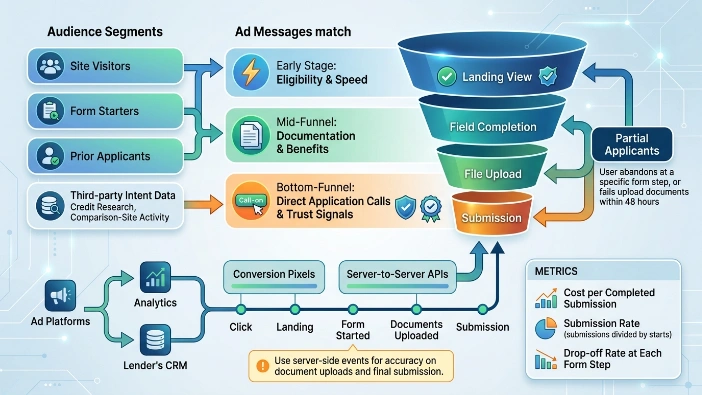
Campaigns begin with audiences segmented by intent, such as visitors who searched loan rates or started an online calculator. Ads deliver messages matched to the user’s funnel stage. Early stage messages emphasise eligibility and speed. Mid-funnel messages address documentation and benefits. Bottom-funnel ads present direct application calls and trust signals.
Data flows from ad platforms to analytics and the lender’s CRM. Conversion pixels and server-to-server APIs record events: click, landing, form started, documents uploaded, and submission. Attribution models assign value to ad exposures that assisted completed submissions. Common optimisation metrics include cost per completed submission, submission rate (submissions divided by starts), and drop-off rate at each form step.
Landing view, consent ticked, field completion, file upload, submission. Ensure consistent naming across platforms. Use server-side events for accuracy on document uploads and final submission.
What components make a loan funnel ad campaign effective?
An effective campaign uses precise audience segmentation, stage-aligned creatives, conversion-optimised landing pages, robust tracking, and compliance controls.
Audience segmentation separates prospects by intent, product interest, and credit profile. Eligibility checks for early stages, document lists for mid stages, and secure submission badges for final stage. Landing pages focus on single tasks: start application, resume application, or upload documents. Tracking links capture query parameters for product-specific routing. Compliance controls display privacy notices and required disclaimers. Technical components include pixels, server events, form validation, pre-fill via known data, and multi-step progressive disclosure of fields.
Creative and messaging
Loan amount range, APR or rate bands, and time-to-decision. Include exact document lists and step counts to set expectations.
Landing page and form design
Limit visible fields to essential items. Use progressive disclosure: show basic identity fields first, then financial details. Offer save-and-resume tokens with 7–30 day expiry. Validate inputs in real time. Provide evidence of encryption and security.
Compliance and consent
Collect explicit consent for marketing and credit checks. Display privacy policy and credit-search impact statements. Log consent with timestamp and source.
What processes reduce applicant drop-off in loan funnels?
Processes that reduce drop-off include progressive profiling, pre-filling known data, automated reminders, simplified document capture, and rapid decisioning.
Progressive profiling reduces cognitive load by collecting basic data first and requesting sensitive details later. Pre-fill fields from known cookies or logged-in profiles. Automated reminders via email and SMS restore incomplete applications after 6, 24, and 72 hours. Simplified document capture accepts photos and PDF uploads and verifies file types and sizes immediately. Rapid decisioning uses automated underwriting for routine cases and flags exceptions for manual review. Real-time eligibility checks prevent wasted effort on ineligible products. Use one-click resume links tied to encrypted tokens to remove login friction.
Send three reminders: 6 hours (gentle nudge), 24 hours (required-docs checklist), 72 hours (last chance to complete). Include a direct resume link and the exact next step.
What benefits do optimised loan funnel ads deliver to lenders?
Optimised funnels increase completed submission rates, lower acquisition cost per submitted application, shorten time-to-decision, and improve data quality for underwriting.
Higher submission rates result from reduced friction and targeted re-engagement. Cost-per-submission falls when audiences focus on high-intent prospects and when creatives reduce starts-to-submissions drop-off. Faster time-to-decision arrives from better data capture and automated rules. Data quality improves with real-time validation and progressive profiling. These benefits improve portfolio yield through higher match rates between product and applicant. Metrics to monitor: submissions per 1,000 clicks, average time from click to submission, cost per submission, conversion funnel rate by step, and submission-to-approval ratio.
Explore the Complete Guide:
How Loan Providers Increase Applications Using Retargeting Ads
Quantitative benchmarks
Track baseline conversion rates and aim for concrete improvements: increase submission rate by 20% within 90 days or reduce time-to-submission by 30% with automated reminders and pre-fill. Use A/B tests to validate changes.
What real use cases demonstrate loan funnel ad success?
Case examples show targeted retargeting increased completed submissions for personal loans, mortgage remortgages, and small-business working capital applications.
Personal loans. Lender identifies 12,000 visitors who used an eligibility calculator. Retargeting sequence with document-list ads and save-and-resume landing pages reduced abandonment by 40% and increased completed submissions by 25% in 60 days.
Mortgage remortgages. Broker retargets clients who viewed fee structures and pre-qual pages. Mid-funnel display ads offered a call-back booking and a one-click resume. Submission completions rose 18% and average time-to-submission fell from 6 days to 2 days.
Small-business loans. Specialist lender retargeted abandoned starts with ads listing required financial statements and an upload guide. Document capture improvements raised submission completions by 30% and reduced manual review time by 22%.
Explore More Expert Insights:
Credit Card Banner Ads That Convert Consideration Into Approved Card Requests
Investment Insight Ads That Turn Market Awareness Into Client Onboarding
How do loan providers measure and attribute completed submissions?
Providers measure completed submissions using event-based conversion tracking, unique applicant IDs, and multi-touch attribution across ad exposures and direct channels.
Assign a unique application ID at form start and persist it across sessions. Fire events for start, partial save, document upload, and submission. Reconcile events between ad platforms, CRM, and underwriting systems using daily deduplication jobs. Use last non-direct click and time-decay models in parallel to evaluate channel contribution. Reconcile ad-attributed submissions with backend approvals to calculate acquisition ROI. Maintain audit logs for consent and communication history.
What actions should decision-makers take now?
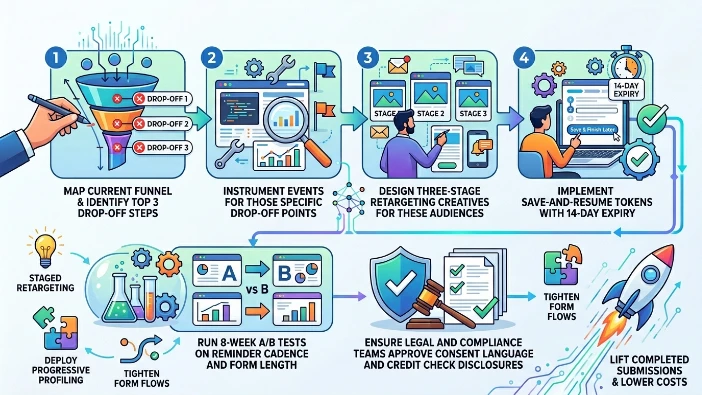
Implement staged retargeting, tighten form flows, deploy progressive profiling, and instrument end-to-end tracking to lift completed submissions and lower costs.
Prioritise these tasks: map current funnel and identify top three drop-off steps, instrument events for those steps, design three-stage retargeting creatives for those audiences, and implement save-and-resume tokens with 14-day expiry. Run 8-week A/B tests on reminder cadence and form length. Ensure legal and compliance teams approve consent language and credit check disclosures.
Find Out More:
How Loan Providers Nurture Applicants Using Mid-Funnel Display Ads