
Mid-funnel display advertising targets users who showed interest in loans and delivers tailored ads to move them toward application completion. It uses behavior signals, segmented audiences, and creative variations to re-engage prospects who visited rate pages or started forms.
Mid-funnel display advertising sits between awareness and conversion. Awareness channels deliver broad impressions; mid-funnel ads focus on users who interacted with loan-related content. Entities involved include the loan provider, ad platforms (demand-side platforms, DSPs), data providers, creative teams, and tracking systems. Typical signals for mid-funnel audiences are site visits to product pages, rate-check interactions, form starts, and time-on-site thresholds. Loan providers use these signals to build audiences of users who have intent higher than casual browsers but lower than ready-to-submit applicants.
How do loan providers build and segment mid-funnel audiences?
Providers segment audiences by on-site actions, credit-score intent, product interest, and engagement recency to tailor display bids and messages. Segments use deterministic first-party data and probabilistic third-party signals.
Segmentation begins with first-party event tracking. Events include page views by product (personal loan, mortgage, auto loan), rate-check interactions, form starts, and partial submissions. Providers assign event weights and recency windows—examples: visited rate page within 7 days, started form within 14 days, returned twice in 30 days. Credit-intent signals come from rate ranges users viewed or declared loan purpose. Data enrichment layers add age bracket, regional location (United Kingdom regions), and device type.
Providers apply different bid multipliers by segment and set frequency caps to limit ad fatigue. A lender bids 3x for “form start in 14 days” segment, 1.5x for “product-interested in 7 days.”
What creative strategies do loan providers use in mid-funnel display ads?
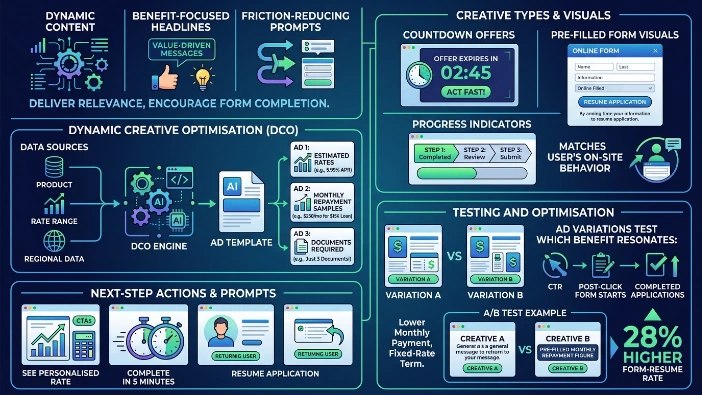
Creatives deliver relevance through dynamic content, benefit-focused headlines, and friction-reducing prompts to encourage form completion. Creative types include dynamic product creatives, countdown offers, and pre-filled form visuals.
Dynamic creative optimisation (DCO) pulls product, rate range, and regional data into ad templates. Ads show estimated rates, monthly repayment samples based on common loan sizes, or the number of documents required to complete an application. Messages highlight next-step actions: “Resume your application”, “See personalised rate,” or “Complete in 5 minutes.” Visuals use progress indicators that match users’ on-site behavior for example, a progress bar showing “Step 1 complete” for users who started a form.
Ad variations test which benefit resonates: lower monthly payment, fixed-rate term, or quick decision time. Providers use A/B and multivariate tests with clear KPIs: click-through rate (CTR), post-click form starts, and eventual completed applications. Example: a lender tested two creatives and found a 28% higher form-resume rate when ads displayed a pre-filled monthly repayment figure.
How do tracking and attribution work for mid-funnel display campaigns?
Tracking uses first-party cookies, server-side events, and device graphing to link display exposure to on-site actions and completed applications. Attribution blends last-click with multi-touch models for performance assessment.
Providers deploy pixel or server-to-server tracking to capture impressions, clicks, and downstream events such as form starts, partial saves, and submission completions. First-party event ingestion enters the data layer and syncs with the DSP for audience suppression or uplift. Cross-device identity resolution uses hashed identifiers and deterministic login data to connect sessions across desktop and mobile. For privacy compliance in the United Kingdom, providers implement consent management platforms and rely on first-party tracking when third-party cookies are unavailable.
Providers report metrics: impressions, CTR, view-through rate (VTR), cost per click (CPC), cost per form start, cost per completed application, and lift in application completion rate. Example attribution insight: display exposures in the 7 days before form completion contributed 40% of attributed value under multi-touch models.
What campaign structures and buying strategies optimise mid-funnel performance?
Campaigns structure by product, intent segment, and recency, using a mix of programmatic open exchange and private marketplace buys to balance scale and control. Bidding uses conversion-based strategies and frequency caps.
Campaigns run separate line items for product types (personal, mortgage, auto), audience segments (high-intent, rate researchers), and creatives. Providers select inventory types: open exchange for scale, private marketplaces for premium placements, and contextual buys on finance-related sites for relevance. Bidding strategies include target CPA (cost per acquisition) for form completions, ROAS where revenue modeling applies, and enhanced CPC for intermediate steps.
Frequency caps limit impressions per user per day to prevent fatigue common settings are 2–4 impressions per day and 10–15 per 30 days depending on intent. Dayparting reduces bids outside peak research times. Real example: a lender reduces bids by 50% on weekends for mortgage products because historical data showed lower conversion rates.
What measurement and KPIs show mid-funnel success for loan providers?
KPIs include cost per form start, cost per completed application, lift in completion rate, view-through conversion rate, and incremental application volume versus control groups. These metrics quantify how display ads move applicants down the funnel.
Measurement uses control-exposed testing and holdout groups to isolate incremental impact. Common thresholds: reduce cost per completed application by 10–30% versus search-only campaigns; increase completed application rate by 15–40% among users exposed to mid-funnel display. View-through conversions capture users who saw an ad and later converted without clicking. Incrementality tests reveal the true causal effect on application volume.
Providers track time-to-completion after exposure. Shorter median time-to-completion indicates successful nudging. Median time from first mid-funnel ad exposure to completed application decreased from 9 days to 4 days after adding DCO creatives.
Get the Full Insights Here:
How Loan Providers Increase Applications Using Retargeting Ads
What benefits do loan providers gain from mid-funnel display ads?
Mid-funnel display ads increase application completion rates, reduce acquisition cost, and improve funnel visibility through segmented measurement. They bridge awareness and conversion with tailored messaging and measurable impact.
Specific benefits:
- Higher completion: targeted messaging reduces drop-off in partial applications.
- Lower acquisition cost: re-engaging warm audiences costs less than cold acquisition.
- Better funnel insight: segmentation identifies friction points in the application process.
- Faster decisions: timely reminders and simplified next-step creatives reduce time-to-complete.
Example result: a provider with 2,000 monthly form starts increased completed applications by 18% and lowered cost per completed application by 22% after implementing segmented mid-funnel display campaigns.
Where do providers use mid-funnel display ads within the loan funnel?
Providers place mid-funnel ads after initial product discovery and before final submission to re-engage visitors who researched rates, started forms, or used calculators. Use cases include abandoned form recovery, rate re-engagement, and cross-sell nudges for related products.
Explore More Expert Insights:
How Banks Increase Credit Card Consideration Using Banner Advertising
How Investment Firms Build Awareness Using Market Insight Ads
How do privacy and regulation affect mid-funnel display strategies in the UK?
UK privacy rules require consent for personal data processing and mandate clear disclosure of tracking and profiling. Providers implement consent management, data minimisation, and secure data handling.
Regulatory constraints include the UK GDPR and the Privacy and Electronic Communications Regulations (PECR). Providers obtain user consent for cookies and personalised ads. They document legal bases for processing, limit retention windows (e.g., 30–180 days for mid-funnel audiences), and anonymise data where possible. Providers also follow Financial Conduct Authority (FCA) guidance on fair, non-misleading communications in financial promotions.
Operational controls include audit trails for data sources, periodic vendor assessments, and suppression lists for opted-out users. Example: a lender retains mid-funnel audiences for a maximum of 90 days and excludes users who opted out from personalised advertising.
Dive Deeper Into This Topic:
Loan Funnel Ads That Turn Applicants Into Completed Submissions
How do loan providers scale and iterate mid-funnel display programs?
Providers scale by expanding audience segments, increasing inventory types, and automating creative optimisation while iterating on measurement and audience definitions. Continuous testing drives efficiency.
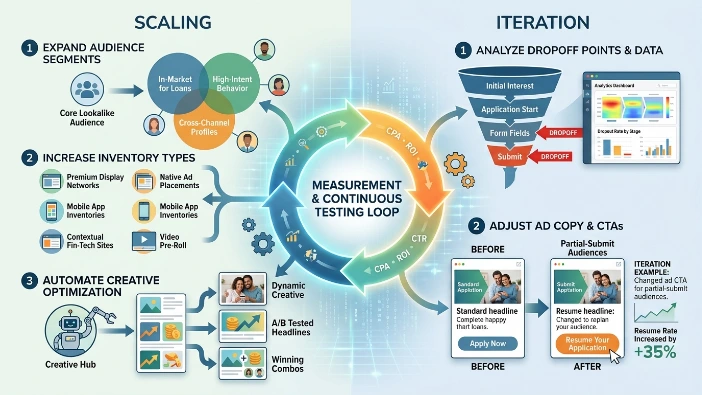
Iteration focuses on reducing drop-off points identified in analytics. Teams adjust ad copy to target the exact form step where users leave. Example iteration: changing ad CTA from “Apply now” to “Resume your application” increased resume rate by 35% for partial-submit audiences.