Banner ads are rectangular online advertisements that display images, text, or animation; banks place them across websites and apps to drive awareness and click-throughs that lead to account application pages.
Banner ads are digital creative units shown on web pages, mobile apps, and within programmatic ad networks. Banks buy placements by demographic, geography, or behaviour. A typical bank banner links to a landing page with an account application flow. Impressions create awareness. Clicks send users to account details and online forms. Conversions occur when a visitor completes an application and passes verification.
Banner ads use standard ad sizes such as 300×250, 728×90, and 320×50 pixels. Advertising platforms report metrics including impressions, clicks, click-through rate (CTR), conversion rate, cost-per-click (CPC), and return on ad spend (ROAS). Banks combine those metrics with backend account-opening data to attribute new accounts to campaigns.
How do banner campaigns for banks get planned and executed?
Banks plan banner campaigns by defining objectives, selecting audiences, designing creatives, choosing channels, and setting measurement methods before launching programmatic buys or direct placements.
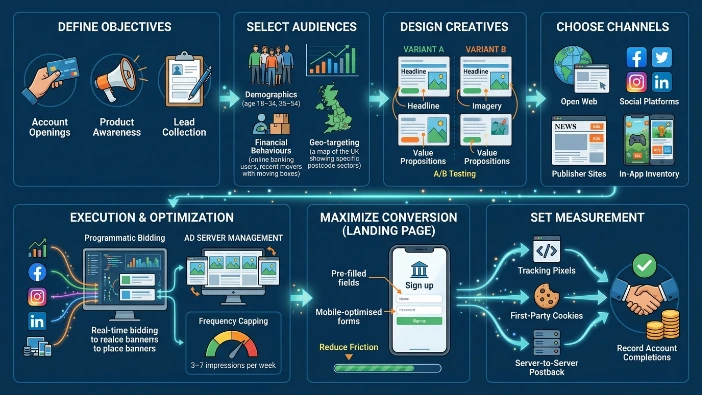
Account openings, product awareness, or lead collection. Teams target audiences using demographics (age 18–34, 35–54), financial behaviours (online banking users, recent movers), and geo-targeting (postcode sectors in the UK). Creative teams produce variants that test headline, imagery, and value propositions. Media teams select channels: open web, social platforms, publisher sites, or in-app inventory.
Execution follows a media plan. Programmatic platforms use real-time bidding to place banners based on audience signals. Ad servers rotate creative variants and apply frequency caps to limit user exposure, commonly 3–7 impressions per week. Landing pages use pre-filled fields and mobile-optimised forms to reduce friction. Measurement uses tracking pixels, first-party cookies, and server-to-server postback to record account completions.
What creative elements drive banner ad clicks and account completions?
Effective banner creative uses a clear headline, concise benefits, strong visual contrast, and a simple call-to-action that leads directly to an account application path.
Savings Account, 3.2% AER.” Benefit lines show a numeric advantage: interest rates, fee savings, or cash incentives. Visuals use single focal images or clean graphics; avoid clutter. Colour contrast improves legibility and click visibility. Calls-to-action use verbs: “Open Online” or “Apply Now.” Mobile creatives use larger fonts and single-touch landing flows.
Variants should test headline copy, offer amounts, imagery, and CTA wording. A/B tests measure CTR and conversion rate to the application completion stage. For example, testing “No Monthly Fees” versus “Free UK Bank Account” can reveal which phrase delivers higher application starts. Include clear compliance text where required, such as fee disclosures and eligibility notes.
How does targeting and audience selection affect account opening rates?
Precise targeting increases relevance, which raises CTR and conversion; banks use segmentation by age, income proxy, life stage, and browsing signals to improve account-opening rates.
Audience segments include students (18–25), young professionals (25–35), family households (35–55), and retirees (55+). Behavioural signals include frequent travel, mortgage research, or comparison site visits. Geographic targeting focuses on city-level or postcode clusters where branch presence or marketing priorities exist. Frequency caps prevent ad fatigue; optimal exposure is typically 3–7 impressions per week.
Banks use lookalike modelling to expand reach to users who share attributes with existing account holders. They also use retargeting for users who clicked but did not complete an application, showing sequential creatives that lower friction or present incentives. For example, retargeting users who visited the online application page within 7 days with a simplified sign-up banner increases completion probability.
How do measurement and attribution work for banner-driven account openings?
Measurement uses event tracking, conversion pixels, and server-to-server attribution to link ad interactions to completed account openings and to calculate cost-per-acquisition (CPA).
Tracking begins with impression and click logs from ad platforms. Conversion pixels fire when a user reaches a confirmation page or submits an application. For higher accuracy, banks implement server-to-server postback that records account openings directly from application servers. Models include last-click, view-through, and multi-touch attribution to allocate credit across touchpoints. Common KPI calculations include CTR, conversion rate (applications started divided by clicks), and CPA (ad spend divided by account openings).
Banks validate digital attribution with backend reconciliations: matching timestamps, hashed identifiers, and application tokens. They also account for fraud and invalid applications. Typical CPA targets vary by account type: for basic current accounts, CPA could be £20–£60; for savings products, CPA ranges from £15–£45, depending on offers and channel efficiency.
What role does landing page and application design play in converting banner traffic?
Landing pages and application processes reduce drop-off when they load fast, show clear steps, and pre-populate fields where possible to shorten completion time.
Every 1-second delay reduces conversion probability. Landing pages present the product headline, key numbers (rates, fees), eligibility criteria, and a progress indicator for the application. Forms minimise required fields; banks use progressive profiling to request sensitive information later. Mobile-first design uses large touch targets, keyboard-optimised fields, and minimal redirects.
Verification processes use digital ID checks, e-signatures, and instant bank account verification to speed approval. For example, using a 3-step form that collects name and contact, verifies ID, and finalises terms reduces abandonment relative to a single long form. Clear disclosures and privacy statements satisfy regulatory requirements and lower hesitation.
What are common compliance and privacy considerations for bank banner campaigns in the UK?
Banner campaigns in the UK must follow financial promotion rules, Data Protection Act and GDPR, ensuring clear risk disclosures and lawful data processing for targeting and tracking.
Financial promotions require that communications are clear, fair, and not misleading. Ad creatives must include required disclaimers for rates and fees. Audience targeting and tracking must follow GDPR: obtain user consent for non-essential cookies and store only necessary first-party data for attribution. Platforms must support user privacy choices, including consent strings via IAB frameworks.
Banks also must maintain records of promotional content and audience segments for regulatory audits. Where personalised targeting uses special categories or sensitive signals, banks must document lawful bases and data protection impact assessments. For example, using credit-score-related targeting requires explicit legal and compliance review.
What benefits do banner ads provide banks compared with other channels?
Banner ads provide scalable reach, rapid testing, and measurable attribution that supports cost-effective acquisition for specific account types.
Banners scale across millions of impressions and reach niche audiences through programmatic targeting. They enable fast creative testing: swap headlines or offers and compare performance within days. Banner campaigns link directly to measurable online applications, enabling real-time optimisation of spend toward lower CPA segments. They complement organic channels by delivering targeted acquisition at defined prices.
Performance varies by channel: display banners often yield higher reach and lower CPC than social or search for top-of-funnel awareness. For account opening funnels, banners perform effectively when paired with focused landing pages and clear conversion paths.
Explore More Expert Insights:
How Investment Firms Attract Clients Using Banner Advertising
How Fintech Companies Acquire Users Using Banner Ads
What real use cases show banner ads driving bank account openings?
Targeted student account campaigns on university network sites, regional current-account drives on local news sites, and savings-rate offers on personal finance portals drove measurable application increases.
A student account campaign targeting university Wi‑Fi portals increases CTR among 18–24 users. A regional current-account campaign on local news sites drives branch-related traffic and online applications in targeted postcodes. A savings-rate banner on a finance comparison site with a direct link to a one-minute application raises completed savings accounts within 14 days of launch. Each case uses tailored creative, frequency caps, and landing pages aligned with the audience.
Get the Full Insights Here:
How Banks Increase Credit Card Consideration Using Banner Advertising
How do banks optimise banner campaigns over time?
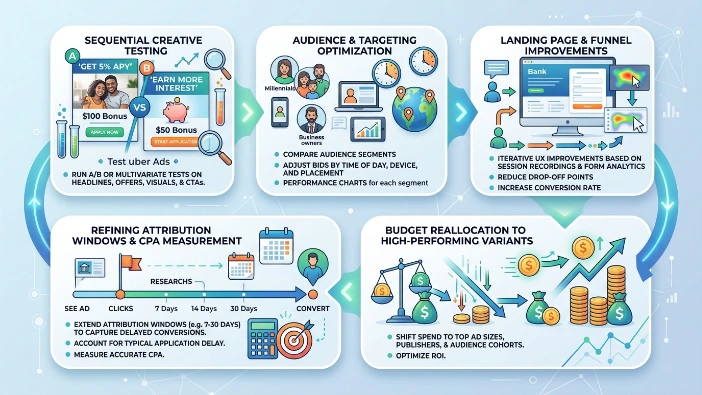
Optimisation uses sequential testing on creative, audience, and landing pages, reallocating budget to high-conversion variants and refining attribution windows for accurate CPA measurement.
Teams run A/B or multivariate tests on headlines, offers, visuals, and CTAs. They compare audience segments and adjust bids by time of day, device, and placement. Landing page funnels receive iterative UX improvements based on session recordings and form analytics. Budget shifts move spend to high-performing ad sizes, publishers, and audience cohorts. Attribution windows extend to 7–30 days depending on typical application delay to capture delayed conversions.
Check the Complete Explanation:
Credit Card Banner Ads That Convert Consideration Into Approved Card Requests
Banner ads drive bank account openings by combining targeted reach, concise creative, optimised landing experiences, and rigorous measurement. Banks plan campaigns with clear objectives, precise audience segments, and fast mobile-first application flows. Compliance and privacy rules in the UK shape targeting and disclosures. Continuous testing and server-level attribution improve CPA and scale results across student, regional, and savings product use cases.