

ROAS, or Return on Ad Spend, measures the revenue generated for every unit of advertising cost. Display banner campaigns influence ROAS by increasing product visibility, driving targeted traffic, and reinforcing purchase intent across multiple digital touchpoints in structured e-commerce advertising ecosystems.
ROAS is a core performance metric in e-commerce marketing. It is calculated by dividing total revenue from ads by total advertising spend. A higher ROAS indicates stronger advertising efficiency and better conversion outcomes.
Display banner campaigns are visual advertisements placed across websites, apps, and digital platforms. These banners appear in fixed or dynamic formats and are designed to attract attention at different stages of the browsing journey.
In the UK e-commerce environment, display banners function as repeated exposure tools. They create familiarity with products and categories before a purchase decision occurs. This repeated visibility improves the probability of conversion, which directly affects ROAS.
Banner campaigns also support structured traffic flow. They direct users from awareness stages to product pages where purchasing decisions are made. This controlled movement improves conversion efficiency and reduces wasted ad spend.
How do display banner ads function in e-commerce marketing ecosystems?
Display banner ads function by distributing visual marketing messages across publisher networks, mobile applications, and websites. They operate through bidding systems, audience data signals, and placement algorithms that match user behavior with relevant commercial content across digital environments.
Display advertising ecosystems operate through automated ad exchanges. These exchanges match advertisers with available digital spaces in real time. The process uses auction-based bidding where advertisers compete for impressions based on audience relevance.
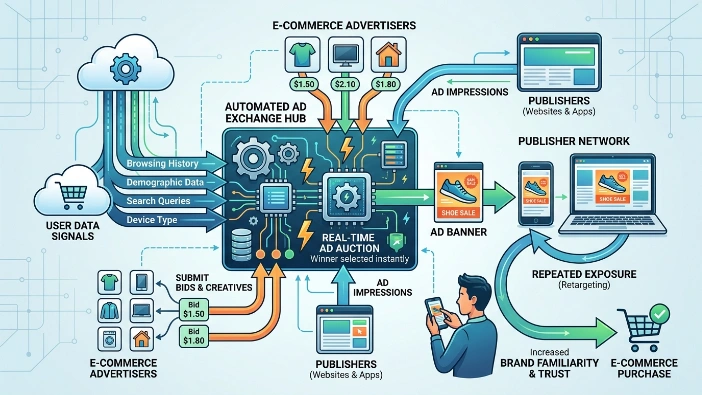
Banner ads are delivered through structured networks that analyze browsing behavior, search history, and demographic signals. This allows ads to appear in contexts aligned with user interest patterns.
In e-commerce, banner ads serve as reinforcement tools. They repeatedly expose users to product categories they have previously viewed or engaged with. This repetition increases familiarity, which influences purchase behavior over time.
UK-based digital platforms frequently integrate display ads across news websites, lifestyle blogs, and retail comparison portals. This broad placement ensures coverage across multiple audience segments.
What components determine the performance of display banner campaigns?
Performance of display banner campaigns depends on targeting accuracy, creative design quality, placement relevance, bidding strategy, and audience intent signals. These components collectively determine engagement rates, click-through performance, and final conversion efficiency in e-commerce advertising systems.
Targeting accuracy defines whether ads reach relevant users. It uses behavioral, demographic, and contextual data. Higher accuracy increases engagement quality and reduces irrelevant impressions.
Creative design determines visual impact. Strong designs use clear messaging, structured layouts, and recognizable product representation. Weak designs reduce attention retention and lower interaction rates.
Placement relevance ensures ads appear in environments aligned with user intent. Contextually relevant placements improve engagement probability because users are already interacting with related content.
Bidding strategy controls cost efficiency. Automated bidding systems adjust ad spend based on predicted conversion value. This maintains balance between reach and profitability.
Audience intent signals represent user readiness to purchase. High-intent audiences respond more strongly to banner exposure, increasing conversion likelihood and improving ROAS outcomes.
How do e-commerce businesses measure improvements in ROAS from banner advertising?
E-commerce businesses measure ROAS improvements from banner advertising by tracking conversion data, attribution models, impression-to-click ratios, and revenue generated per ad interaction. These metrics provide a structured evaluation of campaign efficiency and financial return over defined time periods.
Conversion tracking identifies how many users complete purchases after interacting with banner ads. This data links advertising exposure directly to revenue outcomes.
Attribution models distribute credit across multiple touchpoints. A user may see several ads before purchasing. Attribution systems assign value to each interaction stage.
Impression-to-click ratio measures engagement effectiveness. Higher ratios indicate stronger ad relevance and better visual communication.
Revenue per interaction calculates financial output from each ad engagement. This metric directly reflects ROAS efficiency.
E-commerce platforms in the UK commonly use analytics systems to segment performance by device type, geography, and audience category. This segmentation identifies which banner strategies produce the highest returns.
Why do audience targeting and segmentation affect ROAS in display campaigns?
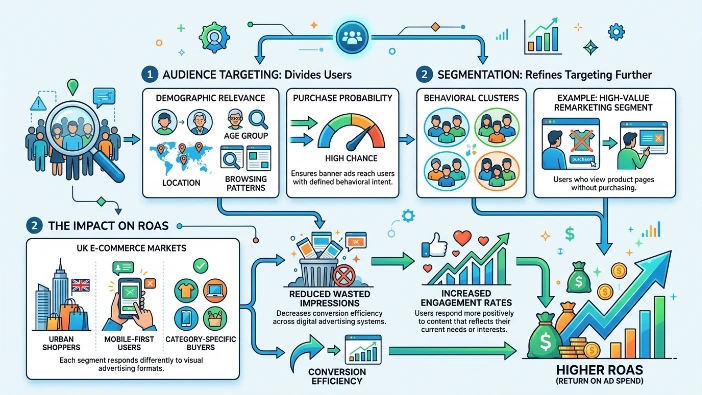
Audience targeting and segmentation affect ROAS because they ensure banner ads reach users with defined behavioral intent, demographic relevance, and purchase probability. Accurate segmentation reduces wasted impressions and increases conversion efficiency across digital advertising systems.
Audience targeting divides users based on characteristics such as age group, location, browsing patterns, and past interactions. This structure improves relevance between ad content and user interest.
Segmentation refines targeting further by grouping users into behavioral clusters. For example, users who view product pages without purchasing form a high-value remarketing segment.
When banner ads align with segmented audiences, engagement rates increase. Users respond more positively to content that reflects their current needs or interests.
In UK e-commerce markets, segmentation often includes urban shoppers, mobile-first users, and category-specific buyers. Each segment responds differently to visual advertising formats.
Higher targeting precision reduces irrelevant impressions. This improves cost efficiency and increases ROAS because more ad spend is directed toward high-probability buyers.
Explore More Expert Insights:
How E-commerce Brands Drive Product Page Traffic with Banner Ads
How Online Retailers Recover Abandoned Carts Using Banner Advertising
What role do creative design and ad placement play in banner campaign efficiency?
Creative design and ad placement determine banner campaign efficiency by influencing user attention, message clarity, and contextual relevance. Strong design increases engagement, while strategic placement ensures ads appear in high-intent digital environments that improve conversion likelihood.
Creative design controls how users perceive an advertisement. Clear product visuals, structured layouts, and concise messaging improve attention capture. Poor design reduces visibility and lowers engagement rates.
Ad placement determines where banners appear across digital platforms. Placement on relevant content pages increases interaction probability because users are already engaged with similar topics.
Contextual alignment strengthens campaign performance. For example, fashion-related banners placed on lifestyle content platforms generate higher engagement than unrelated placements.
In UK digital ecosystems, placement strategies often prioritize high-traffic publisher websites and mobile applications. This ensures consistent exposure across diverse audience groups.
When design and placement operate together, banner campaigns achieve higher click-through rates and improved conversion pathways, directly supporting ROAS growth.
How does display advertising fit into the broader e-commerce conversion journey?
Display advertising fits into the e-commerce conversion journey by creating awareness, reinforcing interest, and supporting purchase decisions across multiple user touchpoints. It operates as a continuous visibility layer that guides users from discovery to final transaction.
The e-commerce conversion journey includes awareness, consideration, and purchase stages. Display advertising primarily operates in awareness and consideration phases but influences all stages indirectly.
At the awareness stage, banner ads introduce products to new users. At the consideration stage, repeated exposure builds familiarity and trust. At the purchase stage, ads reinforce intent and reduce hesitation.
This multi-stage influence creates a structured path toward conversion. Users encounter consistent messaging across different platforms, which increases decision confidence.
Read:
How E-commerce Businesses Improve ROAS Using Display Banner Campaigns
In the MOFU stage, remarketing strategies become more prominent, shaping user preference through repeated engagement signals.
Explore:
How E-commerce Platforms Turn Returning Visitors Into Paying Customers Using Remarketing Campaigns
In the BOFU stage, display campaigns focus on converting returning visitors into paying customers through high-intent targeting and optimized messaging sequences.
Display advertising remains a foundational component of digital commerce systems in the UK. It ensures continuous engagement across fragmented browsing behavior, which improves overall conversion consistency and strengthens ROAS performance across campaigns.



