

Move from interest to action as wishlist behaviour becomes structured purchase intent, where personalised display ads convert stored product signals into final buying decisions through behavioural triggers, product-level targeting, and conversion-focused remarketing systems.
Wishlist-to-purchase conversion in e-commerce advertising refers to the process of turning users who saved products into buyers by using behavioural data, personalised display ads, and timed remarketing triggers that re-engage users with specific items they previously expressed interest in.
Wishlist behaviour represents high-intent user activity. It signals product consideration without immediate purchase action. E-commerce systems treat wishlist entries as structured purchase indicators. Each saved product becomes a tracked conversion opportunity.
Conversion occurs when users return to complete transactions after receiving personalised ad exposure. This stage is positioned at the bottom of the funnel. It focuses on users already familiar with specific products and categories.
Wishlist conversion systems operate using behavioural data models. These models track saved items, revisit frequency, and engagement depth. This creates a structured pathway from passive interest to completed purchase action.
How do personalised display ads target wishlist users?
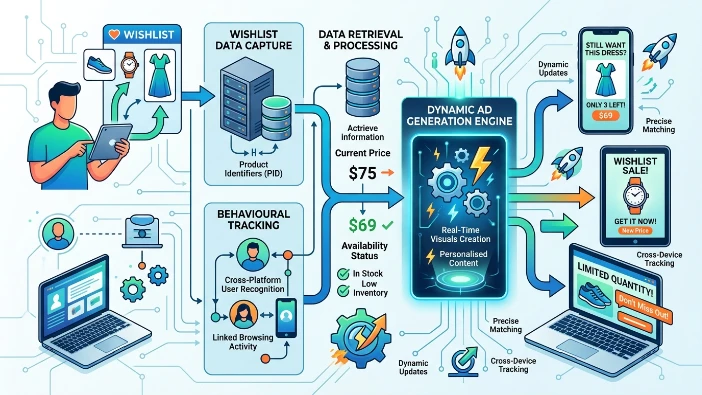
Personalised display ads target wishlist users by using stored product identifiers, behavioural tracking data, and dynamic ad generation systems that display exact saved items, updated pricing, and availability status across multiple digital advertising channels in real time.
Personalised targeting begins with wishlist data capture. Each saved product is stored with a unique product identifier.
Behavioural tracking systems link wishlist activity with browsing sessions. This allows consistent user recognition across platforms.
Display ad systems retrieve saved product information. This includes product name, category, price, and availability. Dynamic ad generation engines create real-time visuals. These ads show the exact product saved by the user.
Retargeting networks distribute these ads across websites and mobile applications. This ensures repeated exposure.
This targeting structure increases relevance at the point of decision-making.
What technologies support wishlist-based remarketing systems?
Wishlist-based remarketing systems rely on customer data platforms, dynamic creative optimisation engines, tracking pixels, API integrations, and real-time bidding infrastructure that synchronises saved product data with personalised display ad delivery across digital ecosystems.
Customer data platforms store wishlist information. These systems centralise user-product relationships.
Tracking pixels capture user interactions across sessions. This includes wishlist additions and product page revisits.
Dynamic creative optimisation engines generate personalised ad variations. Each variation reflects individual wishlist content.
API integrations connect e-commerce databases with advertising networks. This ensures product data accuracy in real time.
Real-time bidding systems allocate ad impressions based on user intent strength. Wishlist users receive higher priority exposure.
These technologies form a unified conversion pipeline from wishlist entry to purchase completion.
Why do wishlist users require personalised display ads to convert?
Wishlist users require personalised display ads to convert because stored interest does not guarantee purchase action, and repeated exposure to exact saved products with updated contextual signals increases decision clarity, reduces hesitation, and reinforces product relevance at the point of conversion readiness.
Wishlist users already show intent. However, intent remains incomplete without additional reinforcement.
Personalised ads provide structured reminders. These reminders display exact saved products repeatedly.
Decision hesitation occurs due to comparison behaviour. Users delay purchase while evaluating alternatives.
Display ads reduce this delay. They reintroduce product relevance during browsing sessions.
Updated signals such as price changes or stock availability increase urgency of decision-making.
This creates a structured conversion pathway from passive saving to active purchasing.
How does behavioural data influence wishlist conversion campaigns?
Behavioural data influences wishlist conversion campaigns by tracking product saves, revisit frequency, cart abandonment patterns, and engagement duration, which collectively determine ad timing, product prioritisation, and frequency of personalised display ad exposure across digital channels.
Product saves represent primary intent signals. Each saved item becomes a conversion candidate.
Revisit frequency indicates reinforcement interest. Users returning multiple times show stronger purchase likelihood.
Cart abandonment patterns signal hesitation at the final decision stage. These users receive intensified ad exposure.
Engagement duration measures depth of product interest. Longer viewing times indicate higher conversion probability.
Systems process these signals in real time. This ensures personalised ads match current user intent states.
Behavioural data ensures conversion targeting remains precise and structured.
What role does dynamic creative optimisation play in conversion ads?
Dynamic creative optimisation in conversion ads generates personalised visual content by automatically adjusting product images, pricing details, and availability indicators based on wishlist data, ensuring each user sees highly relevant, real-time updated ad variations aligned with their saved product behaviour.
Dynamic creative optimisation uses structured product feeds. These feeds contain live product information.
Each ad is assembled in real time. This ensures content accuracy for every impression.
Product images are selected directly from saved wishlist entries. This increases visual recognition.
Pricing updates are applied dynamically. Users see current prices instead of outdated values.
Availability indicators show stock status. This affects urgency in purchase decision-making.
This system increases conversion precision by aligning ads with exact user intent signals.
Read:
How E-commerce Brands Drive Mid-Funnel Engagement Using Display Ads
How does timing affect wishlist-based display ad performance?
Timing affects wishlist-based display ad performance by delivering personalised ads within specific behavioural windows, such as 1 to 3 days after wishlist addition or 7-day re-engagement cycles, when user intent remains active and purchase likelihood remains structurally high.
Early timing captures immediate interest. Ads delivered within 24 hours maintain strong recall.
Short-term timing cycles span 1 to 3 days. This period shows highest engagement responsiveness.
Mid-cycle timing occurs within 7 days. Users are reactivated after initial browsing gaps.
Long-cycle timing extends beyond 14 days. These users require repeated reinforcement exposure.
Timing systems adjust based on user inactivity periods. This ensures consistent re-engagement.
Accurate timing increases conversion probability through structured exposure sequencing.
Explore More Expert Insights:
How Online Stores Maximise Checkout Completion Using Conversion-Focused Banner Retargeting Ads
How E-commerce Platforms Turn Returning Visitors Into Paying Customers Using Remarketing Campaigns
What benefits do e-commerce brands gain from wishlist remarketing?
E-commerce brands gain higher conversion rates, reduced cart abandonment, improved return on ad spend, increased product recall, and stronger purchase completion rates through wishlist remarketing strategies that re-engage high-intent users with personalised display ads across multiple digital touchpoints.
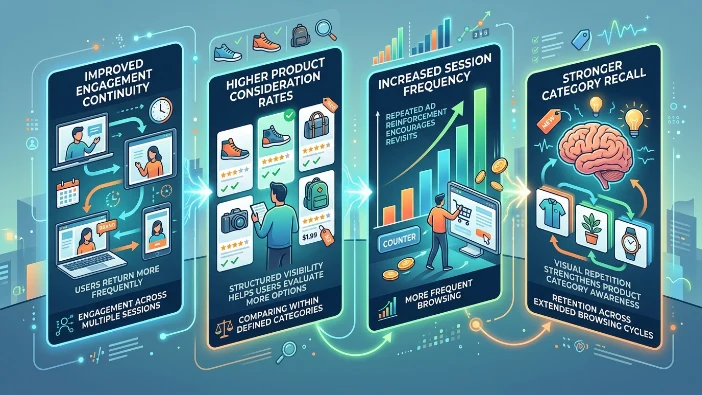
Conversion rates increase due to high-intent targeting. Wishlist users already demonstrate product interest.
Cart abandonment decreases through repeated exposure. Users return to complete transactions.
Return on ad spend improves through focused targeting. Budget is allocated to high-probability users.
Product recall strengthens through visual repetition. Users remember saved items more clearly.
Purchase completion rates increase due to reduced decision friction.
These benefits create a structured improvement in bottom-funnel performance metrics.
Explore:
How E-commerce Platforms Scale Revenue Using High-Performance Banner Ads
Where are wishlist-based display ads most effective in conversion journeys?
Wishlist-based display ads are most effective on retargeting networks, social media feeds, product comparison pages, and checkout-related environments where users demonstrate active decision-making behaviour and high purchase intent within short conversion cycles.
Retargeting networks provide repeated exposure. Users see saved products across multiple websites.
Social media feeds reinforce product visibility. Visual repetition increases recall strength.
Product comparison pages support evaluation completion. Users finalise decision criteria here.
Checkout-related environments capture high intent. Users close to purchase respond strongly to reminders.
Placement strategy focuses on decision-stage environments. These environments increase conversion efficiency.
Effective placement ensures wishlist signals translate into completed purchases.



