
Explore how consideration deepens as users move from awareness to evaluation, where MOFU display ads structure intent signals into sustained engagement, comparison behaviour, and repeated interaction across e-commerce environments.
Mid-funnel engagement in e-commerce display advertising refers to the user stage where visitors actively evaluate products after initial awareness, using repeated ad exposure, category comparisons, and informational content interactions to build structured purchase consideration across multiple digital touchpoints and sessions.
Mid-funnel engagement represents the evaluation layer between discovery and conversion. It focuses on users who already recognise a product category but have not yet made a purchase decision.
Display ads in this stage shift from visibility focus to consideration support. They present structured product information, comparisons, and category reinforcement messages.
E-commerce platforms define this stage using behavioural signals. These include multiple product page visits, return sessions within 7–14 days, and repeated category browsing activity.
This engagement stage is measurable through interaction depth. Users begin comparing specifications, price ranges, and alternative product variations instead of browsing broadly.
Mid-funnel systems use segmented audience groups. Each group receives display ads aligned with their browsing history and engagement intensity level.
How do display ads influence consideration behaviour in the mid-funnel?
Display ads influence consideration behaviour in the mid-funnel by reinforcing product recall, increasing category exposure frequency, and delivering structured comparison signals that guide users toward evaluating alternatives and narrowing decision options across repeated browsing sessions and engagement cycles.
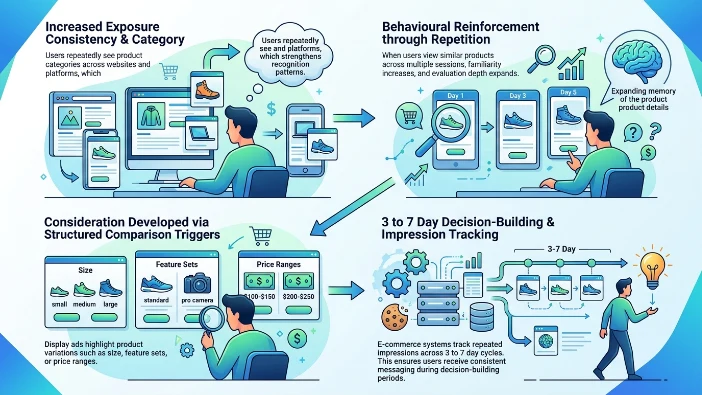
Display ads increase exposure consistency. Users repeatedly see product categories across websites and platforms, which strengthens recognition patterns.
Behavioural reinforcement occurs through repetition. When users view similar products across multiple sessions, familiarity increases, and evaluation depth expands.
Consideration behaviour develops through structured comparison triggers. Display ads highlight product variations such as size, feature sets, or price ranges.
E-commerce systems track repeated impressions across 3 to 7 day cycles. This ensures users receive consistent messaging during decision-building periods.
Display ads also reduce decision uncertainty. Structured visual information helps users differentiate between multiple product options within the same category.
This behavioural influence creates a transition from casual browsing to focused evaluation activity.
What technologies support mid-funnel display advertising systems?
Mid-funnel display advertising systems rely on data management platforms, behavioural tracking engines, segmentation algorithms, real-time bidding infrastructure, and API-based ad delivery systems that process user interaction data and distribute relevant ad creatives across digital ecosystems at scale.
Data management platforms store structured user profiles. These profiles include browsing history, category interest, and engagement frequency.
Behavioural tracking engines collect interaction signals. These include page views, scroll depth, time spent per product, and repeat visits.
Segmentation algorithms classify users into mid-funnel groups. These groups are defined by interaction intensity rather than demographic attributes alone.
Real-time bidding systems allocate ad impressions within milliseconds. This ensures mid-funnel users receive relevant display content during active browsing sessions.
API-based delivery systems synchronise product data with ad platforms. This ensures accuracy in pricing, availability, and product attributes.
These technologies work together to maintain continuous relevance across multiple digital environments.
How is audience segmentation structured for mid-funnel display ads?
Audience segmentation for mid-funnel display ads is structured using behavioural clusters based on product interaction frequency, category interest depth, session recency, and engagement patterns that identify users actively comparing options within defined purchase consideration cycles.
Segmentation begins with behavioural clustering. Users are grouped based on repeated interaction with similar product categories.
Category interest depth defines how often users return to specific product pages. Higher frequency indicates stronger consideration intent.
Session recency measures how recently users interacted with a category. Mid-funnel users typically return within 1 to 7 days.
Engagement patterns include comparison behaviour. Users who switch between multiple product listings indicate active evaluation.
Segmentation systems assign users to structured groups such as light evaluators, active comparers, and high-intent researchers.
These groups determine the type and frequency of display ads shown during the consideration stage.
Explore:
How E-commerce Platforms Scale Revenue Using High-Performance Banner Ads
What role does product comparison play in mid-funnel display ads?
Product comparison in mid-funnel display ads plays a central role by presenting structured differences between product features, pricing tiers, and variations, enabling users to evaluate alternatives systematically and reduce uncertainty during the decision-building phase across multiple browsing sessions and engagement cycles.
Product comparison structures decision pathways. Users receive visual breakdowns of product differences across categories.
Comparison ads highlight measurable attributes. These include size, material, functionality, and price bands.
E-commerce systems organise comparisons into structured formats. This allows users to evaluate multiple options without navigating across separate pages.
Comparison-based display ads reduce cognitive load. Users process structured differences more efficiently than unorganised product listings.
Repeated exposure to comparison content strengthens evaluation clarity. Users narrow choices over time based on consistent attribute exposure.
This process increases mid-funnel engagement depth and supports transition toward purchase readiness.
How do behavioural signals shape mid-funnel ad delivery?
Behavioural signals shape mid-funnel ad delivery by capturing user interactions such as repeated product views, category revisits, cart activity without purchase, and search refinement patterns, which collectively determine ad relevance, frequency, and content structure across display networks.
Repeated product views indicate evaluation intent. Users reviewing the same item multiple times are categorised as active comparers.
Category revisits within short time windows signal sustained interest. Systems increase ad frequency for these users.
Cart activity without purchase indicates hesitation behaviour. Display ads then reinforce product benefits and alternatives.
Search refinement patterns show narrowing intent. Users shifting from broad to specific queries receive more targeted ad content.
How E-commerce Brands Turn Wishlist Users Into Buyers Using Personalized Display Ads
These signals are processed in real time. Ad delivery systems adjust content within seconds based on updated behavioural inputs.
This ensures mid-funnel ads remain aligned with evolving user intent.
Explore More Expert Insights:
How Online Stores Improve Product Awareness Using Targeted Banner Campaigns
How E-commerce Platforms Influence Buying Decisions Using Remarketing Ads
What benefits do e-commerce brands achieve from mid-funnel display ads?
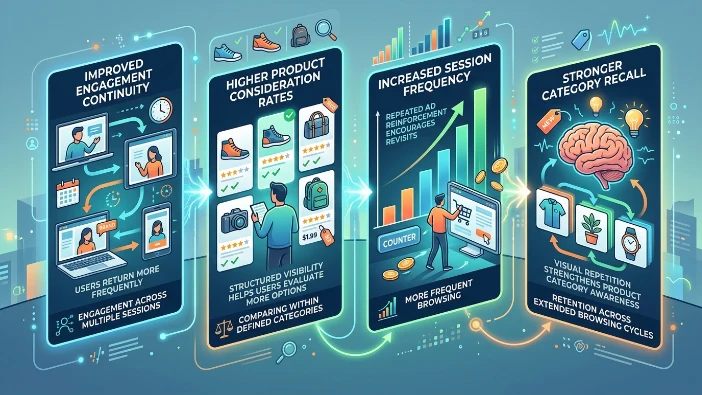
E-commerce brands achieve improved engagement continuity, higher product consideration rates, increased session frequency, and stronger category recall through mid-funnel display ads that systematically reinforce product relevance and guide users through structured evaluation stages before purchase decisions.
Engagement continuity increases across multiple sessions. Users return more frequently after repeated exposure to relevant ads.
Product consideration rates improve through structured visibility. Users evaluate more options within defined categories.
Session frequency increases due to repeated ad reinforcement. Users revisit platforms after encountering related display content.
Category recall strengthens through visual repetition. Users retain product category awareness across extended browsing cycles.
Mid-funnel ads also reduce drop-off rates. Users remain engaged within evaluation pathways instead of exiting early.
These benefits create measurable improvements in consideration-stage performance metrics.
Where are mid-funnel display ads most effectively placed?
Mid-funnel display ads are most effectively placed on category pages, product comparison pages, content recommendation sections, and external partner websites where users demonstrate active evaluation behaviour and sustained engagement with similar product categories across multiple browsing environments.
Category pages provide structured browsing environments. Users actively compare products within defined groupings.
Product comparison pages deliver high engagement value. Users focus on detailed differences between selected items.
Content recommendation sections extend exposure. These placements maintain engagement during non-product browsing sessions.
External partner websites expand reach. Users encounter repeated category exposure outside primary e-commerce platforms.
Placement strategy prioritises visibility during evaluation stages. This ensures consistent exposure during decision development periods.
Effective placement increases mid-funnel engagement depth and improves progression toward purchase consideration stages.