
High-performance banner ads in e-commerce platforms are visual advertising units designed to display dynamic product or message content across digital storefronts and partner websites. They use structured data signals, real-time updates, and optimisation systems to increase visibility and engagement levels.
High-performance banner ads function as structured visual communication layers inside e-commerce ecosystems. They appear across category pages, homepages, and external display networks. Their primary role is controlled content distribution based on user activity and contextual relevance.
These banner ads are not static images. They operate through data-driven content rendering systems. Each banner adapts based on available product feeds, pricing updates, and inventory status. This ensures displayed content remains accurate in real time.
The system behind these ads connects multiple data inputs. Product databases, behavioural logs, and session tracking information combine to generate relevant visual outputs. This creates a continuous cycle of content refreshment aligned with user browsing conditions.
High-performance banner ads also maintain consistency across devices. Desktop, mobile, and tablet environments display adapted layouts while preserving message clarity and visual hierarchy. This ensures uniform communication across digital touchpoints within e-commerce platforms.
How do e-commerce platforms use banner ads to increase revenue?
E-commerce platforms use banner ads to increase revenue by displaying targeted visual promotions that attract user attention, guide browsing behaviour, highlight product availability, and encourage higher interaction rates across multiple digital touchpoints within the shopping journey and website navigation paths.
Banner ads increase revenue by influencing how users interact with digital storefronts. Platforms position banners in high-visibility zones such as homepage headers, category transitions, and checkout-related pages. This placement increases exposure to relevant product categories.
Revenue generation occurs through increased click-through activity. When users interact with banners, they are directed to product pages with structured purchase pathways. These pathways reduce friction in navigation and support faster product discovery.
Banner ads also function as visibility amplifiers for inventory. Products that require higher exposure receive prioritised placement within banner rotations. This ensures balanced distribution of attention across available stock.
E-commerce systems integrate behavioural triggers into banner display logic. Users who browse specific categories receive banners aligned with previous interactions. This increases the probability of product engagement and repeat visits.
The revenue impact is measured through interaction density, session duration, and conversion progression. Each banner impression contributes to guiding users deeper into the purchase funnel.
Explore:
How E-commerce Brands Turn Wishlist Users Into Buyers Using Personalized Display Ads
What technologies power high-performance banner advertising systems?
High-performance banner advertising systems rely on technologies such as real-time bidding platforms, machine learning models, data management systems, tracking pixels, and API integrations that process user signals, optimise ad placement, and deliver personalised visual content at scale across digital environments.
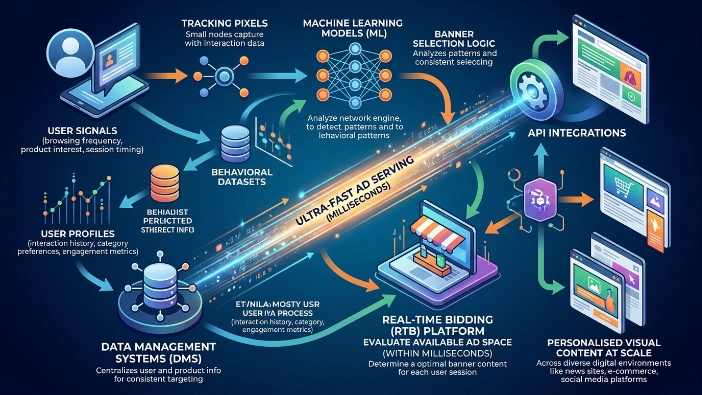
These systems operate through interconnected advertising infrastructures. Real-time bidding mechanisms evaluate available ad space within milliseconds. This process determines which banner content appears for each user session.
Machine learning models analyse behavioural datasets. These models detect patterns in browsing frequency, product interest, and session timing. The output of these models informs banner selection logic.
Data management systems centralise user and product information. These systems store structured profiles that include interaction history, category preferences, and engagement metrics. This enables consistent targeting decisions.
Tracking pixels collect interaction data from user sessions. These signals include page views, scroll depth, and click activity. The data is transmitted back to optimisation engines for analysis.
API integrations connect e-commerce platforms with external advertising networks. These connections ensure that banner content remains synchronised across multiple distribution channels.
Together, these technologies form a unified advertising pipeline that processes input signals, selects content variations, and delivers optimised banner placements.
How is audience targeting applied in banner ad delivery?
Audience targeting in banner ad delivery applies segmentation models based on demographic data, browsing behaviour, purchase intent signals, and contextual relevance. These inputs determine which users see specific banner content, ensuring alignment between displayed message and individual user interest patterns.
Audience targeting begins with segmentation structures. Users are grouped based on shared characteristics such as location, age range, device type, and browsing frequency. These segments define initial exposure rules for banner distribution.
Behavioural targeting refines this process further. Platforms track interaction sequences across product categories. Repeated engagement with specific items increases the likelihood of similar banner exposure.
Purchase intent signals are derived from actions such as repeated product views, wishlist activity, and cart additions. These signals indicate readiness levels within the buying journey.
Contextual targeting evaluates the current page environment. Banner content adjusts based on category relevance and session context. This ensures that displayed content matches the user’s immediate browsing focus.
The final output is a structured targeting system that aligns visual advertising with real-time user behaviour patterns.
Explore More Expert Insights:
How E-commerce Companies Increase Seasonal Sales Using Banner Ads
How E-commerce Businesses Improve ROAS Using Display Banner Campaigns
What role does data analytics play in banner ad optimisation?
Data analytics in banner ad optimisation measures performance metrics such as click-through rates, impressions, conversion events, and engagement duration. It identifies patterns in user interaction, enabling continuous adjustment of creative design, placement strategy, and targeting parameters for improved efficiency levels.
Data analytics provides measurement frameworks for banner ad performance. Each impression is recorded and evaluated against interaction outcomes. This creates a structured feedback loop for optimisation.
Click-through rates indicate how often users engage with banner content. High values suggest strong visual relevance or effective placement strategies. Low values indicate misalignment between content and audience segments.
Impression data tracks exposure frequency. This metric ensures banners reach sufficient audience volume without causing overexposure saturation.
Conversion tracking links banner interaction to downstream actions such as product views or purchase completion. This allows performance evaluation beyond surface-level engagement.
Engagement duration metrics measure how long users interact with pages after clicking banner content. This helps evaluate content relevance and landing page effectiveness.
Read:
How E-commerce Brands Drive Mid-Funnel Engagement Using Display Ads
Why do banner ads influence online purchase behaviour?
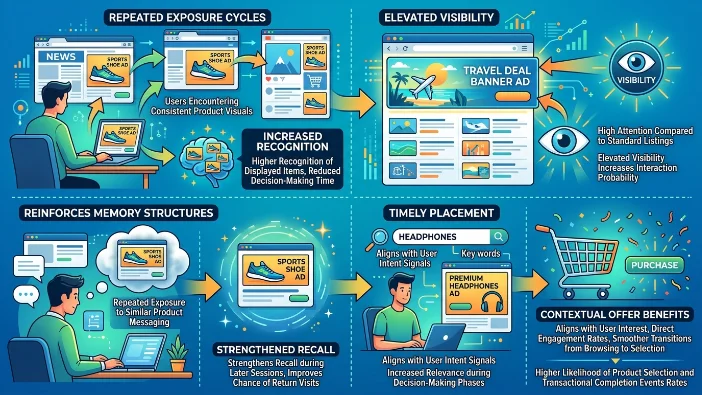
Banner ads influence online purchase behaviour by increasing product visibility, reinforcing brand recall, and presenting contextual offers during browsing sessions. Repeated exposure strengthens familiarity, while timely placement during decision phases increases likelihood of product selection and transactional completion events rates.
Banner ads affect purchase behaviour through repeated exposure cycles. Users encountering consistent product visuals develop higher recognition of displayed items. This recognition reduces decision-making time during browsing.
Visibility plays a central role in behavioural influence. Products displayed in banner positions receive higher attention compared to standard listings. This elevated visibility increases interaction probability.
Banner ads also reinforce memory structures. Repeated exposure to similar product messaging strengthens recall during later browsing sessions. This improves the chance of return visits.
Timing influences effectiveness. Banner ads displayed during active browsing sessions align with user intent signals. This increases relevance during decision-making phases.
Contextual placement ensures alignment between user interest and displayed products. This alignment directly increases engagement rates and supports smoother transitions from browsing to selection.