

Cart abandonment occurs when a shopper adds products to an online shopping cart but leaves the website before completing checkout. It is a measurable drop-off point in ecommerce funnels where purchase intent exists but final transaction does not happen due to friction or interruption.
Cart abandonment represents a critical behavioral signal in online retail systems. It occurs after a user engages with product pages, selects items, and proceeds to cart creation. However, the checkout stage remains incomplete.
In most digital retail systems, abandonment is tracked when a session ends without order confirmation. This metric is used across ecommerce analytics platforms to identify loss points in conversion funnels.
Cart abandonment is not random. It reflects user hesitation, external distraction, or technical friction during checkout flow completion.
Why do customers abandon shopping carts?
Customers abandon shopping carts due to unexpected costs, complex checkout processes, limited payment options, slow website performance, and distraction during browsing. These friction points interrupt purchase intent and reduce conversion completion rates in structured ecommerce environments.
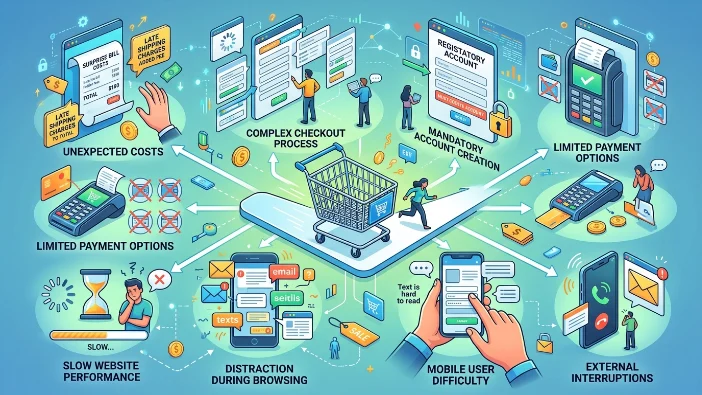
Cart abandonment occurs when friction exceeds purchase motivation. A common factor is price inconsistency between product pages and checkout pages. Shipping fees introduced late in the process increase drop-off probability.
Complex checkout forms also reduce completion rates. Systems requiring account creation or multiple input steps generate higher abandonment compared to guest checkout flows.
Mobile users exhibit higher abandonment rates due to smaller screens and input difficulty. Payment method limitations further reduce checkout completion.
External interruptions such as notifications or switching devices also contribute to abandonment behavior in digital retail environments.
How does banner advertising help recover abandoned carts?
Banner advertising helps recover abandoned carts by re-engaging users after they leave an ecommerce site. It uses display placements across websites to show previously viewed products and reminders, reinforcing purchase intent through repeated visual exposure and behavioral targeting signals.
Banner advertising operates through display networks that track user interactions with product pages. When a user leaves without purchasing, tracking pixels record session data for later ad delivery.
These banners appear on external websites visited by the same user. They display product images or cart reminders based on previous browsing behavior.
This method works by reinforcing memory recognition. Repeated exposure increases likelihood of return visits to checkout pages.
Display banners maintain product visibility beyond the original website session. This extends the conversion window and captures delayed purchase decisions.
Read & Explore:
How E-commerce Businesses Warm Up Leads Through Dynamic Display Ads
What data is used for abandoned cart banner targeting?
Abandoned cart banner targeting uses behavioral data including product views, cart contents, session duration, click paths, device type, and time of exit. This structured data enables identification of high-intent users for retargeted display advertising campaigns across external digital environments.
Behavioral tracking systems collect interaction data during user sessions. Each product view is logged with timestamps and session identifiers.
Cart data includes item type, quantity, and price range. This information defines the content of subsequent banner ads.
Device segmentation separates mobile, desktop, and tablet users. This allows optimized banner formatting for each screen type.
Time-based signals identify how long a user remained before abandonment. Short sessions indicate browsing behavior, while longer sessions indicate purchase intent.
Exit points are also recorded to understand where users disengage in the funnel.
How do dynamic banners personalize abandoned cart recovery?
Dynamic banners personalize abandoned cart recovery by automatically updating ad content based on user-specific browsing history. They display exact products viewed or added to cart, along with real-time pricing and availability data, increasing relevance and recall accuracy in display advertising systems.
Dynamic banner systems connect product databases with user session identifiers. When a user leaves a site, product metadata is stored for ad rendering.
Each banner is generated in real time using structured product feeds. These feeds include images, titles, and pricing information.
Personalization increases relevance by matching ad content to individual behavior patterns. This reduces irrelevant impressions and improves re-engagement probability.
In some systems, dynamic banners also reflect stock availability. This creates urgency-based visual cues for users who previously interacted with limited inventory products.
What are the key stages in cart recovery through display ads?
Cart recovery through display ads follows four stages: data capture, audience segmentation, ad creation, and retargeting delivery. Each stage processes user behavior data into structured advertising outputs that re-engage users across external digital platforms and networks.
The first stage is data capture. User actions such as product views and cart additions are recorded in analytics systems.
The second stage is audience segmentation. Users are grouped based on behavior intensity, such as high-intent cart abandoners or low-intent browsers.
The third stage is ad creation. Product-based banners are generated using stored catalog data and user interaction history.
The final stage is retargeting delivery. Ads are distributed across display networks to reconnect users with abandoned carts.
Each stage operates in sequence to convert behavioral data into actionable advertising impressions.
Explore More Expert Insights:
How E-commerce Stores Boost Sales Using Retargeting Banner Ads
How Banner Ads Increase E-commerce Sales and Conversions Fast
What metrics measure abandoned cart banner performance?
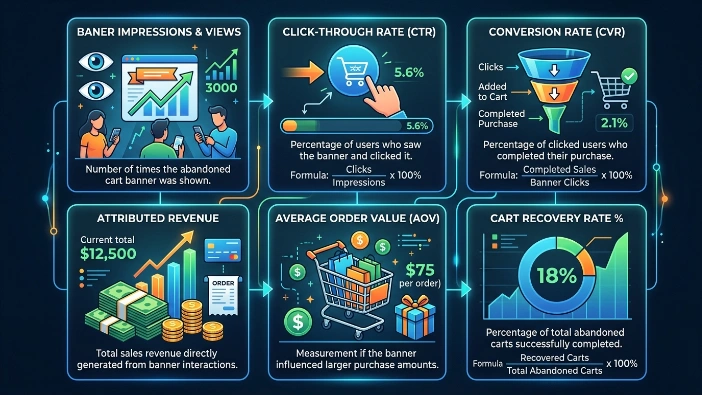
Abandoned cart banner performance is measured using click-through rate, return-to-site rate, conversion rate, impression frequency, and cost per recovered purchase. These metrics evaluate engagement strength, re-engagement efficiency, and final transaction recovery effectiveness in display advertising systems.
Click-through rate measures how often users interact with banner ads after viewing them. Higher rates indicate stronger relevance.
Return-to-site rate tracks how many users revisit the ecommerce platform after seeing ads.
Conversion rate measures completed purchases after re-engagement.
Impression frequency tracks how often ads are shown to the same user.
Cost per recovered purchase evaluates the efficiency of ad spend in relation to recovered transactions.
These metrics collectively define recovery performance in structured advertising systems.
How E-commerce Businesses Drive Instant Purchase Decisions Using High-Intent Display Retargeting
How does retargeting frequency affect cart recovery rates?
Retargeting frequency directly influences cart recovery rates by controlling how often users see banner ads after abandonment. Moderate frequency increases recall effectiveness, while excessive frequency causes ad fatigue, reducing engagement and lowering conversion probability in display advertising environments.
Frequency management determines exposure balance. Low frequency reduces visibility and weakens memory reinforcement.
High frequency increases repetition but can lead to user irritation and reduced click behavior.
Optimal frequency maintains repeated exposure across different websites without overwhelming the user.
Time decay models are also used in frequency planning. These models reduce ad exposure intensity as time passes after abandonment.
Controlled frequency ensures sustained visibility during the critical recovery window, improving the probability of return visits and completed purchases.



