Banner advertising is a graphical online ad format displayed on web pages to raise awareness and drive clicks to loan application pages. Banner ads include static images, animated GIFs, HTML5 creatives, and rich media placed on websites, apps, and ad networks to reach target audiences.
Banner advertising functions as a top-of-funnel awareness tool. It delivers visual messages about loan products to broad or segmented audiences. In digital ad systems, advertisers bid for impressions or clicks through programmatic exchanges, direct buys, or private deals. Common placements include news sites, finance portals, publisher networks, and mobile apps.
How do banks use banner advertising to target potential borrowers?
Banks use demographic, behavioural, contextual, and location targeting to place banners in front of likely loan applicants. Targeting narrows audiences to people whose online behaviour, interests, or location align with loan needs. Demographic targeting selects age, income bands, and employment status. Behavioural targeting uses past browsing related to mortgages, personal loans, or small-business finance. Contextual targeting places banners on pages discussing loans, housing, or business finance. Location targeting focuses on UK regions, cities, or postcodes for branch-based lending.
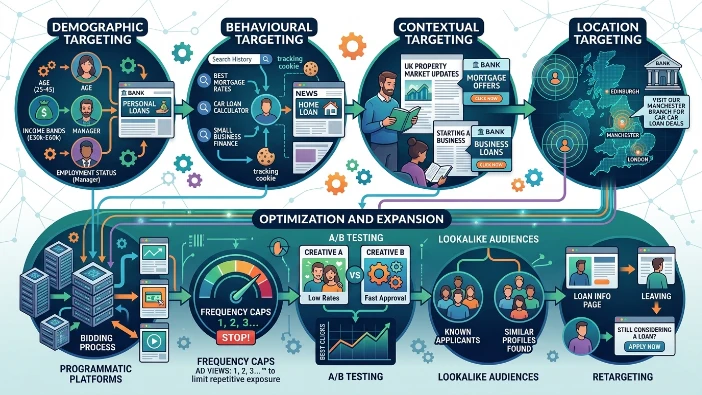
Programmatic platforms match creatives to users in real time. Banks set frequency caps to limit repeated exposure and A/B test creatives to determine which messages generate the most clicks. Lookalike audiences expand reach by finding users with profiles similar to known applicants. Retargeting shows banners to users who previously visited loan information pages to re-engage and move them toward application.
What creative elements improve banner ad performance for loans?
High-performing bank banners use clear loan terms, strong visual hierarchy, concise calls-to-action, and compliant disclosures. Design must present loan type, headline, and a clear action. Use numeric cues such as interest rates, term lengths, or representative APR where regulations require. Visual hierarchy directs attention to the headline and then to supporting facts. Colour contrast improves legibility. Use readable fonts and a single, straightforward CTA phrase such as “Learn more” or “Check eligibility.” Include required regulatory text in legible size.
Testing creative variants isolates which headlines, images, or value propositions increase click-through rates. Test variants can include different offers (fixed-rate mortgage vs. unsecured loan), benefit-focused headlines (lower monthly payments) and informational headlines (how loan works). Track asset-level performance to iterate creatives that drive the most qualified traffic.
How do banks measure success of banner campaigns?
Banks measure banner campaigns with metrics that progress from impressions to applications: impressions, clicks, click-through rate, site engagement, lead form starts, and completed applications. Impressions quantify reach. Clicks and click-through rate indicate initial engagement. On-site metrics include pages per visit, time on page, and bounce rate to assess content relevance. Conversion metrics track form starts, partial form saves, form completions, and final loan applications. Attribution models assign credit across exposure touchpoints; multi-touch models distribute credit across several interactions.
Banks use conversion rate (completed applications divided by clicks) and cost per acquisition (total ad spend divided by applications) to evaluate ROI. Return on ad spend (ROAS) and lifetime value of new borrowers inform longer-term profitability. Cohort analysis compares borrowers acquired via banners to those from other channels on metrics such as approval rate and credit performance.
What campaign structures and bidding strategies drive more loan applications?
Campaign structures use audience segmentation, tailored creatives, sequential messaging, and bidding for conversions to increase qualified applications. Start with broad awareness buys to build reach, then move audiences into retargeting pools based on site behaviour. Create audience segments for mortgage intent, personal loan interest, and SME finance. Develop tailored creative sets for each segment. Use sequential messaging that progresses from educational banners to eligibility-check banners to application reminders.
Bidding strategies shift from CPM (cost per thousand impressions) for awareness to CPC (cost per click) or CPA (cost per acquisition) for conversion-focused campaigns. Use automated bidding that optimises for completed applications when enough conversion data exists. Implement conversion tracking and server-to-server event reporting to feed accurate signals into bidding engines.
How do compliance and regulation affect bank banner ads in the UK?
UK regulations require clear disclosure of representative APR, fair and non-misleading claims, and appropriate risk information in loan banners. Advertising rules under the Financial Conduct Authority and Advertising Standards Authority require lenders to present transparent pricing information. Representative APR should appear where an interest rate is quoted. Claims about loan approvals must not guarantee outcomes. Banners promoting regulated loan products must avoid omission of key terms that materially affect consumer decisions.
Advertisers must store records of creatives and targeting to demonstrate compliance in audits. Use legible fonts and contrast to ensure mandatory information is readable on both desktop and mobile creatives. Regularly review ad copy and creatives against updated guidance and regulatory changes.
How do banks optimise landing pages linked from banners?
Banks optimise landing pages for clarity, mobile speed, minimal friction, and clear next steps to convert banner clicks into applications. Landing pages match the banner’s message and set clear expectations. Include concise explanations of loan features, eligibility criteria, representative pricing, and a simple conversion path. Use progressive disclosure to request only essential information on the first step and move complex questions to later stages. Implement one-click actions for eligibility checks or calculators. Ensure pages load under 3 seconds on mobile and desktop to reduce drop-off.
Use form analytics to identify fields with high abandonment and remove or simplify them. Provide persistent access to help channels such as live chat or phone numbers. Use secure markers and privacy statements to build trust and reduce perceived risk.
What role does creative sequencing and messaging cadence play?
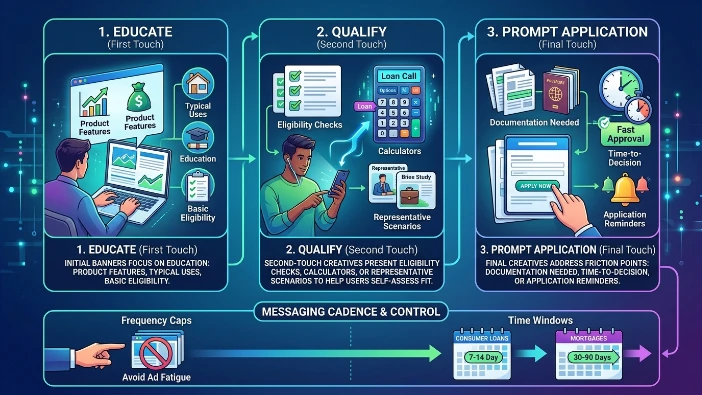
Sequenced messages that educate, then qualify, then prompt application increase the likelihood that clicks turn into completed applications. Initial banners focus on education: product features, typical uses, and basic eligibility. Second-touch creatives present eligibility checks, calculators, or representative scenarios to help users self-assess fit. Final creatives address friction points: documentation needed, time-to-decision, or application reminders. Frequency caps control exposure and avoid ad fatigue. Time windows define cadence: a short 7–14 day sequence for consumer loans, a longer 30–90 day sequence for mortgages.
What data and analytics practices support banner-driven application growth?
Robust tracking, first-party data collection, and privacy-compliant audience building enable accurate measurement and optimisation. Implement server-side conversion tracking and tag management to capture clicks and downstream events. Build first-party audiences from site behaviour, form interactions, and logged-in user activity. Use hashed customer lists for deterministic matching in authorized channels. Apply cohort and lift studies to isolate the incremental impact of banner exposure on applications.
Maintain data governance and compliance with UK data protection laws and GDPR. Document processing activities and legal bases for audience targeting. Use aggregated, anonymised reporting where possible to reduce privacy risk.
Explore More Expert Insights:
How Financial Services Build Trust Using Educational Banner Advertising
How Agencies Increase Buyer Engagement Using Display Remarketing Ads
What are typical benefits and measurable outcomes of banner campaigns for banks?
Banner campaigns increase loan product awareness, site traffic, lead volume, and can lower cost per application when optimised. Benefits include higher brand recall and increased referral traffic. Measurable outcomes include increases in impressions, clicks, form starts, and completed applications. Campaigns can shorten the time from awareness to application by guiding users through educational touchpoints. Proper segmentation yields higher-quality leads and improved approval rates for applicants sourced through targeted banners.
Example outcomes from benchmark studies show click-through rates for finance banners range between 0.05% and 0.25% and conversion rates from click to application between 1% and 5%, depending on offer and audience targeting. Cost per application varies by product: unsecured personal loan acquisition costs often exceed secured mortgage acquisition costs, given differing funnel length and underwriting complexity.
What use cases show banner advertising driving loan applications?
Use cases include consumer mortgage awareness, short-term personal loan promotion, and small-business loan lead generation. For mortgages, banners educate first-time buyers about deposit requirements and representative rates, then retarget visitors with affordability calculators. For personal loans, banners highlight typical loan amounts and term examples, then present eligibility checks. For SME loans, banners target business owners on finance sites and retarget users who download business loan guides.
How Banks Nurture Loan Leads Using Informational Display Ads can guide how banks nurture these leads further through informational display ads and follow-up.
Banner advertising serves as a structured top-of-funnel channel for banks to raise awareness and drive qualified traffic toward loan applications. Effective campaigns combine precise targeting, compliant creatives, measurable landing pages, and data-driven optimisation. Clear metrics and sequential messaging transform impressions into measurable application outcomes while maintaining regulatory compliance and consumer transparency.
For more detail explore: Banking Display Ads That Turn Loan Interest Into Approved Applications