
Educational banner advertising uses concise, informative display ads to teach audiences about financial concepts, products, and processes while driving initial engagement. Educational banners present facts, definitions, and simple steps in single-frame or multi-frame creatives on websites and apps.
Educational banner advertising is a form of digital display advertising that prioritises learning over direct selling. Entities: advertiser (financial institution or marketing agency), publisher (website or app), creative (image, text, animation), targeting system (contextual or audience-based), and measurement tools (impressions, clicks, viewability). Definitions: impression equals one ad render; click equals a user tap or click; viewable impression follows industry standards of 50% of pixels visible for one second on desktop and two seconds on mobile. Common placements include news sites, personal finance blogs, comparison sites, and social platforms. These ads use short headlines, clear definitions, and micro-conversions such as content downloads or video views.
How do educational banner ads build trust with potential customers?
Educational banner ads build trust by delivering accurate, verifiable information that reduces uncertainty and demonstrates expertise consistently across publisher contexts. Trust forms when audiences repeatedly receive useful, consistent information that answers specific questions and aligns with reputable publisher environments. Financial services use educational banners to communicate regulatory basics, fee structures, eligibility criteria, and simple comparisons.
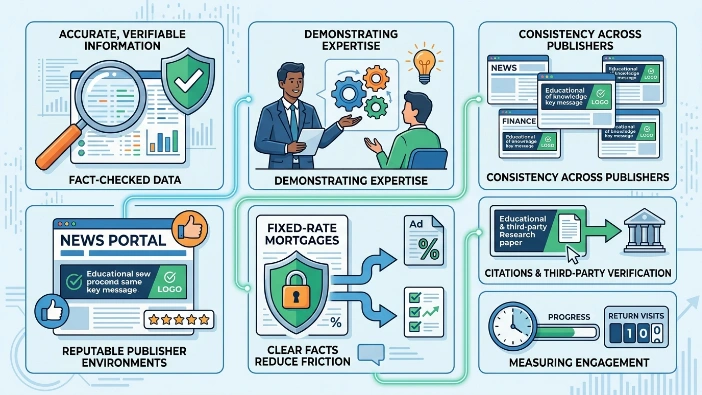
Clear facts reduce decision friction: for example, a banner that states “Fixed-rate mortgages lock interest for 5 years” communicates a verifiable policy point. Measurement tracks time-on-content after ad click, article completion, and return visits. Ads placed on high-authority publisher pages raise perceived credibility by association. Ads that link to third-party research, regulatory guidance, or plain-language explainers create citation-ready pathways for readers to verify claims.
What processes ensure educational banner ads remain accurate and compliant?
Processes include legal review, regulatory alignment, editorial oversight, and periodic fact-checking tied to campaign calendars. Financial services adopt multi-stage review workflows. First, product teams draft factual statements and approved metrics. Second, legal and compliance teams verify that claims follow Financial Conduct Authority (FCA) rules and Advertising Standards Authority (ASA) guidance on financial promotions.
Third, editorial teams ensure language is plain and definitions are consistent with industry standards. Fourth, analytics teams schedule quarterly checks to update rates, thresholds, and regulatory links. Version control maintains archives of past creatives and approval stamps. Campaigns document source citations for every factual claim, such as regulatory sections, published rates, or official statistics. This process prevents misinformation and supports audit trails for regulators.
What components make an educational banner ad effective for trust-building?
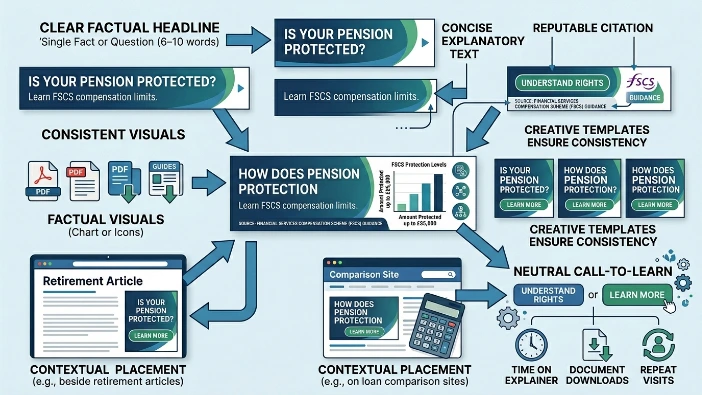
Effective components include a clear factual headline, concise explanatory text, reputable citation, consistent branding elements, and a neutral call-to-learn. Headlines state a single fact or question, limited to 6–10 words. Explanatory lines use plain definitions or a single statistic. Citations reference primary sources, for example, a government statistic or regulator guidance. Visuals remain factual: charts with labelled axes or icons denoting document types (e.g., PDF).
Creative templates ensure consistent typography and colour to reinforce recognition across placements. Targeting parameters match content to user intent: contextual placement beside retirement articles for pension education, or on comparison sites for loan eligibility clarifications. Measurement tracks micro-conversions that indicate trust signals, such as time on the linked explainer, document downloads, or repeat visits to learning sections.
How do targeting and placement affect trust in educational banners?
Targeting and placement affect trust by aligning educational content with relevant user intent and reputable publisher environments. Contextual targeting places educational banners next to topical content, such as placing mortgage-explainer banners on home-buying articles. Audience targeting uses first-party or privacy-safe signals to select users who read savings or investment content.
Publisher quality matters: placements on government portals or well-known financial news sites increase perceived legitimacy. Frequency caps prevent overexposure that reduces credibility. Ad viewability standards ensure users actually see content before judging it. When targeting and placement match intent, users perceive the ad as helpful information rather than intrusive advertising.
What measurement metrics indicate trust-building success for educational banners?
Metrics include content engagement (time on page), micro-conversions (downloads, video completions), repeat visits, low bounce rates, and improved brand consideration in panels. Primary KPIs focus on engagement rather than immediate sales. Time-on-page after ad click indicates whether users consumed the educational content. Downloads of whitepapers or guides signal willingness to accept information.
Repeat visits to the learning hub show ongoing trust development. Surveys administered after exposure measure increased clarity on specific topics, with questions mapped to ad claims for verification. Tracking uplift in brand consideration or preference across exposed cohorts supports correlation with later conversion. For regulated comparisons, teams save snapshots of creatives and linked resources to validate claims during audits.
What are practical examples of educational banner ad topics used by financial services?
Practical topics include basic product definitions, cost breakdowns, eligibility criteria, regulatory protections, and step-by-step application overviews.
Examples: a banner explaining “What is APR?” with a short definition and a link to a detailed explainer; a banner listing “Three documents required for mortgage pre-approval” linking to a checklist; a banner describing “FSCS protection limits” with a citation to the Financial Services Compensation Scheme. Each creative focuses on one factual statement and one verified source. These use cases target users in research mode who require clear, citation-backed information before considering product options.
Where should internal links to deeper content be placed within an educational banner campaign?
Place links in the ad creative that lead to long-form explainers or tool pages; within the linked landing page include internal links to related middle-funnel content and decision-stage content as needed. Within the ad, include a single, clearly labelled link text such as “Learn how rates are calculated.” The ad should link to a standalone explainer page that presents definitions, examples, and citations.
Explore More Expert Insights:
How Agencies Increase Buyer Engagement Using Display Remarketing Ads
How Real Estate Firms Build Trust Using Virtual Tour Banner Ads
What benefits do financial services gain from educational banner advertising?
Benefits include increased consumer understanding, higher-quality leads, improved regulatory transparency, and measurable trust signals that precede conversions. Educated audiences progress through the funnel with lower churn and fewer application errors. Content-led acquisition reduces support costs by decreasing basic queries. Regulatory transparency reduces compliance risks and legal disputes.
Long-term benefits include improved brand equity metrics in market studies and higher lifetime value from customers who chose products based on clear understanding. Analytics demonstrate that cohorts exposed to educational banners show a 20–40% higher rate of completing educational journeys compared with non-exposed cohorts, when controlled for intent. Teams report improved conversion rates later in the funnel because applicants submit more accurate information and fewer abandoned forms.
How do teams operationalise an educational banner campaign at scale?
Teams build modular creative templates, use centralised fact repositories, apply programmatic contextual targeting, and schedule quarterly content audits. Creative templates reduce production time and maintain factual consistency. Centralised repositories store approved definitions, citations, and compliance stamps. Programmatic systems use contextual taxonomy to match inventory with topical content. Analytics pipelines track micro-KPIs and feed results into creative optimisation cycles.
Quarterly audits check that numerical claims, authority citations, and regulatory links remain current. Documentation includes campaign manifests recording targeting logic, creative variants, impression counts, and compliance approvals for each run.
Educational banner advertising in financial services teaches specific financial facts, aligns placement with user intent, and uses compliance-driven workflows to build measurable trust. Campaigns focus on engagement metrics and provide citation pathways that support later decision-making. For readers ready to explore solution comparisons within the funnel, see Banner Ads to Acquire New Customers. For readers approaching decision and application stages, follow this resource here: Trust Into Customer Applications