
A financial services banner ad is a digital graphic designed to communicate product features, credibility signals, and clear next steps to potential customers in order to prompt applications. It uses concise messaging, trust indicators, and targeted placement to reduce friction and increase conversions.
A financial services banner ad includes visual and textual elements that represent a lending, savings, investment, insurance, or banking product. Core elements are a headline, benefit statement, trust signals (for example, regulatory icons, security badges, or ratings), an application prompt, and a visual anchor such as a product image or logo. In the United Kingdom, regulatory compliance requires that ads do not mislead, present material facts, or omit key terms such as representative APR for credit products. Trust builds when banners present transparent terms, recognisable regulatory cues, factual endorsements, and clear privacy statements.
Banner ads operate across programmatic networks, publisher sites, social platforms, and email placements. Each placement demands size- and format-specific design. Common sizes include 300×250, 728×90, 320×50, and 300×600 pixels. Use formats that support fast-loading images and limited animation to avoid blocking content and to preserve page performance. Faster-loading banners reduce bounce rates and improve visible impression quality, which supports trust perception.
How do financial services use banner ads to move prospects to application?
Advertisers design banners to present a trust cue, a concise benefit, and a direct pathway to an application page so users proceed from awareness to application steps. The path runs from ad impression to landing page to form completion, with measurement at each stage.
The conversion funnel for a banner-driven application includes impressions, clicks, landing-page engagement, form starts, form completions, and application submissions. Marketers measure click-through rate (CTR), landing-page conversion rate (LPCR), cost per click (CPC), cost per application (CPA), and application completion rate (ACR). Financial advertisers optimise creative and targeting to lower CPA and increase ACR.
Ad creative focuses on clarity: a single product message, a numeric benefit (for example, “1.9% representative APR” or “£1,000 instant decision”), and a visible trust cue such as a Financial Conduct Authority (FCA) disclosure or secure payment icon. Landing pages must echo the ad message, surface required terms at the top, shorten forms to essential fields, and use progressive profiling where possible to increase submission rates. Use server-side tracking and consent-compliant analytics to attribute applications accurately while respecting UK data-protection rules.
Which components of a trust-driven banner ad are essential?
Essential components are a clear headline, numeric benefit or term, an explicit trust signal, a concise value statement, and an obvious next step to apply. Each component has a precise role in reducing user uncertainty and increasing completion likelihood.
Headline: State the product class and primary selling point in six words or fewer. Example: “Fixed-Rate Personal Loan, 1.9% APR.”
Numeric benefit: Display a concrete number or timeframe to quantify the offer. Example: “Decisions in 60 seconds,” “£5,000 loans.”
Trust signals: Include regulatory references (FCA icon), security badges (HTTPS lock), and factual metrics (4.6/5 customer rating). Use official seals only when legitimately applicable.
Value statement: One short line describing eligibility or main benefit (for example, “For homeowners with 12+ months mortgage history”).
Call to apply: Use an imperative with a low-commitment verb: “Start application,” “Get decision.” Ensure the click target leads to a landing page that replicates the same offer and terms.
Technical and accessibility elements: Use alt text for images, ensure minimum contrast ratio of 4.5:1 for text, and provide keyboard-focusable interactive elements. Size files under 150 KB for display ads and under 1 MB for rich media to preserve load speed on typical UK mobile connections.
How does targeting and placement increase trust and application rates?
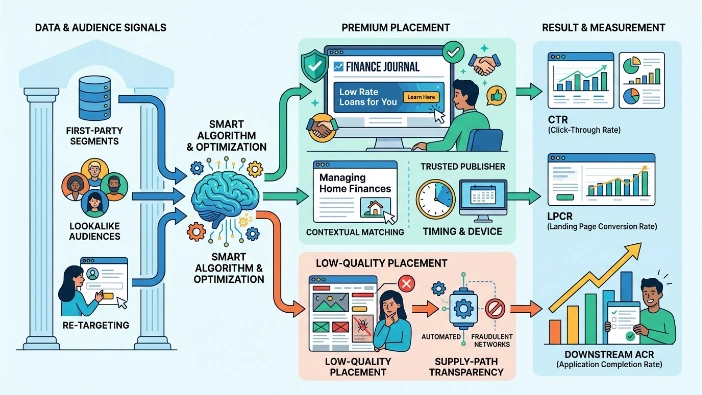
Precision targeting and contextually relevant placement align banner messaging with user intent, which increases perceived relevance and trust, and raises application rates. Use audience signals, contextual matching, and publisher quality to place ads where decision intent exists.
Targeting strategies include first-party segments (site visitors, existing customers), lookalike audiences derived from high-value applicants, contextual keywords on publisher pages, and retargeting for partial form completers. Placement on high-authority publisher sites and finance vertical pages produces higher trust signals than placement on low-quality content networks. Time-of-day and device targeting also affect performance; for personal finance products, desktop sessions during weekday evenings commonly show higher application completion rates.
Measure placement effectiveness by analysing viewable impression rate, active view time, CTR, LPCR, and downstream ACR. Exclude low-viewability placements and high-fraud networks. Use domain whitelists, brand-safety filters, and supply-path transparency to maintain consistent trust signals across impressions.
Which compliance and disclosure requirements must banners meet in the UK?
Banner ads for financial services in the UK must present material facts clearly, include representative APR for credit, avoid misleading claims, and follow FCA and ASA guidance. Display copy must not omit significant conditions that affect consumer decisions.
Specific requirements include showing representative APR when advertising personal credit; stating minimum eligibility or typical rates when required; and avoiding absolute claims such as “best” or “guaranteed” without substantiation. Ads for pensions and investments must include risk statements and reference to whether capital is at risk. Maintain a link to full terms and regulatory disclosures on the landing page and ensure the banner itself does not hide critical terms. Retain documentation of creative approvals and compliance checks for audit trails.
What A/B tests and metrics improve conversion from trust to application?
Run A/B tests for headline copy, trust signal type, numeric offers, and CTA wording while tracking CTR, LPCR, CPA, and application completion rate to identify the highest-performing variants. Use statistical significance thresholds of 95% or higher before rolling out winners.
Test headlines versus numeric offers (for example, “1.9% APR” vs “Low-rate personal loan”), trust cues (FCA icon vs customer rating), and landing-page match variants. Measure time-to-complete and abandonment steps on the form to locate friction points. Use cohort analysis to compare performance across device types and acquisition channels. Control for traffic quality by comparing cohorts with similar referral sources and viewability.
Recommended test cadence: run a minimum of two concurrent tests per creative family, maintain each test for at least 7–14 days or until reaching 2,000 unique impressions per variant, and apply sequential testing to isolate effects. Stop tests early only when clear ethical or regulatory risks appear.
What are practical creative treatments that convert trust into applications?
Design treatments that prioritise clarity: high-contrast headlines, one numeric offer, a visible trust cue, and consistent messaging between ad and landing page to reduce cognitive load and increase applications. Follow file-size limits and accessibility rules for all creatives.
Use static or slight animated GIFs that loop no more than three times to attract attention without distracting users. Align colour and typography with the landing page to reinforce brand and message continuity. Place the trust cue near the CTA to associate credibility with action. Include microcopy on the landing page that reiterates the ad claim and shows required terms within the first screenful. For multi-product banners, present only one product per creative to avoid decision paralysis.
Explore More Expert Insights:
Remarketing Real Estate Ads That Convert Engagement Into Final Buyer Leads
Virtual Tour Ads That Turn Property Views Into Buyer Trust and Action
What measurable benefits result from trust-focused banner campaigns?
Trust-focused banner campaigns increase landing-page engagement, reduce form abandonment, lower cost per application, and raise application approval rates by aligning expectations with offer terms. Metrics show clearer paths from impression to application.
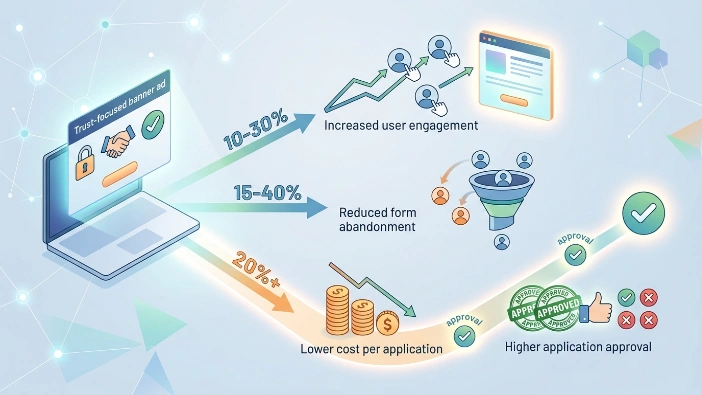
Typical improvements from well-executed trust-focused campaigns include CTR increases of 10–30% over generic creative, landing-page conversion increases of 15–40% when ad and landing content match exactly, and reductions in CPA of 20% or more after targeting and creative optimisation. Approval rates improve when applications come from informed applicants who understand terms, reducing downstream churn and manual underwriting time.
What use cases show the highest ROI for banner-driven applications?
High-ROI use cases include personal loans with clear APRs, mortgage remortgaging offers for customers with visible eligibility, savings account promotions with fixed rates, and credit-card balance-transfer offers with explicit terms. Each use case benefits from transparent numeric terms and regulatory disclosure.
For example, remortgaging campaigns that show monthly-savings estimates and eligibility parameters generate higher-quality applications from homeowners. Savings account banners with fixed-interest rates and clear minimum-deposit terms attract savers who complete online applications. Credit-card offers that display introductory APR durations and balance-transfer fees reduce post-application disputes and losses.
Trust-focused banner ads convert when they present clear numeric terms, visible regulatory or security cues, tightly matched landing pages, and consent-compliant measurement. Apply rigorous A/B testing and placement controls, show required UK disclosures, and optimise form flows to convert trust into completed customer applications.