A banking display ad is a visual online advertisement that promotes loan products using images, text, and interactive elements to drive conversions. It differs from search ads by focusing on visual engagement rather than keyword intent.
A banking display ad appears across websites, apps, and ad networks. It targets users by demographics, behaviour, contextual placement, or retargeting. Typical formats include static banners, animated GIFs, HTML5 rich media, and native placements. Display ads aim to build awareness, generate leads, and capture applications for loan products such as personal loans, mortgages, and business credit.
Display ads use programmatic buying or direct placements. Programmatic uses real-time bidding and data signals to match ad creative to the user profile. Direct placements rely on negotiated inventory on specific websites or publishers. Display campaigns integrate with tracking systems to measure view-through and click-through conversions.
How do display ads convert a user’s loan interest into an application?
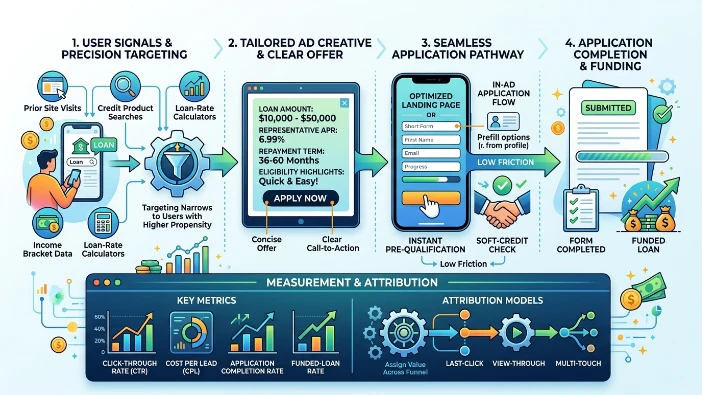
Display ads convert interest into applications by combining precise targeting, tailored creative, clear value propositions, and seamless application pathways that reduce friction.
Conversion begins with matching the ad to a user signal. Signals include prior site visits, credit product searches, income bracket data, and loan-rate calculators visited. Targeting narrows to users with higher propensity to apply. Creative then communicates a concise offer: loan amount range, representative APR, repayment term, and eligibility highlights.
A clear call-to-action leads users to an optimised landing page or in-ad application flow. Landing pages present a short application form, prefill options from known data, and instantaneous pre-qualification with soft-credit checks. Measurement ties click and view events to completed forms and funded loans. Attribution models include last-click, view-through, and multi-touch to assign value across the funnel.
Conversion metrics include click-through rate (CTR), cost per lead (CPL), application completion rate, funded-loan rate, and cost per funded loan. Benchmarks vary by product: personal loans target 0.25–0.75% CTR and 1.5–4% application completion; mortgages show lower CTR and higher funding value per application.
What targeting strategies drive higher-quality loan applications?
High-quality targeting combines first-party data, third-party intent signals, contextual placement, and retargeting to reach users with clear loan intent.
First-party data includes past applicants, existing customers, and CRM segments such as salary band or account tenure. Third-party intent uses behavioural indicators: visits to interest-rate comparison pages, mortgage calculators, or credit score tools. Contextual placement targets content about home buying, small-business finance, or car purchasing. Retargeting addresses users who visited product pages but left before applying.
Lookalike modelling expands reach by finding users who match high-value applicant profiles. Frequency capping limits ad fatigue; set caps between 3–7 impressions per week per user. Dayparting places higher bids during peak conversion hours identified via analytics. Bid strategies align with business goals: maximize conversions for volume, target CPA for efficiency, or maximize conversion value for funding prioritisation.
Targeting must comply with UK data protection law (UK GDPR) and financial conduct rules. Use lawful bases for processing, document consent where required, and provide transparent data-use notices. Avoid using sensitive personal data for targeting without explicit legal basis.
What creative elements increase application rates in banking display ads?
Creative that increases application rates uses a clear headline, concise offer terms, visual trust signals, and a simple action path that matches the landing experience.
Headlines should state loan type and key benefit, for example: “£5,000–£25,000 Personal Loans, 6.9% APR Representative.” Include a short supporting line with eligibility or speed: “Decisions in 15 minutes, instant funds.” Use brand-safe imagery and avoid clutter. Visual trust signals include FCA registration number, security icons, and testimonials when permitted.
Ad formats that increase interaction include expandable HTML5 units with in-ad calculators, and instant forms (lead-gen) that capture basic applicant data without leaving the page. Ensure creative and landing page use the same language and terms to reduce friction and improve quality. Test multiple creatives with A/B experiments; measure effect on application completion and funded-loan rate, not just CTR.
Design creatives with 72 DPI minimum for clarity, ensure legible fonts at mobile sizes, and include alt text for image-based units. Optimize file size under 150 KB for mobile delivery to reduce load time. Faster creatives yield lower bounce rates and higher completion rates.
For more information explore:
How Banks Increase Loan Applications Using Banner Advertising
What landing page and application-path features increase approvals?
Landing pages that increase approvals use concise forms, pre-qualification checks, progressive profiling, and clear documentation requirements to speed accurate submissions.
Start with a benefit summary and representative rates. Present eligibility checklist and required documents (ID, payslips, bank statements). Use progressive profiling: gather essential data first (name, income, loan amount), then request supporting documents after conditional approval. Prefill known fields using secure single-sign-on or previously captured CRM data.
Implement soft-credit pre-checks to show personalised rate ranges without hard inquiries. Use real-time validation for fields to prevent errors. Provide an estimated decision time and next steps. For instant decisions, integrate automated underwriting that evaluates income, affordability, and credit score using deterministic rules and machine-learning models audited for compliance.
Use TLS 1.2+ for all data transmission. Encrypt stored PII, log access, and apply role-based controls. Display privacy notice and consent checkboxes where required. Use third-party identity verification services to reduce fraud and downstream declines.
What measurement and optimisation processes drive funded applications?
Optimisation relies on end-to-end tracking from impression to funded loan, iterative testing of creative and audience segments, and ROI-focused bid strategies tied to funded-loan value.
Establish tracking of view-through conversions, click conversions, application starts, application completions, and funds disbursed. Use unique tracking tokens and server-to-server conversion postbacks to reduce attribution loss from ad blockers. Evaluate cohorts by channel, creative, and audience segment to identify high-yield sources.
Run conversion-rate optimisation tests: simplify forms, change CTAs, and vary offer terms. Use multi-armed bandit or controlled A/B tests with a minimum sample of 2,000 impressions per variant to achieve statistical relevance. Shift budgets toward segments with lower cost per funded loan. Monitor fraud rates, first-payment defaults, and regulatory complaints as quality controls.
Report weekly on leading indicators (CTR, CPL, application rate) and monthly on lagging KPIs (funded-loan rate, default rate, ROI). Include lifetime value (LTV) modelling for funded cohorts to guide acquisition spend.
What are the main benefits of using display ads for loan acquisition?
Display ads expand reach, speed lead generation, lower acquisition cost per funded loan, and enable precise audience segmentation for higher-quality applicants.
Display campaigns reach users across the open web and app ecosystems. They accelerate pipeline generation by engaging users before direct search intent. Programmatic buying reduces manual placement time and enables real-time optimisation. Visual formats allow clearer presentation of representative rates and eligibility criteria, improving qualified traffic.
Display enables staged engagement: awareness units, retargeting units, and in-ad lead forms that shorten the path to application. This staged approach reduces drop-off; campaigns with progressive funnels see 20–40% higher application completion versus a single-channel approach in controlled studies.
Explore More Expert Insights:
Financial Services Banner Ads That Convert Trust Into Customer Applications
Remarketing Real Estate Ads That Convert Engagement Into Final Buyer Leads
How do banks ensure compliance and reduce risk in display campaigns?
Ensure compliance by embedding regulated messaging, using transparent targeting disclosures, and auditing data sources and creative for FCA and UK GDPR requirements.
Include required disclaimers such as representative APR and eligibility statements. Maintain creative approval workflows with legal and compliance teams. Use anonymised or consented datasets for behavioural targeting. Retain audit trails for data providers and maintain vendor contracts that ensure lawful processing.
Implement fraud prevention tools that detect bot traffic and anomalous conversions. Monitor complaints and opt-outs closely and maintain rapid response processes to amend or remove non-compliant creatives.
Conduct pre-launch compliance checks, weekly creative audits, and quarterly vendor privacy reviews. Keep a register of processing activities for display campaigns and update privacy notices to reflect advertising practices.
What next-step actions convert interest into decisions?
Define target segments, prepare compliant creative with clear representative rates, implement a friction-minimised landing application flow, and measure to funded-loan outcomes using end-to-end tracking.
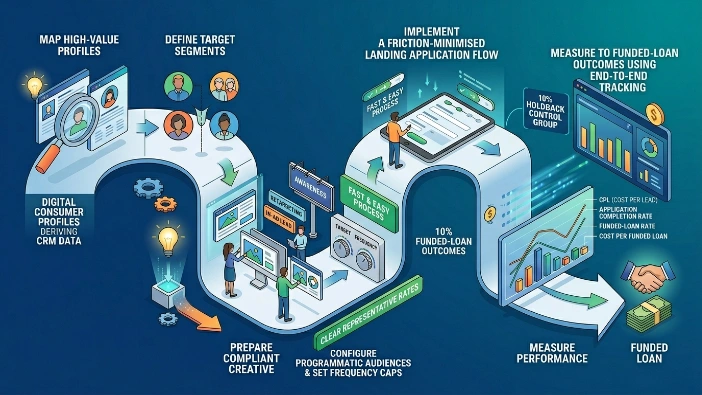
Begin by mapping high-value applicant profiles from CRM data. Create three creative variants per segment: awareness, retargeting, and in-ad lead. Configure programmatic audiences and set frequency caps. Launch with a holdback control group equal to 10% of traffic for causal measurement. Measure performance against CPL, application completion rate, funded-loan rate, and cost per funded loan.
For internal reference and deeper exploration of mid-funnel tactics, see the following: