
Agencies increase buyer engagement with display remarketing by re-showing targeted visual ads to users who previously interacted with a website, using segmented audiences, tailored creative, controlled frequency, and performance measurement to drive repeat visits and conversions.
What is display remarketing advertising and how does it work?
Display remarketing advertising shows visual ads to people who visited specific website pages or took actions, using tracking pixels and audience lists to target them on ad networks.
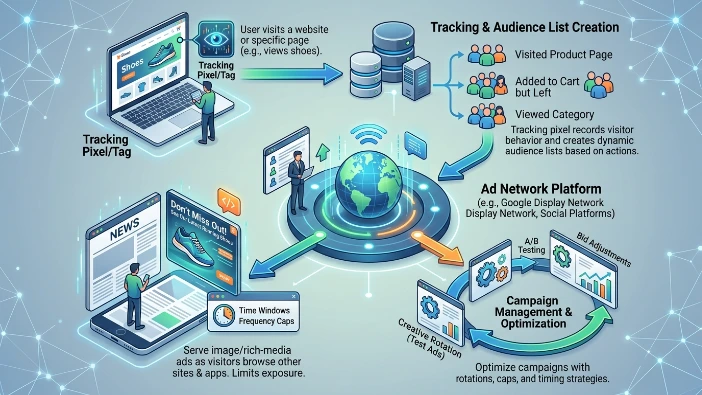
Display remarketing uses a small tracking pixel or tag placed on a website to record visitor behaviour and create audience lists based on pages viewed or actions taken. Agencies upload those audience lists into ad platforms (for example, Google Display Network or social platforms) to serve image or rich-media ads as visitors browse other websites and apps. Campaigns use time windows, frequency caps, and creative rotations to manage exposure and limit ad fatigue.
How do agencies segment audiences for higher engagement?
Agencies segment audiences by behaviour, intent, and interaction stage (page views, form starts, cart abandonment), and assign different creative to each segment.
Segmentation splits visitors into groups such as listing viewers, neighbourhood-search users, contact-form starters, and converted leads. Agencies map each segment to a specific message: property highlights for listing viewers, valuation offers for sellers, and reminder ads for incomplete inquiries. This reduces irrelevant impressions and increases click-through rates and on-site re-engagement.
What creative elements increase click-through and on-site actions?
High-engagement creative uses clear headlines, a single visual focal point, numeric details, and a short action line tailored to the audience segment.
Agencies test ad sizes, visuals, and copy variations to identify the best performers. For property-focused campaigns, creative often includes sharp property photos, the price or bedroom count, and a direct prompt (example: “3-bed near central London — view floorplan”). Rotating creative every 7–21 days keeps ads fresh and prevents banner blindness.
What bidding and budget strategies do agencies use?
Agencies use audience-weighted bids, conversion-based bidding, and frequency-aware budgets to prioritise high-value segments and control ad exposure.
Platforms allow bid adjustments for remarketing lists and conversions; agencies increase bids for users who visited high-intent pages (for example, contact or booking pages) and lower bids for general visitors. Budget pacing aligns spend to peak browsing hours and to campaign lifecycle stages to avoid exhausting reach early. Agencies monitor cost-per-click and cost-per-conversion and reallocate budget to top-performing audience segments.
How do agencies measure engagement and attribute conversions?
Agencies track click-through rate, view-through conversions, on-site events, and assisted conversions to measure remarketing impact and attribute value across channels.
Tracking combines platform conversion tags and analytics events to count form completions, PDF downloads, viewing-scheduler clicks, and other micro-conversions. View-through conversions capture users who saw an ad and later converted without clicking; agencies include those to reflect display influence. Attribution models (last-click, time-decay, data-driven) show how remarketing contributes to later-stage conversions.
Which frequency and timing rules maximise buyer attention?
Optimal rules limit impressions to avoid fatigue: 3–8 impressions per week for mid-funnel audiences and tighter caps for recent converters.
Agencies set frequency caps by audience recency: users who visited within 1–7 days see more ads for urgency, while older audiences receive fewer exposures. Time-window strategies place higher intensity during the first 14 days after a visit, then reduce exposure and refresh creative. These rules maintain visibility without generating annoyance that reduces engagement.
What targeting networks and placements work best?
Agencies place remarketing creative across search partner display networks, social feeds, video platforms, and premium publisher sites to reach users where they spend time.
Most campaigns combine Google Display Network placements with social platforms to cover desktop and mobile inventory. Video remarketing and dynamic display ads increase engagement for listings with tours or multiple images. Placement exclusions remove low-quality sites and apps to preserve brand context and viewability.
What role does personalisation play in remarketing?
Personalisation increases relevance by showing property-level details, previously viewed listings, or locally tailored messages to each audience segment.
Dynamic remarketing uses templates to auto-fill visuals and details for the exact listing a user viewed. Agencies also personalise by audience intent, for example showing valuation offers to seller-oriented visitors and viewing invitations to buyer-oriented visitors. Personalised creative raises click-through rates and reduces wasted spend.
How do agencies combine display remarketing with other channels?
Agencies coordinate remarketing with search, email, and CRM signals to create sequential messaging and unified measurement.
A typical sequence starts with display remarketing for awareness, moves to personalised email for deeper content, and uses search ads for transactional queries; agencies align messages and track cross-channel conversions. CRM uploads let agencies reach known leads on publisher networks and exclude converted users from further ads.
What are the measurable benefits for buyer engagement?
Remarketing increases repeat site visits, improves click-through rates, and contributes to a higher conversion rate from mid-funnel prospects to leads.
Benchmarks vary by sector and campaign, but agencies report higher engagement metrics for segmented remarketing versus generic display, including uplift in return visits and form completions. Controlled frequency and tailored creative reduce wasted impressions and lower cost per qualified lead.
Explore More Expert Insights:
How Real Estate Firms Build Trust Using Virtual Tour Banner Ads
How Property Portals Nurture Investors Using Listing-Based Ads
What practical use cases show display remarketing success?
Use case examples include: listing viewers re-engaged with dynamic ads, valuation-form abandoners sent valuation invites, and neighbourhood-search users shown area-market snapshots.
Example 1: A user viewed a London flat listing; dynamic ads showed that exact flat with a booking link and raised view requests. Example 2: A seller started a valuation form but did not finish; remarketing served a valuation offer ad and increased form completion rate. Example 3: Visitors browsing “two-bedroom homes in Brighton” saw area-market creative and returned to book viewings.
What are common pitfalls agencies avoid?
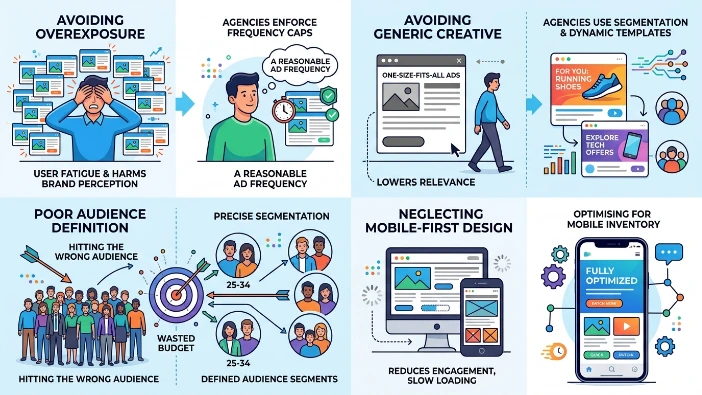
Agencies avoid overexposure, generic creative, poor audience definitions, and neglecting mobile-first design when running remarketing campaigns.
Overexposure reduces ad effectiveness and harms brand perception; agencies enforce frequency caps. Generic creative lowers relevance; agencies use segmentation and dynamic templates. Failure to optimise for mobile inventory reduces engagement on mobile-heavy audiences.