
An informational display ad is a visual digital advertisement that presents concise facts about loan products to build awareness and engagement. Informational display ads combine images, short text, and links. They explain loan types, rates, eligibility, and application steps. Entities: banks, display networks, ad creatives, landing pages, tracking pixels. Example: a banner showing a 5.9% personal loan rate and a link to eligibility requirements.
Banks deliver targeted, educational creatives across websites and apps to answer borrower questions and prompt next-step actions. Banks segment audiences by intent signals such as site visits, search terms, and credit-interest indicators. They serve ads that explain loan features, required documents, and repayment examples. Ads link to tailored landing pages that continue the education and present a clear pre-qualification path. Example: ads shown to visitors who read mortgage calculator pages that direct them to a landing page detailing deposit and income thresholds.
What targeting methods do banks apply for loan lead nurturing?
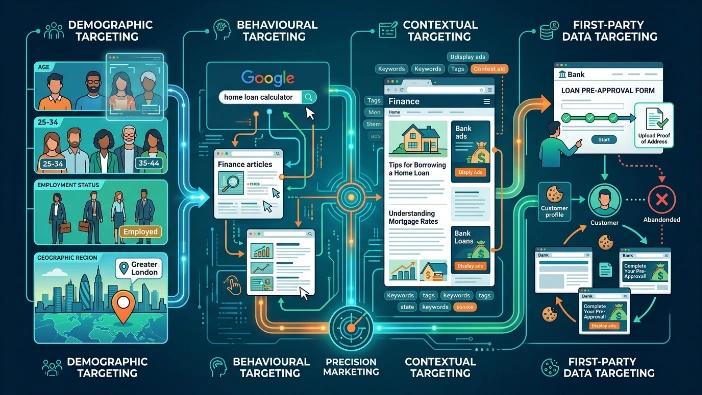
Banks use demographic, behavioural, contextual, and first-party data to target display ads precisely. Demographic targeting includes age bands (25–34, 35–44), employment status, and region (e.g., Greater London). Behavioural targeting tracks prior searches for “home loan calculator” or interactions with loan content. Contextual targeting places ads on finance pages that discuss borrowing. First-party targeting uses website cookies or logged-in customer behaviour to retarget users who started applications. Example: retargeting users who abandoned a loan pre-approval form after uploading proof of address.
How do banks design ad creatives for educational impact?
Banks design simple visuals and short copy that present one clear fact, one next step, and a link to detailed content.
Creatives use readable fonts and one core metric, such as rate, term, or monthly payment example. Copy avoids sales language and focuses on clarity: “Fixed-rate mortgage: 25-year term, example repayment £1,200/month on £200,000.” Images show neutral financial scenes or product icons. Creatives include tracking parameters for attribution. Example: a carousel banner with three tiles: loan types, eligibility checklist, and documentation list.
What landing page elements support informational display ads?
Landing pages extend the ad’s education with defined product explanations, requirements, calculators, and a clear progression to pre-qualification.
Key elements: headline matching the ad, a 3–5 bullet eligibility checklist, an interactive repayment calculator, required-document list, and an option to save progress. Pages include consented data capture fields and privacy statements aligned with UK regulations. Pages load within 3 seconds to reduce drop-off. Example: a landing page that automatically populates region-based interest rates after the user selects their postcode.
How do banks measure effectiveness of informational display campaigns?
Banks track click-through rate, engagement time, micro-conversions, assisted conversions, and cost-per-acquisition to measure performance.
Click-through rate shows ad relevance. Engagement time and pages per session show educational success. Micro-conversions include calculator use, eligibility checks, and document uploads. Assisted conversions attribute later applications to initial ad exposure via multi-touch models. Cost-per-acquisition compares campaign spend to approved loan value. Example metrics: 0.45% CTR, 2:10 average engagement, 18% calculator use rate, and £320 CPA for pre-approvals.
How do banks use creative sequencing and drip messaging?
Banks sequence ads to deliver progressively deeper information across multiple impressions, starting with simple facts and advancing to application guidance.
First impression introduces loan type and one core number. Second impression explains eligibility and documents. Third impression directs users to pre-qualification tools. Frequency caps prevent fatigue. Sequencing ties to user signals: high-intent users see application logistics sooner. Example: a three-stage sequence for car loans: 1) “Representative APR 6.9%”, 2) “Minimum 12 months employment required”, 3) “Start pre-approval — upload payslips”.
What role does compliance play in informational display ads?
Compliance requires clear disclosure of rates, representative examples, and adherence to Financial Conduct Authority (FCA) rules for fair, transparent communication.
Ads state representative APR where applicable and avoid misleading claims. Ads include links to terms and a mechanism to display eligibility criteria. Consent for cookies and data use follows UK GDPR. Creative review processes include legal sign-off and archive of final creatives. Example: an ad stating “Representative 6.4% APR” links to a page showing the percentage of customers who achieved that rate.
How do banks integrate first-party data with display advertising?
Banks use logged-in behaviour, CRM segments, and consented contact data to create precise audience cohorts for display campaigns. Cohorts include recent depositors, applicants who paused at document upload, and customers with upcoming maturity dates. Banks match hashed email lists to display platforms for personalised education. All matching happens using secure hashes and consent checks. Example: a cohort of customers with expiring fixed-rate mortgages receives ads explaining remortgage options and checklist requirements.
What technologies enable tracking and optimisation?
Banks deploy tracking pixels, conversion APIs, analytics platforms, and machine-learning bidding to attribute and optimise campaign performance. Pixels record ad views and on-site actions. Conversion APIs send verified events to ad platforms while preserving privacy. Analytics platforms tie ad exposure to lifecycle stages like application started and approved. Machine-learning bidding optimises for micro-conversions such as calculator use, not only clicks. Example: server-side conversion reporting improved match rates for pre-qualifications by 32%.
What are the typical campaign KPIs for nurturing loan leads?
Typical KPIs include click-through rate, micro-conversion rate, pre-qualification rate, application-start rate, approval rate, and cost per approved application. Targets vary by product: personal loans target 0.4–0.6% CTR and 12–20% calculator use, mortgages target 0.3–0.5% CTR and 8–15% pre-approval starts. Approval rates depend on underwriting; campaigns aim to increase qualified applications by 15–40% versus baseline. Example KPI: a campaign aims for 10% uplift in application starts and a £450 cost per approved mortgage application.
For more detail explore:
Banking Display Ads That Turn Loan Interest Into Approved Applications
What testing methods improve informational ad performance?
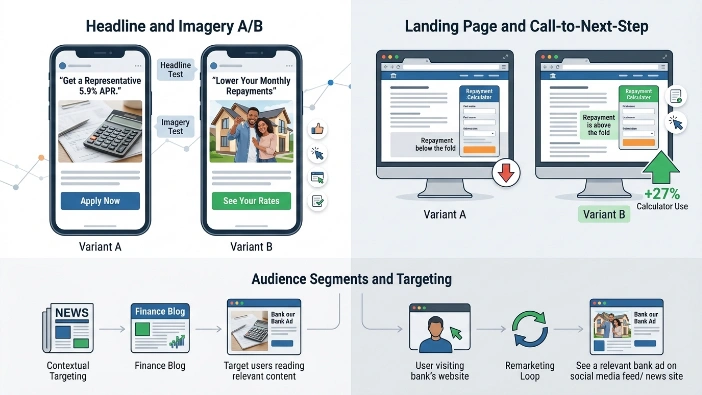
Banks run A/B tests on headlines, call-to-next-step, imagery, audience segments, and landing page flows, measuring micro-conversions. Headline tests compare specific metrics (“Representative 5.9% APR”) with benefit-focused headlines (“Lower monthly repayments”). Landing-page tests vary the position of calculators and forms to minimise friction. Audience tests compare contextual placements with first-party retargeting. Example result: moving the repayment calculator above the fold increased calculator use by 27%.
What are common benefits of using informational display ads for loan nurturing?
Informational display ads increase qualified lead volume, improve applicant preparedness, reduce abandonment, and lower downstream acquisition costs. Educated prospects submit more complete applications with required documents. This reduces manual follow-up and speeds underwriting. Lower abandonment increases conversion efficiency. Example: educating borrowers on documentation reduced manual verification time by 22% and cut approval turnaround by 12 days.
Explore More Expert Insights:
How Financial Services Build Trust Using Educational Banner Advertising
How Agencies Increase Buyer Engagement Using Display Remarketing Ads
What use cases demonstrate successful informational ad strategies?
Use cases include pre-approval nurturing for mortgages, documentation education for personal loans, and eligibility clarification for small business loans. Pre-approval campaigns target users who used mortgage calculators and show step-by-step qualification requirements. Personal loan campaigns explain income thresholds and example repayments to reduce incomplete forms. Business loan campaigns detail turnover and trading-history requirements to reduce unsuitable applications. Example: a mortgage pre-approval series reduced abandonment at the ID-verification step by 35%.
How do banks ensure privacy and data security in these campaigns?
Banks enforce consent-based targeting, data minimisation, secure hashing for list matches, and documented vendor contracts to protect customer data. Consent banners capture lawful bases for cookie use. Banks avoid sharing raw customer identifiers with external platforms; they use hashed lists and only send necessary event data. Vendors undergo security assessments. Customer email lists hashed with SHA-256 before upload to a matching platform; only hashed values transmit.
For more information explore:
How Banks Increase Loan Applications Using Banner Advertising