Aligning banner creative with editorial context means matching ad messaging, imagery, and format to the audience and subject matter of a specific news section to increase relevance, engagement rates, and measured uplift in campaign KPIs.
Alignment requires mapping editorial categories to audience intent and content tone. Editorial context includes section taxonomy, article sentiment, recurring topics, and author or publication signals. Banner creative covers static display, animated formats, and rich media with headlines, imagery, and calls to action. Relevant alignment uses section labels such as Politics, Business, Technology, Sports, and Lifestyle to guide creative choices. Publishers and media buyers exchange metadata to enable contextual targeting and creative selection at scale.
How do you define editorial context in UK news environments?
Editorial context is the structured classification of news content by section, topic, sentiment, and author attributes used to describe audience intent and topical relevance for targeted ad placement.
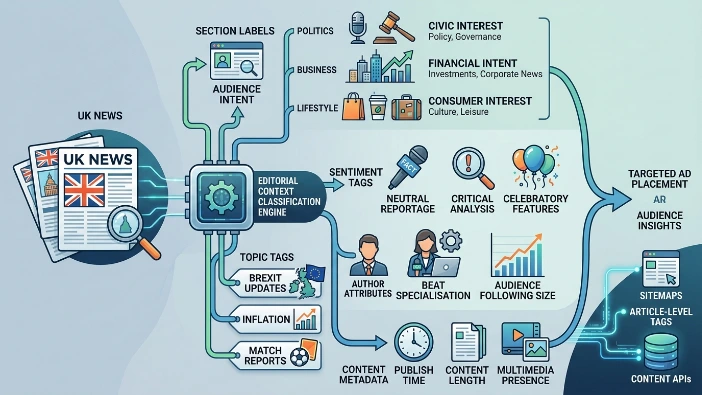
Section labels indicate audience intent Politics indicates policy and civic interest, Business indicates financial intent, and Lifestyle indicates consumer interest. Topic tags narrow context: Brexit updates, inflation, or match reports. Sentiment tags describe tone: neutral reportage, critical analysis, or celebratory features. Author attributes include beat specialisation and audience following size. Content metadata includes publish time, content length, and multimedia presence. UK publishers typically expose this metadata through sitemaps, article-level tags, or content APIs.
What process selects banner creative for specific news sections?
The selection process audits section performance, defines section-specific objectives, maps creative variants to section signals, runs controlled tests, and scales based on measured lift and attribution.
Audit begins with historical performance by section: conversion rate, engagement rate, and viewability. Objectives for each section define KPIs: brand lift for long-form opinion sections, lead generation for Business, and product consideration for Lifestyle. Creative mapping pairs headlines, visuals, and offers to section signals—use topical imagery for Sports and factual headlines for Politics. Testing uses A/B or geo-split experiments with holdout controls to measure incremental impact. Scale follows positive lift results and cost-per-action thresholds.
What components of banner creative change by news section?
Components include headline framing, imagery selection, copy length, value proposition emphasis, and interactive elements; each adapts to the editorial tone and audience goals of the section.
Headline framing uses authority and data-driven language in Business and Politics. Imagery selection uses product and lifestyle photography in Lifestyle, action and player imagery in Sports, and infographic-style visuals in Technology. Copy length shortens for high-frequency news sections and lengthens for in-depth features where users spend more time. Value proposition emphasises utility in Business and emotional appeal in Lifestyle. Interactive elements such as instant forms appear in Business; video-first creatives appear in Technology and Culture sections.
What measurement methods validate alignment effectiveness?
Measurement uses viewability, engagement rate, click-through rate, completed video views, and incrementality tests, complemented by media-mix modeling and post-click conversion tracking.
Viewability tracks measurable impressions within viewable thresholds. Engagement rate records interactions per impression for rich media. Click-through rate monitors immediate response. Completed video views measure attention in video placements. Incrementality tests use holdout groups to isolate causal impact on conversions or brand metrics. Media-mix modeling integrates these results with offline channels. Post-click conversion tracking links section-level impressions to downstream actions such as form completion or purchase.
What are the technical requirements to serve context-aligned creatives at scale?
Requirements include section-level metadata feeds, creative variant management, server-side or client-side contextual targeting, and reporting that attributes performance to editorial segments.
Metadata feeds provide section IDs, topical tags, and sentiment labels. Creative variant management stores multiple banner versions with mapped section rules. Contextual targeting uses keyword taxonomies, semantic classifiers, or publisher-provided tags to match creative to content. Server-side logic can attach creatives before page render; client-side logic can swap creatives after DOM analysis. Reporting must capture section identifiers to enable attribution of impressions and actions to editorial contexts.
What benefits arise from aligning creatives with news sections?
Benefits include higher engagement, improved conversion rates, reduced wasted impressions, and clearer attribution for budget decisions.
Aligned creatives increase relevance and user attention, raising engagement metrics such as dwell time on ad units and interaction rates. Conversion rates rise when messaging matches intent signaled by section topics. Waste reduces because frequency and audience duplication controls rely on contextual segmentation instead of broad placement. Attribution clarity improves campaign optimisation and budget allocation by demonstrating which sections drive measurable outcomes.
What use cases illustrate effective alignment in UK news sections?
Use cases include a finance advertiser using business-section creatives for lead generation and a consumer brand using lifestyle-section creatives for product consideration and measurable online sales lift.
The finance use case targeted Business and Economy sections with headline-driven banners emphasising interest rates and product benefits. The campaign used contextual targeting and a lead form creative variant for direct capture, measuring qualified leads and account openings. The consumer brand placed lifestyle imagery and benefit-oriented copy in Lifestyle and Culture sections. The campaign measured online sales uplift through tracked coupon redemptions and conversion pixels, comparing performance with non-contextual baseline buys.
Explore More Expert Insights:
From Programmatic to Premium: Why UK Brands Are Moving Budget Back to Direct Display
The Attention Economy: How UK Banner Ads on Trusted Sites Get 4× More Viewability
How do content taxonomies and creative taxonomies align operationally?
Operational alignment maps content taxonomy labels to creative taxonomy rules that determine which creative variant serves against which editorial tag and which KPI measurement attaches to that placement.
Content taxonomy includes section IDs, topic tags, and sentiment flags. Creative taxonomy defines headline variants, imagery options, and call-to-action types. Mapping rules pair content labels to creative IDs and assign KPI tags for reporting. Automation uses rule engines or feed-based joins to match creatives at scale. Reporting pipelines ingest section identifiers and creative IDs to produce section-level performance dashboards for optimisation.
How should teams structure testing and governance for contextual creative strategies?
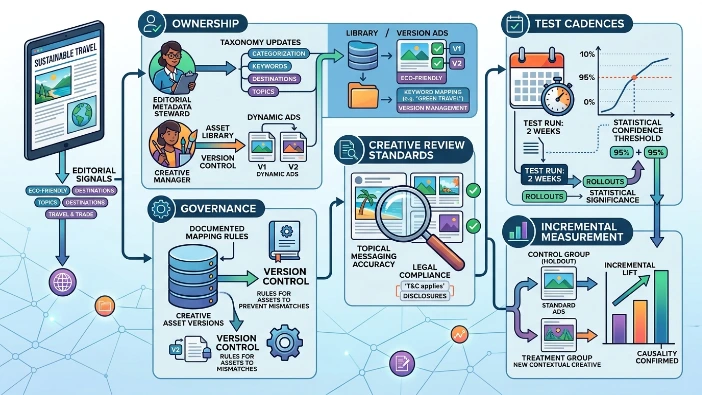
Teams should define test cadences, assign ownership for taxonomy updates, enforce creative review standards, and require incremental measurement with control groups for every major allocation change.
Test cadences set durations and statistical thresholds for rollouts. Ownership designates editorial metadata stewards and creative managers. Creative review standards enforce accuracy of topical messaging and legal compliance. Incremental measurement uses holdout controls and pre-post analyses to confirm causality. Governance mandates version control for creative assets and documented mapping rules to prevent mismatches between editorial signals and messaging.
Explore the Advanced Guide:
How the UK’s Second-Largest Ad Export Market Is Shifting Its Spend in 2026
Aligning banner creative with the editorial context of UK news sections requires structured taxonomies, controlled testing, clear measurement, and operational mapping between content signals and creative variants. This approach increases relevance and measurable performance in campaigns while enabling teams to optimise budgets based on section-level ROI. For teams exploring solution options, integrate metadata feeds, design creative taxonomies, and run disciplined incrementality tests to validate alignment outcomes.
Check the Complete Explanation:
Display Advertising ROI Report Template: How UK Brands Present Campaign Results Internally