

Editors want clean, verifiable factual packages that state news value clearly in the first two paragraphs. Fleet Street editors now prioritise accuracy, traceability, and immediate news value. A complete factual package places the key fact, primary source, and timestamped data point up front. Editors treat clear news value as the threshold for editorial consideration.
Define the package components precisely. The lead is a single declarative sentence summarising the news event or claim. Primary sources are named individuals, organisations, or documents that directly substantiate the lead. The date/time shows currency. The supporting data point is a statistic, figure, or quote that a desk editor can verify in under five minutes. These elements reduce back-and-forth and speed editorial decisions.
How do editors assess news value quickly?
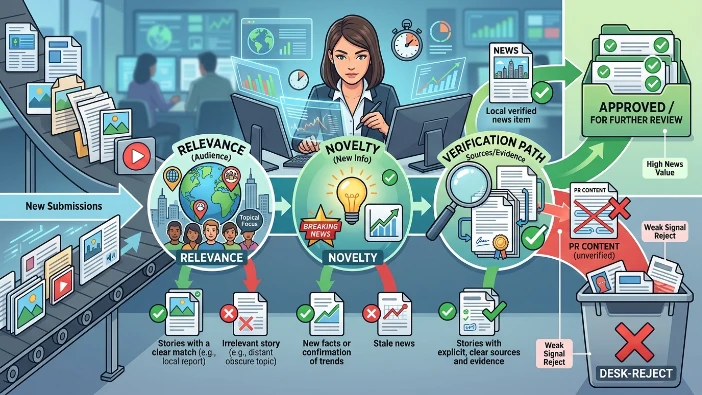
Editors scan for three signals: relevance to audience, novelty, and verification path. Relevance is geographic and topical fit to the outlet’s readership. Novelty is whether the information adds new facts or confirms existing trends. Verification path is the clarity of sources and evidence that allow rapid fact-checking. If any signal is weak, editors reject or desk-reject the item. PR content that omits explicit verification paths fails this triage.
What verification details do editors require?
Editors require named sources, contactable spokespeople, links to original documents, and raw data references.
Named sources include job title and organisation. Contactable spokespeople include direct phone or verified email. Links must point to original documents, datasets, regulatory filings, or public records. Raw data references show where the numbers come from (dataset name, access path, or methodology summary). Editors avoid vague references such as “internal data” without provenance.
How should PRs structure the opening paragraphs for Fleet Street?
Start with a one-sentence lead, a one-line context sentence, and a one-line verification sentence.
The lead states the principal fact. The context sentence locates the fact in time, place, or trend. The verification sentence names the primary source and gives a direct link or contact. This three-line structure fits an editor’s skim pattern and provides the core facts immediately. PRs that use long narrative leads waste editorial time.
What factual elements increase pickup probability?
Editors prefer specific figures, exact dates, named documents, and unequivocal quotes.
Specific figures include percentages with numerators/denominators or raw counts. Exact dates avoid month ranges. Named documents include titles and issuing bodies. Unequivocal quotes include the speaker’s role. These elements let an editor assess credibility and craft a headline quickly. Generic statements or unattributed claims lower pickup probability.
How do editors handle embargoes and exclusives in 2026?
Editors accept embargoes only with a verifiable origin, clear embargo terms, and a named contact for exceptions.
An embargo must state the exact embargo lift time in the recipient’s timezone and include the issuer’s contact. Exclusive windows must indicate which outlet has exclusivity and for how long. Failure to supply precise embargo metadata leads editors to treat the content as unusable for coordinated publication.
What role do primary documents play in editorial decisions?
Primary documents act as the decisive evidence that moves an item from pitch to story.
Regulatory filings, reports, datasets, FOI responses, or official statements allow editors to corroborate claims without relying solely on PR copy. A named document with a stable URL or PDF attachment reduces verification time and increases trust. PRs that attach or link to original documents improve acceptance rates significantly.
How do data and methodology affect credibility?
Editors evaluate credibility by checking sample sizes, collection dates, and measurement methods.
A data point without sample size is incomplete. Collection dates show currency. Measurement methods explain how variables were defined. Editors prefer a one-paragraph methodology summary for any new dataset. Absent methodology, editors treat data as anecdotal.
What metadata should accompany multimedia assets?
Multimedia must include a caption, creator credit, creation date, location, and usage rights.
A caption states what the image or video shows and its relevance to the lead. Creator credit names the photographer or agency. Creation date and location establish context. Usage rights specify editorial permissions. Editors decline assets without clear rights and provenance.
How do legal and privacy considerations shape editorial acceptance?
Editors require statements on consent for identifiable individuals, regulatory compliance, and any legal caveats.
Consent declarations must show when and how consent was obtained. Compliance statements reference relevant UK regulations when applicable, such as data protection or advertising rules. Legal caveats highlight ongoing litigation or confidentiality constraints. Lack of these statements prompts legal review and delays coverage.
What tone and language choices do editors expect in 2026?
Editors expect concise, neutral, and declarative language with no promotional adjectives.
Avoid promotional language, flowery adjectives, and marketing claims. Use precise verbs and concrete nouns. Sentences should state facts, not value judgements. This neutral tone allows editors to adapt copy for different sections without heavy rewriting.
How should PRs provide follow-up access for verification?
Provide a named verifier, available times, direct contact details, and supplementary documents accessible via stable links.
A verifier is a person who can confirm facts quickly. Include office hours in recipient timezones and at least two contact methods. Supplementary documents should be hosted on stable servers or attached. Editors value immediate, reliable access over long email chains.
Which technological formats do editors prefer for delivery?
Editors prefer plain text for initial pitches, PDF for documents, and high-resolution JPG/MP4 with metadata for assets.
Plain text is readable across mail clients and mobile. PDF preserves document formatting and provenance. High-resolution image and video files must embed metadata or accompany a separate metadata file. Complex file types or proprietary formats delay editorial handling.
What common PR practices cause immediate rejection?
Vague claims, missing sources, promotional framing, inaccessible documents, and unclear embargo terms cause immediate rejection.
Vague claims lack specifics. Missing sources leave editors unable to verify. Promotional framing hides news value. Inaccessible documents or broken links stop verification. Unclear embargo terms risk publication errors. These issues lead to desk-rejects.
Explore More Expert Insights:
Regional vs National UK Media: Which Press Release Distribution Actually Works?
Why 6.67% Annual Growth in UK PR Demands a Smarter Distribution Strategy
What benefits accrue to PRs who meet these editorial requirements?
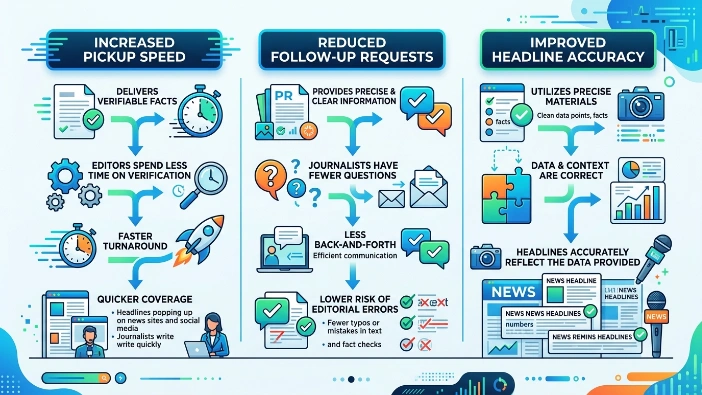
Meeting editorial requirements increases pickup speed, reduces follow-up requests, and improves headline accuracy.
When PRs deliver verifiable facts, editors spend less time on verification. Faster turnaround yields quicker coverage. Fewer follow-ups lower the risk of editorial errors. Precise materials produce headlines that accurately reflect the data provided.
What use cases show this approach working in practice?
Local council reports, clinical trial announcements, and public policy datasets gain faster editorial traction when packaged correctly.
A council report with a document link and named officers allows local news desks to publish same-day. A clinical trial summary with methodology and regulator references reaches health desks quickly. A public policy dataset with a methodology summary supports beat reporters. These concrete examples demonstrate how verifiable packages convert into stories.
Dive Deeper Into This Topic:
Press Release Distribution Mistakes: What 300 UK Campaign Audits Revealed
Clean factual packages with a sharp lead, named primary sources, verifiable documents, clear data methods, and explicit multimedia metadata define what Fleet Street editors want in 2026. PRs that adopt this format reduce editorial friction and increase the chance that a pitch becomes a published story.
Learn Everything About It Here:
Why 82% of Brands That Try DIY Distribution Switch to Managed Within 6 Months



