

Viewability is the percentage of ad impressions that meet industry criteria for being seen; measurement uses time-in-view and pixel-in-view thresholds tracked by ad viewability technology.
Viewability defines whether a banner ad had a real chance to be seen by a human. The standard measurement for display ads in the UK follows global industry practices: at least 50% of pixels in view for one continuous second for display banners, and two continuous seconds for video. Measurement software detects browser viewport positions, pixel visibility, and time-on-screen. Measurement reports deliver metrics such as viewable impressions, viewability rate (viewable impressions divided by measurable impressions), and average time in view. Third-party verification services and software development kits (SDKs) instrument ad calls or page events to capture these signals.
Viewability differs from impressions and served ads. An impression counts the delivery of an ad tag; a viewable impression confirms the ad was actually in front of a user long enough to be noticed. Publishers, advertisers, and verification platforms reconcile logs to produce post-bid or server-side audits that show viewability performance by placement, creative, device, and page type.
Why do banner ads on trusted UK news sites deliver higher viewability?
Trusted UK news sites produce higher viewability because users spend longer on articles, page layouts prioritize visible ad placements, and site trust reduces adblocking and rapid navigation away.
High-quality news sites design article pages to retain readers through related-article links, long-form content, and editorial structure. Readers arrive via search, social referrals, or direct navigation and remain engaged while reading. Page templates place banner ads adjacent to article copy and above-the-fold areas, increasing the likelihood that 50% of pixels remain visible for the required time. Trusted domains also maintain consistent traffic patterns, lowering bounce rates and increasing active time on page.
User trust influences technical factors. Trusted sites have lower rates of adblocker usage among certain cohorts and maintain robust site performance and infrastructure. Faster page loads and fewer layout shifts reduce accidental non-viewable renders. Publishers use lazy-loading that defers off-screen ads while ensuring on-screen ads load promptly. Combined, these editorial, technical, and behavioural elements raise viewability multiples when compared with low-engagement or low-trust sites.
How does a 4× viewability uplift get calculated?
A 4× uplift is the ratio of viewability rates on trusted UK news sites to the baseline viewability on comparable open-web placements; calculation uses consistent measurement windows and identical thresholds.
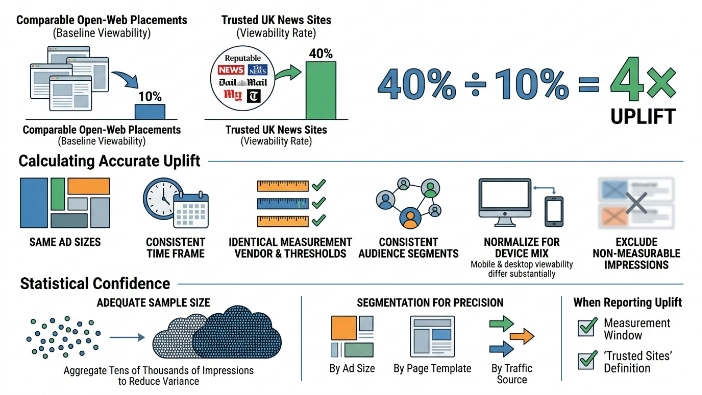
Calculate uplift by dividing the viewability percentage on trusted sites by the baseline percentage on the comparison set. For example, if baseline viewability on generic open-web placements is 10% and trusted news sites average 40%, the uplift equals 40% ÷ 10% = 4×. Accurate calculation requires comparable measurement conditions: same ad sizes, same time frame, same measurement vendor and thresholds, and consistent audience segments. Analysts exclude non-measurable impressions and normalise for device mix because mobile and desktop viewability differ substantially.
Statistical confidence requires adequate sample size. Analysts aggregate tens of thousands of impressions to reduce variance. Segmentation by ad size, page template, and traffic source produces more precise uplift insights. When reporting uplift, include the measurement window and the definition of “trusted sites” to ensure reproducibility.
What site and page components increase banner ad viewability?
Components that increase viewability include article length, above-the-fold placements, stable layout (low cumulative layout shift), fast page load times, and consistent navigation behaviour.
Article length matters because longer articles increase time-on-page. Above-the-fold placements and sticky units remain visible as users scroll or pause. A stable layout prevents displacement of ads after render; cumulative layout shift metrics correlate with viewability loss when ads move out of view. Page speed ensures ads render before users scroll away; slower pages produce unmeasurable or non-viewable ad renders. Navigation and internal linking keep readers on the site, giving ads repeated exposure across related pages.
Technical integrations influence outcomes. Server-side ad insertion and header bidding setups can lower latency and improve bid response times for on-screen inventory. Lazy-loading logic that loads visible ads immediately while deferring off-screen units prevents wasted impressions. Viewability improves when ad creatives and scripts are optimised to avoid blocking or deferring critical rendering paths.
How do user behaviour patterns on UK news sites affect viewability?
User behaviour patterns that affect viewability include session length, scroll depth, referral source, and time of day; longer sessions and deep scrolls increase the chance that banner ads meet pixel-and-time thresholds.
Readers coming from search typically arrive focused on a specific article and scroll deeply, producing sustained visibility for inline banners. Social referrals often show higher initial bounce but can still yield viewable impressions when content matches intent. Direct and loyalty traffic show the longest session durations; returning visitors consume multiple pages per session, boosting cumulative ad exposures. Time of day affects dwell time: morning and evening peaks correlate with longer reading sessions, while short midday visits reduce viewability.
Device choice matters. Desktop sessions show higher average viewability because larger viewports display full creatives and scrolling is slower. Mobile sessions dominate UK traffic volumes but produce lower per-impression viewability due to quicker scrolling and smaller visible areas. Publishers mitigate this with sticky headers or mid-article placements designed for mobile view.
What are the measurement and reporting best practices for viewability claims?
Best practices require third-party verification, consistent thresholds, large sample sizes, and transparent reporting of measurement windows, device mix, and excluded impressions.
Use independent verification vendors that conform to Global Alliance standards. Report viewability as viewable impressions over measurable impressions and disclose the chosen thresholds (for display and video). Avoid mixing third-party and ad-server metrics without reconciliation. Provide segmentation by device, creative size, placement, and traffic source. Report sample sizes and confidence intervals when claiming multipliers like 4×. Include any inventory exclusions, such as non-human traffic filters, invalid traffic remediation, and adblocker-affected impressions.
Implement measurement tags that do not alter rendering or add excessive latency. Prefer passive measurement that reads viewport and time signals rather than intrusive scripts. Regular audits and cross-checks with server logs improve accuracy.
What are the benefits of higher viewability for advertisers and publishers?
Higher viewability increases campaign effectiveness by ensuring ads are seen, improves measurement accuracy for brand metrics, and increases yield for publishers through premium inventory pricing.
For advertisers, viewability correlates with increased ad recall, brand lift, and measurable outcomes because impressions registered as viewable have a verified chance to influence audiences. Higher viewability reduces wasted spend by lowering the fraction of served but unseen ads. For publishers, demonstrated higher viewability supports premium CPMs and strengthens inventory differentiation. Advertisers pay more for inventory that reliably delivers measurable exposure. Advertisers also gain clearer attribution when viewable impressions align with downstream engagement and conversions.
Explore More Expert Insights:
Brand Safety in UK Digital Advertising: Why News Environments Score Highest in 2026
Why Premium News Site Banner Ads Have Lower Bounce Rates Than Social Display
Which use cases gain the most from placing banner ads on trusted UK news sites?
Use cases that gain the most include brand awareness campaigns, product launches, public information campaigns, and contextual advertising tied to news topics.
Brand awareness campaigns benefit because viewable impressions increase reach quality and campaign recall. Product launches require consistent exposure across high-trust audiences; news sites provide receptive contexts during launch windows. Public information campaigns that depend on broad reach and verified exposure see improved effectiveness through higher viewability and editorial trust. Contextual advertising that aligns with news topics performs better because placement within related editorial content increases relevance and engagement.
For measurement-focused buyers, retargeting and sequential messaging gain precision when initial exposures are viewable; confirmation that an initial ad was seen allows accurate sequencing based on verified impressions.
How should teams interpret viewability data to inform media planning?
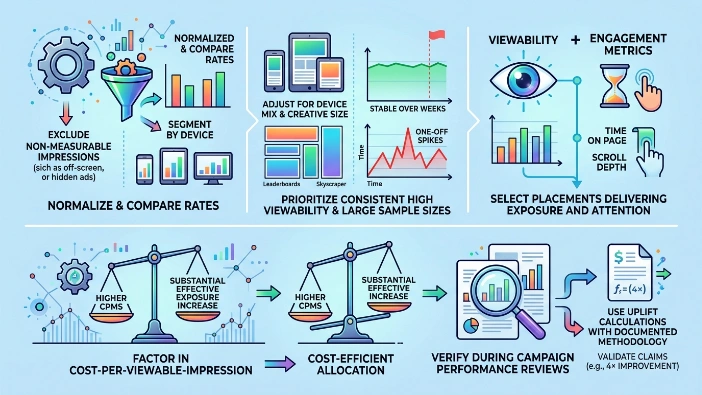
Teams should interpret viewability data by comparing normalised rates across placements, adjusting for device mix and creative size, and prioritising inventory with consistent high viewability and large sample sizes.
Normalise rates by excluding non-measurable impressions and segmenting by device. Use viewability alongside engagement metrics—time on page and scroll depth—to select placements that deliver both exposure and attention. Prioritise inventory that shows stable viewability over multiple weeks rather than one-off spikes. Factor in cost-per-viewable-impression when allocating budget: higher CPMs can be cost-efficient if viewability substantially increases effective exposure. Finally, require verification during campaign performance reviews and use uplift calculations with documented methodology to validate claims such as 4× improvements.
Complete Details Available Here:
Banner Ad Seasonal Strategy: When UK News Audiences Are Most Receptive by Quarter
Trusted UK news sites deliver significantly higher viewability for banner ads because of engaged audiences, editorial page design, and technical site quality. Viewability uplift calculations require consistent measurement, large sample sizes, and transparent reporting. Advertisers gain more reliable exposure and better measurement; publishers gain premium revenue for verifiable inventory.
For education on seasonal timing and verified impressions, explore:
How Times Intelligence Delivers Verified Impressions Across Its UK News Network



