
Direct display gains priority because it delivers clearer inventory control, guaranteed impressions, first-party audience alignment, and transparent pricing compared with programmatic channels.
UK advertisers face three structural pressures that drive this shift. First-party data growth and the decline of third-party identifiers change how audiences are targeted. Publishers that sell direct display accept first-party signals and logged-in user cohorts, enabling brands to reach verified audiences without relying on cross-site trackers. Second, brand safety and contextual relevance demand predictable placements. Direct display offers vetted page contexts and exact placement positions, reducing reputational risk and improving message fit. Third, measurement and transparency requirements from marketing teams and regulators push buyers toward inventory with verifiable delivery metrics and clearer fee structures. Together, these factors make direct display attractive for brand campaigns that require control, compliance, and measurable outcomes.
How does direct display differ from programmatic buying?
Direct display is a negotiated, inventory-specific purchase with fixed delivery terms, while programmatic buying uses automated auction systems and probabilistic targeting across many sellers.

Direct display involves a human-negotiated insertion order that specifies exact placements, creative units, start and end dates, and guaranteed impressions or viewability targets. Programmatic uses real-time bidding or automated guaranteed deals executed through supply-side platforms and demand-side platforms. Programmatic emphasises scale and dynamic targeting across thousands of sites, often relying on third-party cookies or identifiers. Direct display focuses on selected publisher environments and precise creative control. In practice, direct display yields deterministic placement data per impression, while programmatic provides aggregated reach estimates and impression-level metadata but less predictable placement context.
What inventory and terms define premium direct display?
Premium direct display inventory includes homepage takeovers, MPU and leaderboard placements, sponsored article slots, and guaranteed homepage or section rotations sold with fixed CPMs and impression minimums.
Premium direct inventory is defined by position prominence, creative flexibility, and editorial adjacency. Common terms include guaranteed impressions, fixed CPM or flat-fee buys, fixed creative sizes, and editorial approval clauses. Contracts list start and end timestamps in UTC, frequency caps, viewability thresholds (for example 70 percent viewable for one continuous second), and third-party ad-server tagging allowances. Premium direct deals often include reporting cadence, proof-of-play logs, and defined remediation steps for underdelivery. Payment terms typically use 30- or 60-day net invoices, with rebates or makegood impressions specified for non-compliance.
How does first-party data change the value proposition of direct display?
First-party data increases the precision and measurability of direct display by enabling deterministic audience targeting and direct match rates inside publisher environments.
Publishers collect verified user attributes via registrations, subscriptions, and logged-in behaviours. When a brand buys direct display on a news site, the publisher can map creative delivery to known audience segments such as subscribers, age cohorts, or topical readers. This mapping improves measurement accuracy because conversions and engagement can be matched to known user identifiers without third-party cookies. For UK advertisers focused on privacy compliance, first-party targeting reduces reliance on cross-site tracking while preserving audience relevance. The result is higher CPMs justified by higher expected engagement and clearer attribution.
What measurement and verification practices make direct display more trusted?
Strict ad verification uses viewability standards, independent ad servers, impression-level logs, and human-reviewed contextual checks to ensure delivery and placement integrity.
Trusted direct display buys specify measurement partners or allow independent verification through neutral ad servers. Key metrics include rendered impressions, viewable impressions (measured to the IAB viewability standard), click-throughs, and engagement events such as video quartile completions. Contracts include access to impression-level logs for audit, timestamps, creative IDs, and placement metadata. Brand safety checks involve automated keyword filtering plus manual review of editorial context. Financial reconciliation uses agreed reconciliation windows and defined tolerances for discrepancies. These practices reduce disputes and enable procurement and marketing teams to validate that media bought was media delivered.
What are the cost and performance trade-offs between programmatic and direct display?
Direct display typically yields higher CPMs and higher viewability, while programmatic provides lower CPMs and greater reach; the choice depends on campaign goals for efficiency or control.
Direct display demands premium pricing for guaranteed positions and editorial adjacency. Higher cost comes with benefits: higher average viewability rates, deterministic placement data, and lower fraud risk. Programmatic grants access to scale and real-time optimisation with lower nominal CPMs, but that price often reflects weaker contextual control and reliance on probabilistic targeting. For brand campaigns prioritising awareness and message safety, the higher CPM of direct display produces stronger ad exposure per impression. For performance campaigns prioritising cost per conversion, programmatic remains attractive because of bid-level optimisation and cross-supply targeting.
How do UK regulatory and privacy frameworks affect the move back to direct display?
UK privacy rules and browser restrictions reduce third-party tracking, making publisher-controlled direct display better suited to compliant audience targeting and documented consent practices.
Regulatory frameworks such as the UK Data Protection Act and evolving guidance on consent require advertisers and publishers to demonstrate lawful bases for processing personal data. Browsers and operating systems increasingly restrict third-party cookies and fingerprinting. Direct display operates within the publisher’s consent ecosystem and first-party data governance, allowing lawful targeting when users have consented or when publishers use anonymised cohorts. This reduces legal complexity for advertisers and aligns with procurement and compliance policies. Publishers can supply audience segments based on consented attributes, enabling privacy-first targeting that avoids cross-site identifiers.
What creative and operational changes do brands make when buying direct display?
Brands standardize creative sizes, prepare higher-resolution assets, implement server-side tagging, and coordinate closely with publisher creative teams for editorial alignment.
Creative teams produce assets tailored to specific inventory sizes and editorial environments, including static images, rich media, and video files with specified codecs and durations. Operationally, brands use centralised ad servers and provide creatives in advance of start dates to allow editorial review and technical validation. Server-side tagging reduces client-side load and ensures accurate counting. Brands also negotiate ad labelling and disclosure language required by the publisher. The procurement and marketing teams create insertion orders with precise creative acceptance criteria, technical specifications, and fallback assets. These preparations shorten trafficking cycles and decrease the risk of technical rejection on launch.
What performance indicators should UK brands monitor for direct display campaigns?
Brands track viewable impressions, time-in-view, click-through rate, engagement events, and post-exposure lift in brand awareness metrics using controlled studies.
Viewable impressions and time-in-view quantify whether users actually saw creative content. Click-through rate and interaction metrics capture immediate engagement. For richer insights, brands commission measured lift studies or pixel-based conversion tracking tied to deterministic publisher audiences. Brands monitor frequency distribution to avoid oversaturation and check placement reports for editorial adjacency and creative rendering. Reporting cadence is weekly or campaign milestone-based, with final reconciliation using impression logs and viewability audits. These indicators validate whether the premium spend translates into meaningful audience attention and campaign objectives.
Explore More Expert Insights:
The Attention Economy: How UK Banner Ads on Trusted Sites Get 4× More Viewability
Brand Safety in UK Digital Advertising: Why News Environments Score Highest in 2026
What use cases justify moving budget from programmatic to direct display?
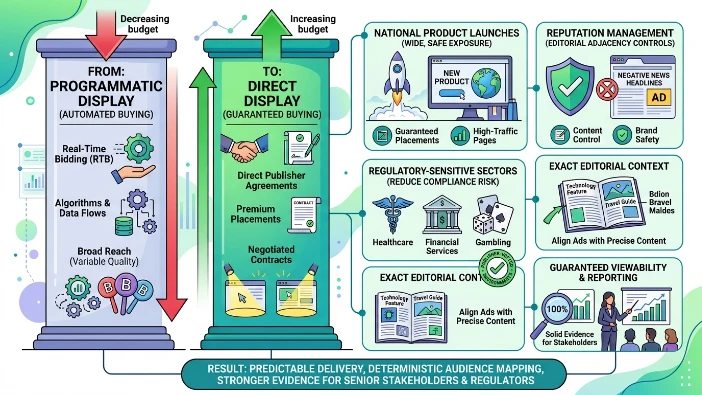
Brand awareness, product launches, reputation management, regulatory-sensitive sectors, and campaigns requiring exact editorial context justify shifting budget to direct display.
For national launches that need wide but contextually safe exposure, direct display guarantees placements on high-traffic pages and secured sections. Reputation management campaigns need editorial adjacency controls that programmatic cannot promise. Sectors with strict regulation financial services, healthcare, gambling benefit from publisher-vetted environments that minimise compliance risk. Direct display also suits campaigns that require guaranteed viewability for research or reporting to stakeholders. In each case, the predictable delivery and deterministic audience mapping produce stronger evidence for senior stakeholders and regulators.
How should UK marketers decide the right balance between programmatic and direct display?
Marketers allocate budgets based on clear objectives: assign direct display to placements needing control, safety, and deterministic measurement and use programmatic for scale and cost efficiency.
Start by mapping campaign goals to media characteristics. If the objective is brand reach with verified context and measurable attention, allocate spend to premium direct display. If the objective is performance at scale or dynamic retargeting, continue using programmatic channels. Use pilot direct display buys to test viewability uplift and brand lift versus programmatic benchmarks. Compare CPM-adjusted attention metrics and conversion-adjusted efficiency before scaling. Maintain a governance framework that documents procurement rules, acceptable inventory types, and reporting standards to guide consistent allocation decisions across campaigns.
For further detail on audience-based approaches, see:
First-Party Audience Targeting on UK News Sites: How It Replaces Third-Party Cookies
Direct display returns budget to premium publisher environments because it provides inventory control, deterministic audience alignment, transparent measurement, and regulatory alignment. UK brands prioritise these features for brand campaigns, regulated sectors, and situations requiring clear proof of delivery. Marketers should match objectives to channel strengths reserve direct display for control and verification, and use programmatic for reach and cost efficiency.
For contract and negotiation guidance, see the following:
Banner Advertising Contract Essentials: What UK Brands Must Negotiate Before Signing