
First-party audience targeting uses data that publishers collect directly from users to define segments and target ads without relying on third-party cookies.
First-party data includes registration details, subscription status, onsite behaviour, and consent records. Publishers aggregate these signals to create audience segments such as subscribers, frequent visitors, or readers of specific verticals. Targeting uses publisher-side matching or cohort-based segments delivered via clean-room environments, server-to-server APIs, or publisher-managed activation suites. This method avoids cross-site tracking and leverages deterministic identifiers within the publisher domain. Advertisers receive segment definitions and targeting endpoints rather than raw user-level identifiers.
How does first-party targeting technically replace third-party cookies?
Publishers store and match user attributes on their own domains, then expose anonymised segments or hashed identifiers for ad activation without third-party cookie exchange.
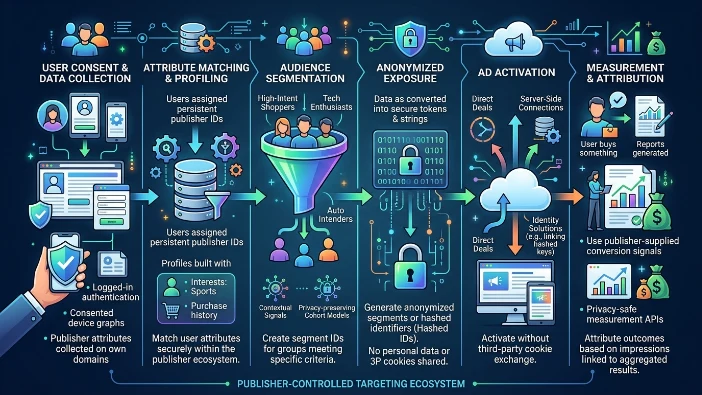
Technical approaches include audience segments, hashed identifier syncing, contextual signals, and privacy-preserving cohort models. Publishers implement logged-in authentication or consented device graphs to associate behaviours with persistent identifiers. They then create segment IDs that represent groups of users who meet defined criteria. Activation happens via direct deals, server-side exposes, or through identity solutions that accept hashed first-party keys. Measurement uses publisher-supplied conversion signals or privacy-safe measurement APIs to attribute outcomes. The removal of third-party cookies shifts identity resolution to publisher-controlled systems and neutral environments that link impressions to aggregated outcomes.
What entities and data types form first-party audience segments?
Important entities include user accounts, subscription records, page taxonomy tags, behavioural events, and consent records; data types are hashed emails, login IDs, page views, and time-on-site.
User accounts and subscription records provide deterministic identity anchors when users log in. Taxonomy tags classify content into topics such as politics, sports, or finance and enable topical segments. Behavioural events record clicks, article reads, video plays, and scroll depth. Consent records document lawful bases for processing. Publishers transform personal identifiers into hashed tokens or aggregated counts to preserve privacy. Segment definitions combine these entities and data types to form groups like “logged-in finance readers with 3+ articles last 30 days” or “subscribers aged 25–44 who read product reviews.”
What activation channels deliver first-party audiences to advertisers?
Activation occurs via direct publisher deals, server-to-server targeting APIs, private marketplaces, and identity partnerships that support hashed-match or cohort signals.
Direct deals use insertion orders that specify segments and delivery metrics. Server-to-server APIs allow advertisers to request segment IDs and deliver creatives without exposing raw identifiers. Private marketplaces enable programmatic access to publisher inventory for specific segments under negotiated terms. Identity partnerships provide hashed-email matching or universal first-party IDs accepted across publisher networks. Activation pathways emphasise server-side handoffs and tokenised segments to prevent cross-site leakage. Reporting links back through publisher measurement endpoints or shared attribution models.
How is consent and privacy managed in first-party targeting?
Publishers document consent, present granular choices via consent management platforms, and implement processing based on lawful bases under UK data protection law.
Consent management platforms record user choices and propagate consent flags to targeting systems. Publishers restrict segment creation to users who granted consent for personalised advertising or use legitimate interest only when documented and assessed. Data minimisation practices limit fields shared with advertisers. Pseudonymisation and hashing reduce identifiability. Retention policies define time limits for segment storage, for example 90 days for behavioural cohorts. Cross-border transfers require contractual safeguards such as standard contractual clauses when data moves outside the UK. Audit trails record processing activities for compliance and vendor reviews.
How does measurement and attribution work without third-party cookies?
Measurement uses publisher-supplied aggregated conversion data, probabilistic matching within controlled environments, and privacy-preserving APIs to attribute ad exposure to outcomes.
Publishers run deterministic matchbacks when users convert while logged in, linking exposure events to conversions via internal identifiers. For anonymous users, publishers supply aggregated conversion counts or cohort-level lift metrics. Neutral measurement partners receive aggregated logs for independent verification. Privacy-preserving APIs, such as conversion reporting frameworks, return limited, de-duplicated event counts rather than user-level data. Advertisers compare publisher-provided lift studies or aggregated conversion windows to internal KPIs. Reconciliation requires shared schemas for timestamps, creative IDs, and segment definitions.
What are the performance and cost implications for advertisers?
First-party targeting reduces audience leakage and fraud, increases viewability and relevance, and often commands higher CPMs compared with open-exchange programmatic inventory.
Advertisers gain higher match rates when users log in, producing stronger signal strength for targeting and measurement. Reduced fraud and improved contextual adjacency increase effective engagement per billed impression. Publishers charge premiums for deterministic segments and premium placements. CPMs for curated publisher segments typically exceed open-exchange averages by 20–100 percent depending on exclusivity and audience quality. Advertisers should evaluate attention metrics, viewability rates, and conversion lift rather than raw CPM alone. Performance benefits vary by campaign objective and creative relevance.
What operational changes do advertisers and publishers need to implement?
Advertisers update trafficking workflows for server-side integrations, adapt measurement pipelines to aggregated reporting, and renegotiate insertion orders to reference segment IDs.
Technical integration includes setting up server-to-server endpoints, accepting hashed tokens, and using publisher-provided creative specifications. Advertisers adjust tag deployment to support server-side counting or use publisher ad servers. Reporting teams ingest aggregated feeds and align attribution windows with publisher schemas. Contract terms require explicit segment definitions, delivery metrics, and reconciliation windows. Publishers invest in identity graphs, consent frameworks, and data engineering to produce segments at scale. Both parties adopt standardised nomenclature for segment IDs, placement IDs, and time zones to avoid mismatches.
What benefits do UK advertisers gain from publisher-controlled audiences?
Advertisers gain deterministic reach, improved brand safety, clearer consent records, and stronger alignment with regulated sector requirements.
Deterministic reach arises when users log in or subscribe, enabling precise targeting and conversion matchbacks. Publisher editorial controls reduce adjacency risks and support compliance in regulated advertising verticals such as finance and healthcare. Consent records help auditors verify lawful processing. Publishers provide contextual targeting that complements audience segments for campaigns requiring specific topical adjacency. These benefits support evidence-based reporting to procurement and compliance teams and justify premium spend for campaigns that demand measurability and safety.
Explore More Expert Insights:
Banner Ad Seasonal Strategy: When UK News Audiences Are Most Receptive by Quarter
How to Plan a UK Banner Campaign Across Multiple News Sites Without Duplicating Reach
What use cases are best suited to first-party audience targeting on news sites?
Use cases include brand awareness campaigns, subscription promotions, regulated sector messaging, and campaign measurement that requires deterministic attribution.
Brand awareness benefits from topical adjacency and high viewability on premium pages. Subscription promotions use publisher-owned registration flows to target likely converters. Regulated sectors require editorial controls and documented consent for audience processing. Measurement-oriented campaigns use publisher matchbacks to demonstrate conversion lift tied to deterministic segments. Campaigns that focus on reputation management or stakeholder reporting benefit from the clear audit trails publishers maintain.
How should advertisers evaluate first-party audience offerings?
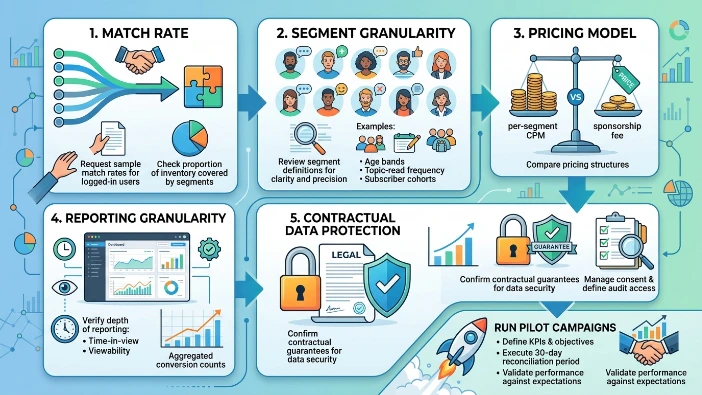
Evaluate offerings by match rate, segment granularity, pricing model, reporting granularity, and contractual data protection guarantees.
Request sample match rates for logged-in users and the proportion of inventory covered by segments. Review segment definitions for clarity and granularity, such as age bands, topic-read frequency, or subscriber cohorts. Compare pricing models that charge per-segment CPM or flat sponsorship fees. Verify reporting granularity, including time-in-view, viewability, and aggregated conversion counts. Confirm contractual commitments for data protection, consent management, and audit access. Run pilot campaigns with defined KPIs and a 30-day reconciliation period to validate performance against expectations.
For More Information, Explore:
From Programmatic to Premium: Why UK Brands Are Moving Budget Back to Direct Display
First-party audience targeting on UK news sites replaces third-party cookies by using publisher-collected identifiers, hashed tokens, and cohort segments to enable deterministic targeting, privacy-aligned measurement, and improved brand safety. Activation occurs through direct deals, server-side APIs, and private marketplaces. Advertisers gain clearer consent records, higher match rates, and contextual adjacency at a premium cost. Operational changes include server-to-server integrations, aggregated reporting workflows, and updated contractual terms.
For banner contract negotiation, see:
Banner Advertising Contract Essentials: What UK Brands Must Negotiate Before Signing