
Cross-publisher reach duplication occurs when the same user sees an ad on multiple publisher domains; it inflates measured impressions and reduces unique audience reach efficiency.
Reach duplication measures overlap between audiences across publishers. In programmatic buying, duplicate exposures show as multiple impressions for the same user ID or device. High duplication increases cost per unique reach and reduces campaign distinct-reach metrics. Entities involved are advertisers, demand-side platforms (DSPs), supply-side platforms (SSPs), publishers, and data providers. Example overlaps include the same user reading both a national newspaper and a regional title, or a user accessing an aggregator and a source site. Understanding duplication is essential for planning frequency caps, budgeting, and audience targeting to ensure efficient spend on unique reach.
How do you define campaign goals and unique reach targets?
Define clear objectives, set a target unique reach percentage, and convert that target into required gross impressions and budgets.
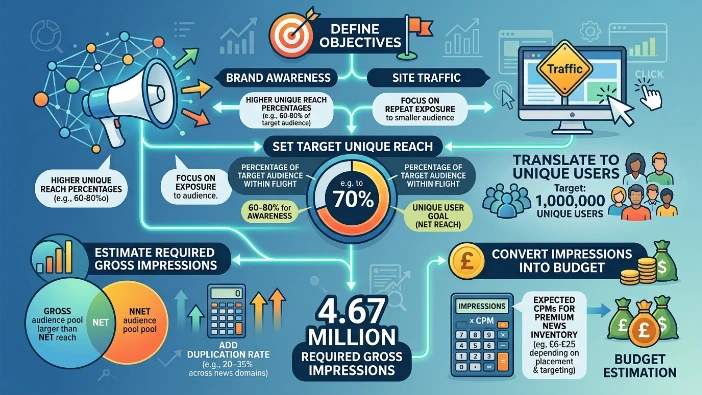
Start by selecting an objective: brand awareness or site traffic. Brand awareness targets often require higher unique reach percentages, commonly 60–80% of the target audience within the flight. Direct response targets focus on repeat exposures to a smaller audience. Translate unique reach goals into numbers. For example, targeting 1,000,000 unique users at 70% reach requires planning for a gross audience pool large enough to deliver that net reach after duplication. Use historical duplication data or benchmark duplication rates of 20–35% across news domains to estimate required gross impressions. Convert impressions into budget by using expected CPMs for premium news inventory, for example £6–£25 CPM depending on placement and targeting.
How do you select the right set of news publishers to balance scale and uniqueness?
Select publishers by editorial relevance, verified inventory type, audience profiles, and historical overlap metrics to balance scale and uniqueness.
Prioritise publishers with strong editorial fit for the campaign theme. Verify inventory types: direct-sold deals and private marketplaces provide more control than open exchanges. Obtain audience profile data from publishers and from measurement partners to evaluate demographic and behavioral overlap. Use historical overlap matrices that show percentage audience duplication between publisher domains. Choose a mix of national, regional, and vertical news sites to lower overlap. For example, combine one national broadsheet, two regional publishers, and one sector-specific news site to reach varied audience segments. Negotiate PMP deals that include exclusivity windows or audience guarantees where possible to reduce duplication risk.
How do you set up targeting and frequency controls to limit duplication?
Use unified ID systems, cross-domain frequency caps, cohort-level targeting, and campaign-level frequency rules to limit duplicate exposures.
Implement a unified user identifier across DSP buys to recognize the same user across publisher domains. Set campaign-level frequency caps for unique reach goals, for example one exposure per user per day and three exposures per user per campaign flight. Configure frequency caps at the same identifier scope used by measurement vendors to ensure consistent counting. Use cohort-level targeting such as contextual segments or aggregated audience cohorts to reduce reliance on device-level targeting that increases duplication. Where available, apply deduplication features in DSPs that exclude users already reached by a parallel deal or line item. Monitor frequency distributions and adjust caps dynamically to maintain reach efficiency.
How do you negotiate deals and set contractual terms to control overlap?
Negotiate PMPs with inventory allocation clauses, audience guarantees, and deduplication commitments to control overlap and secure transparency.
Request deal terms that specify inventory allocation by content vertical, time slots, or audience segments. Include audience delivery guarantees with remediation clauses that credit or rebill for shortfalls. Ask publishers for available first-party audience match rates and expected overlap estimates. Require sellers to provide inventory logs, placement IDs, and sampling access for measurement verification. Where possible, negotiate exclusivity windows for target segments to reduce simultaneous bidding across multiple publishers. Contractual language can mandate participation in agreed verification standards and reporting cadences.
How do you plan campaign structure and line-item logic in the DSP?
Design a hierarchical campaign structure with deduplication-aware line items, exclusive priority rules, and sequential delivery windows.
Create separate line items for each publisher deal and label them by priority and target segment. Set higher priority for direct-sold or PMP line items and lower priority for open-exchange fallbacks. Use exclusion lists to prevent the same user being targeted by lower-priority line items once served by a higher-priority line item. Implement sequential delivery windows so that initial net reach buys run first, then apply frequency-driven retargeting waves for additional exposure. Configure shared frequency caps across all line items to enforce campaign-level exposure limits. Maintain consistent creative rotation and tracking pixels across line items to simplify deduplication monitoring.
How do you measure duplication and verify unique reach during the campaign?
Use third-party measurement that provides person-level or probabilistic deduplication, viewability filters, and cross-domain reach reports to verify unique reach.
Deploy a verification vendor or independent measurement partner that reports unique reach, duplicate exposure rate, and viewability-adjusted impressions. Use person-level identifiers where privacy-compliant; otherwise use probabilistic matching models validated against panel data. Request cross-domain reach curves and reach by frequency buckets. Apply viewability thresholds, for example 50% pixels in view for one second for display, to exclude non-viewed impressions from reach calculations. Compare DSP delivery logs with verification reports to detect discrepancies and reconcile counts. Adjust campaign pacing and frequency caps based on real-time reach curves to hit net reach targets.
What tools and technologies reduce duplication risk?
Tools include unified ID solutions, clean-room matching, measurement partners, PMP deal management platforms, and publisher-supplied first-party segments.
Check Out the Full Article:
Brand Awareness vs Direct Response: Choosing the Right UK Banner Campaign Objective
Unified ID solutions reduce fragmentation of identifiers across platforms. Clean-room matching enables privacy-safe deduplication between publisher and advertiser datasets. Measurement partners provide independent reach and duplication metrics. PMP deal management platforms aggregate deal IDs and help set cross-deal deduplication rules. Publisher-supplied first-party segments allow targeting without relying on broad audience pools that increase overlap. Use these technologies together to enforce consistent identity, measurement, and exclusion logic.
Explore More Expert Insights:
Retargeting vs Contextual Placement: UK B2B Banner Performance Data Compared
UK Display Advertising Benchmarks 2026: CTR, Viewability and CPM by Sector
What reporting cadence and optimisation steps ensure target reach with minimal duplication?
Establish daily delivery checks, weekly deduplication audits, and mid-flight optimisation to rebalance buys and update frequency rules.
Run daily checks on impressions, frequency distributions, and publisher delivery. Conduct weekly audits of overlap metrics and reach curves to identify excess duplication or under-delivery. If duplication exceeds forecasted thresholds, reallocate budget from high-overlap publishers to lower-overlap publishers or expand contextual breadth to new verticals. Update frequency caps and line-item priorities based on observed reach velocity. At the midpoint, run a controlled increment test by pausing a publisher deal to measure incremental reach and refine future allocation.
What are common failure modes and how are they mitigated?
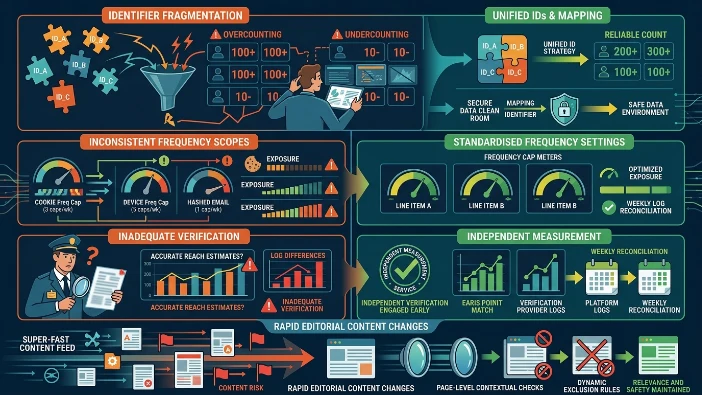
Common failures include identifier fragmentation, inconsistent frequency scopes, and inadequate verification; mitigation requires unified IDs, standardised frequency settings, and independent measurement.
Identifier fragmentation happens when different systems use distinct IDs, causing overcounting or undercounting. Adopt a single identifier strategy or map identifiers through clean rooms. Inconsistent frequency scopes occur when caps apply to cookie, device, or hashed email differently standardise frequency scope across line items. Inadequate verification leads to inaccurate reach estimates; engage independent measurement early and reconcile logs weekly. Also mitigate rapid editorial content changes by applying page-level contextual checks and dynamic exclusion rules to maintain relevance and safety.
Get Detailed Information Here:
Brand Safety in UK Digital Advertising: Why News Environments Score Highest in 2026
Planning a UK banner campaign across multiple news sites without duplicating reach requires explicit goals, quantified unique reach targets, publisher selection guided by overlap matrices, and structured DSP setups with shared frequency caps. Negotiate PMPs with clear delivery and deduplication terms. Use unified identifiers, clean-room matching, and third-party measurement to verify unique reach. Maintain active reporting and mid-flight optimisation to rebalance spend and achieve efficient net reach. These steps create a disciplined approach to scale reach across verified news inventory while minimising wasted impressions and maximising campaign efficiency.



