

A banner advertising contract is a legally binding agreement that defines ad placement, delivery, pricing, measurement, and liability for digital display campaigns.
A banner advertising contract sets obligations for both advertiser and publisher. It records campaign start and end dates, creative specifications, inventory positions, guaranteed impressions or clicks, and payment terms. The contract converts commercial intent into enforceable terms. For UK brands, this document protects budget, ensures measurable delivery, and assigns legal responsibility for data processing and content compliance. Advertisers use the contract to require reporting, define remediation for underdelivery, and secure intellectual property protections for creative assets.
What core delivery terms must marketers negotiate?
Negotiate guaranteed impressions, delivery schedule, frequency caps, and viewability thresholds with clear remediation for underdelivery.
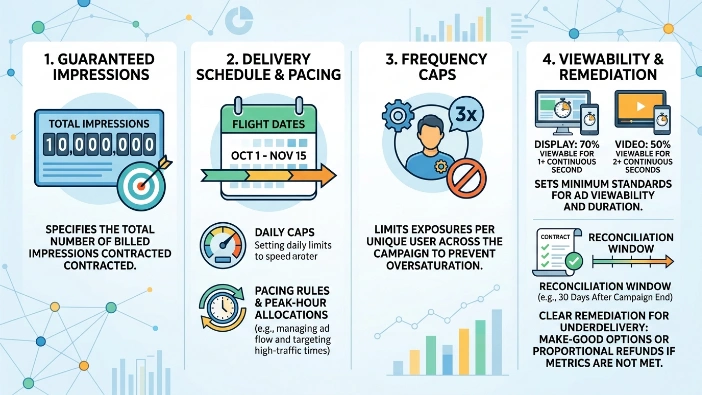
Guaranteed impressions specify the total number of billed impressions. The delivery schedule defines flight dates and pacing rules, including daily caps and peak-hour allocations. Frequency caps limit exposures per unique user across the campaign to prevent oversaturation. Viewability thresholds set minimum standards, often expressed as a percentage viewable for a minimum duration, for example, 70 per cent viewable for one continuous second for display and 50 percent for video for two continuous seconds. Contracts must state percentage options or proportional refunds if guaranteed metrics are not met within an agreed reconciliation window, typically 30 days after campaign end.
What pricing and payment clauses are essential?
Define CPM or flat-fee rates, billing currency, invoicing cadence, late-payment penalties, and rebates or credits for non-delivery.
Specify the pricing model: cost per mille (CPM), cost per click (CPC), flat-fee sponsorship, or programmatic guaranteed. Include the exact price per unit and any volume discounts tied to impression bands, for example reduced CPM after 5,000,000 impressions. State billing currency, usually GBP for UK contracts, and invoicing cadence, commonly 30-day net. Include penalties for late payment, such as 2 percent per month, and conditions for withholding payment if delivery disputes exist. Require documented credits or makegood impressions when underdelivery exceeds an agreed tolerance, often 5 percent.
What technical and creative specifications must be included?
List exact creative sizes, file formats, weight limits, clickthrough URLs, and approved backup assets with trafficking acceptance timelines.
Technical specs define ad dimensions (for example 300×250, 728×90, 300×600), accepted file types (JPEG, PNG, HTML5, MP4), maximum file sizes (for example 150 KB for static; 1 MB for rich media), and acceptable codecs for video. The contract must state whether third-party ad servers are allowed and include ad-tagging procedures. Creative acceptance timelines require advertisers to deliver assets a specified number of business days before launch, commonly five business days. The agreement should require publisher confirmation of successful trafficking and provide fallback creative instructions for rejected assets.
How should measurement, verification, and reporting be defined?
Specify primary metrics, independent verification partners, reporting cadence, and access to impression-level logs for audits.
Define measurement metrics such as delivered impressions, viewable impressions, time-in-view, clicks, and video quartile completions. Name acceptable measurement vendors or allow independent verification through neutral ad servers. Set reporting cadence, typically weekly during flight and final reconciliation within 15–30 days post-campaign. Include the right to access impression-level logs containing timestamps, creative IDs, placement IDs, and viewability tags for audit purposes. State the reconciliation process and acceptable discrepancy tolerances, for example 5 percent, and dispute resolution timelines.
What brand safety, editorial, and contextual placement terms are required?
Negotiate explicit placement restrictions, adjacency rules, keyword exclusions, and editorial approval procedures to protect brand reputation.
Define prohibited content categories such as illegal activity, hate speech, and adult content. Include adjacency clauses that prevent placement next to specified topics or keywords. Require publisher-provided placement lists or section-level targeting with exact URLs where available. State editorial approval rights for sponsored content or native units and require the publisher to confirm page-level context before flight. For regulated sectors, include mandatory pre-approval and periodic checks during the campaign.
How must data protection and privacy responsibilities be allocated?
Allocate responsibilities for data collection, processing, consent, and cross-border transfers, with explicit compliance references to UK data protection law.
Identify data types processed: IP addresses, cookie identifiers, hashed emails, and behavioural signals. Specify lawful bases for processing under the UK Data Protection Act and, where applicable, consent management platform requirements. Require publishers to maintain records of consent and to supply anonymised or aggregated reporting when identifiers are not available. Include clauses for data retention limits and data deletion upon campaign completion. Address cross-border data transfers and require standard contractual clauses or equivalent safeguards when personal data moves outside the UK.
What intellectual property and creative usage rights must be negotiated?
Grant limited-use licences for creative assets, defining ownership, usage periods, and rights for derivatives or re-use.
State that advertisers retain ownership of creative except for license grants necessary for campaign delivery. Define licence scope: territories (for example, the United Kingdom), duration (for example campaign dates plus 30 days for reporting), and permitted uses (display on specified inventory only). Require written permission for any reuse, modification, or derivative works. Include indemnities for third-party IP claims arising from advertiser-provided assets and require publishers to remove infringing materials upon notice.
What liability, indemnity, and termination clauses protect both parties?
Define caps on liability, indemnity scopes, insurance requirements, and termination rights for breach or prolonged non-performance.
Set liability caps tied to fees paid under the contract, commonly equal to the total campaign fee or two times the campaign fee for severe breaches. Define indemnity obligations: advertisers indemnify publishers for IP infringement and illegal content in creatives; publishers indemnify advertisers for misrepresentation of inventory or non-compliance with data law. Require minimum insurance coverage levels, for example £1,000,000 public liability. State termination rights for material breach with cure periods, frequently 15 business days, and outline repayment or pro-rata refund mechanics upon termination.
Explore More Expert Insights:
How Times Intelligence Delivers Verified Impressions Across Its UK News Network
Brand Awareness vs Direct Response: Choosing the Right UK Banner Campaign Objective
What operational workflows and governance help ensure smooth execution?
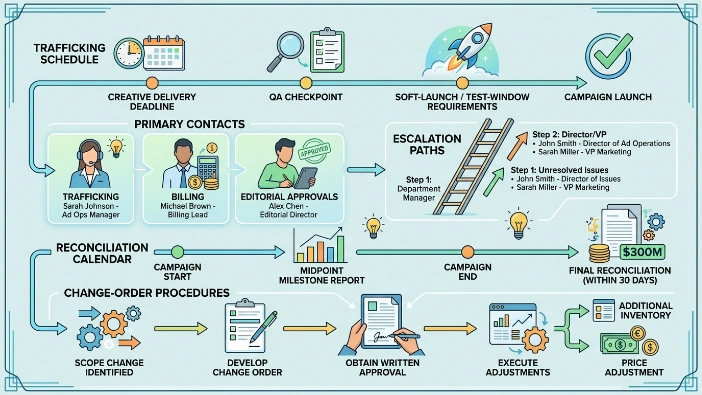
Establish trafficking timelines, points of contact, escalation paths, and a reconciliation calendar with specified milestones.
Include a trafficking schedule that lists creative delivery deadlines, QA checkpoints, and soft-launch or test-window requirements. Name primary contacts for trafficking, billing, and editorial approvals, and list escalation contacts for unresolved issues. Define a reconciliation calendar with milestone reports at campaign midpoint and final reconciliation within 30 days. Require change-order procedures for scope changes, including written approval and price adjustments for additional inventory.
When should brands use premium or guaranteed direct inventory versus programmatic options?
Use premium guaranteed inventory for brand safety, editorial adjacency, and deterministic audience alignment; use programmatic for scale and dynamic performance optimisation.
Align inventory choice with campaign objectives. If the objective requires precise context control, known audience segments, and guaranteed viewability, negotiate direct guaranteed buys with publishers. If the objective prioritises broad reach, rapid optimisation, and lower CPMs, retain programmatic channels. For campaigns combining both needs, include hybrid clauses that allow partial makegoods across channels or define substitution rules with prior written consent.
Get the Full Insights Here:
From Programmatic to Premium: Why UK Brands Are Moving Budget Back to Direct Display
A robust banner advertising contract converts commercial intent into enforceable technical, legal, and operational terms. UK brands must negotiate delivery guarantees, pricing and payment, technical and creative specs, measurement and verification, brand safety and editorial controls, data protection allocations, IP rights, liability and termination provisions, and operational governance. Clear, measurable clauses reduce disputes, protect budgets, and align campaign execution with legal and compliance requirements.
For technical audience-targeting strategies, see the following:
First-Party Audience Targeting on UK News Sites: How It Replaces Third-Party Cookies



