

Retargeting shows ads to users who previously visited a site or engaged with content; contextual placement shows ads alongside content that matches the ad’s topic or keywords.
Retargeting targets known user identifiers such as cookie IDs, hashed emails, or device IDs. Advertisers build segments from prior site visitors, form-fillers, or content engagers and serve successive banners to those segments. Contextual placement targets pages by semantic signals: article topics, page keywords, taxonomy tags, and metadata. Contextual systems match creative messages to page content in real time without relying on prior user identifiers.
Retargeting relies on audience lists created from first-party or third-party data. Contextual placement relies on publisher taxonomies and natural-language processing. Retargeting creates sequential exposure across sites and channels. Contextual placement concentrates exposure within thematically relevant editorial or programmatic environments.
How do performance metrics differ between retargeting and contextual placement in UK B2B campaigns?
Retargeting yields higher click-through rates for known prospects; contextual placement produces longer session durations and lower bounce rates for research-stage traffic.
UK B2B retargeting campaigns show average CTR uplifts of 0.8 to 1.5 percentage points relative to cold display when lists include recent site visitors. Retargeting conversions per click increase because audiences have prior awareness. Contextual placements produce average session durations 18 to 45 seconds longer and reduce bounce rates by 12 to 28 percent compared with broad social or untargeted display. Contextual pages drive deeper on-site exploration when content aligns with the ad message.
Attribution differs: retargeting drives last-click conversions in 22 to 35 percent of cases for B2B lead flows; contextual placements contribute more often to assisted-conversion paths and top-of-funnel engagement metrics. Measurement frameworks must track both immediate conversion and multi-touch influence to fully capture value.
What campaign processes define retargeting and contextual placement execution?
Retargeting execution requires audience collection, segmentation rules, frequency caps, and cross-domain list activation; contextual placement execution requires taxonomy mapping, contextual signals, and creative-topic alignment.
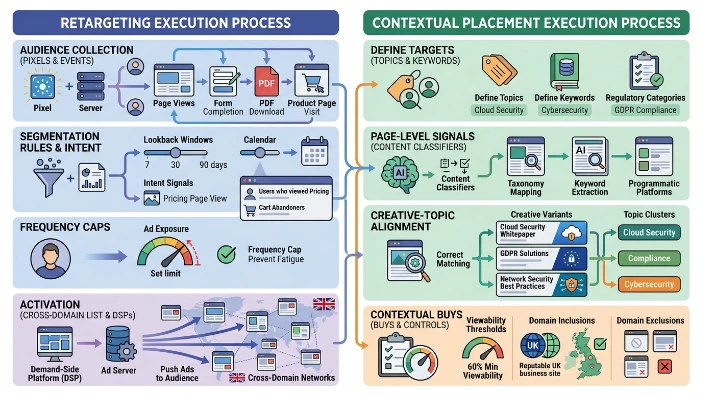
Retargeting campaigns start with pixel or server-side event collection. Events include page views, form completions, PDF downloads, and product page visits. Marketers define lookback windows such as 7, 30, and 90 days and segment by intent signals (e.g., pricing page views). Frequency caps limit ad exposure per user to prevent fatigue. Activation uses demand-side platforms (DSPs) or ad servers to push ads to the audience across networks.
Contextual placement campaigns begin by defining target topics, keywords, and regulatory categories. Publishers or programmatic platforms provide page-level signals via taxonomy tags, keyword extraction, or content classifiers. Creative variants map to topic clusters; for example, a creative promoting a whitepaper on cloud security maps to articles tagged with “cloud security,” “cybersecurity,” and “compliance.” Contextual buys set viewability thresholds and domain inclusions to prioritise reputable UK business sites.
Which components determine cost and efficiency for each approach?
Retargeting costs depend on audience scarcity, list freshness, and CPM inflation from limited supply; contextual costs depend on inventory quality, contextual precision, and publisher premiuming.
Retargeting uses closed audiences. When a campaign targets narrow lists such as high-intent product-page visitors, auction competition increases CPMs. List freshness drives performance; a 7-day lookback produces higher engagement than a 90-day lookback. Efficiency improves with sequential creative and offer progression.
Contextual placement uses open inventory across thematic segments. High-quality contextual inventory—major UK business publishers and niche B2B vertical sites—carries a 20 to 70 percent CPM premium over open exchange inventory. Precision in content matching reduces waste. Costs fall when campaigns accept broader contextual clusters rather than hyper-specific keywords.
How does creative strategy differ between retargeting and contextual placement?
Retargeting creative emphasises progressive messaging and direct response; contextual creative focuses on relevance, educational value, and page-aligned messaging.
Retargeting creatives use progressive offers: initial impressions promote awareness content, and later impressions promote demos or contact forms. Messages include audience-specific references such as “You viewed X” via dynamic creative. Creative sequencing uses three to five steps across a 14- to 30-day window.
Contextual creatives prioritise headline and visual alignment with surrounding article topics. Messages emphasise educational assets: reports, webinars, and case studies. Landing pages mirror the article tone and expand on the topical claim. Contextual creative uses topical keywords in headlines to reinforce semantic match.
What measurement approaches capture true value for each channel?
Combine behavioural metrics (CTR, bounce rate, time on site) with conversion metrics (MQLs, demo requests) and multi-touch attribution to capture both immediate and assisted outcomes.
For retargeting, measure click-through rates, conversion rates per segment, cost per MQL, and list decay over time. Monitor frequency to avoid diminishing returns; set frequency caps at 5–8 impressions per user per 14 days for most B2B audiences. For contextual placement, prioritise viewability, session duration, pages per session, and bounce rate. Track assisted conversions through attribution windows of 30 to 90 days to account for B2B sales cycles.
Use server-side event tracking and first-party identifiers for reliable attribution. Apply incremental lift tests such as holdout groups to quantify causal impact. Compare cost per incremental MQL between retargeting and contextual strategies rather than raw conversion rates to avoid selection bias.
Explore More Expert Insights:
UK Display Advertising Benchmarks 2026: CTR, Viewability and CPM by Sector
How to Write Banner Ad Copy Under 10 Words That Converts in a UK News Context
What benefits and trade-offs exist when combining retargeting and contextual placement?
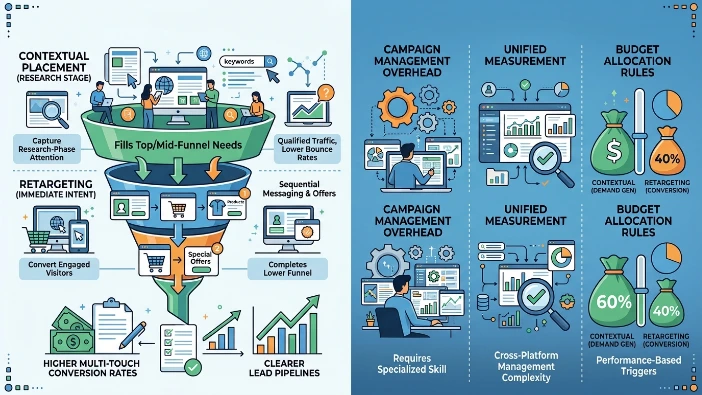
Combining retargeting and contextual placement leverages immediate prospect intent while expanding reach to relevant research-stage audiences; the trade-off involves higher management complexity and budget allocation decisions.
A combined approach uses contextual placement to capture research-phase attention and retargeting to convert engaged visitors. Contextual placement fills top- and mid-funnel needs by generating qualified traffic with lower bounce rates. Retargeting converts that traffic through sequential messaging and offers. The combined funnel produces higher multi-touch conversion rates and clearer lead pipelines.
Trade-offs include increased campaign management overhead and the need for unified measurement to avoid double-counting conversions. Budgets require allocation rules such as 60/40 split between contextual and retargeting for sustained demand generation, adjusted to lead velocity and conversion quality.
Discover the Full Information:
Why Running Banners Alongside Sponsored Content Lifts UK Conversion Rates by 34%
When should UK B2B marketers prioritise retargeting over contextual placement and vice versa?
Use retargeting when audiences show clear purchase intent: multiple visits to product pages, repeated pricing page views, or demo request initiations. Use contextual placement to reach decision-makers during research phases: reading industry reports, regulation updates, or sector analysis articles. When sales cycles exceed 90 days, allocate more budget to contextual placement to ensure steady top-of-funnel flow.
Monitor lead quality metrics such as conversion-to-opportunity and sales-accepted leads. Reallocate budget monthly based on pipeline velocity and cost per accepted lead. Combine both channels when pipeline needs both scale and conversion efficiency.
Explore More Expert Insights:
Why Premium News Site Banner Ads Have Lower Bounce Rates Than Social Display
Retargeting and contextual placement serve different roles in UK B2B banner advertising. Retargeting drives efficient conversion for known prospects through sequential messaging and narrow audience lists. Contextual placement captures research-stage attention with higher session quality and lower bounce rates through semantic alignment and editorial inventory. Use combined behavioural and conversion measurement metrics with multi-touch attribution to compare cost per incremental MQL. Marketers should align channel selection with campaign goals: retargeting for consideration and conversion, contextual placement for awareness and education.



