Premium news site banner ads show lower bounce rates because audiences on news sites have higher engagement intent, viewability rates are higher, and ad-context alignment increases relevance for readers.
Premium news sites attract users who seek information, analysis, and updates. These users read articles for longer sessions and navigate multiple pages. Banner ads on these sites appear within editorial environments that match the user’s informational intent. That alignment increases the chance users click and then continue interacting with the landing page, producing lower bounce rates. Social display ads appear inside feeds where users browse for social signals, entertainment, or quick updates. Feed-based environments generate rapid scrolling and less focused attention, which increases the likelihood that a user clicks and then leaves the landing page immediately, or never clicks at all.
Higher viewability on premium sites results from page layouts built for long-form reading and standardized ad placements that load with content. Social feeds use dynamic loading and variable placements that reduce viewability and measurable engagement. Measurable engagement correlates with post-click behaviors; ads seen by engaged readers convert into sessions with multi-page views more often than ads seen in transient social contexts.
Why does user intent on premium news sites reduce bounce rates compared with social platforms?
Users on news sites search for facts and context; this task-driven intent increases time on site and page-depth after ad clicks.
Task-driven sessions begin with a goal: verify a fact, follow a developing story, or research a topic. Readers enter a news site to satisfy that goal. When an ad aligns with that goal—commercial information, a detailed report, or a related analysis—the user evaluates the landing page as part of their research process. This evaluation leads to additional clicks, article reads, or deeper navigation. Social platforms prioritize interpersonal updates and entertainment. Browsing sessions there focus on novelty and social signals, not structured research. Clicks originating in those sessions often lack the same information-seeking frame, which increases single-page exits.
Search behaviors also differ. Users who arrive at a news site from search engines often have precise queries, and on-site navigation reflects follow-up queries. Social clicks frequently interrupt a scroll, and the interruption lacks the same search-oriented follow-up behavior. As a result, post-click pathways on premium news domains show more sequential pageviews compared with social-originated traffic.
How do viewability and ad placement affect bounce rates on premium news sites?
High viewability and standardised placements on news sites deliver ads in-visible locations, increasing ad attention and subsequent site interaction.
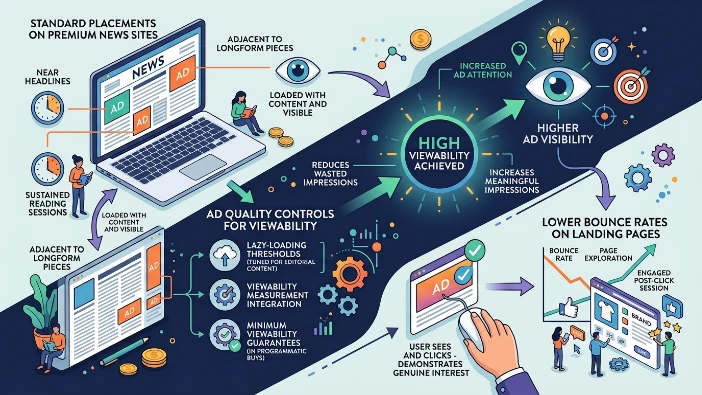
Premium news sites use layout conventions that serve content and ads together. Ad slots are positioned near headlines, within article columns, or adjacent to long-form pieces. These positions load with the article and are visible during sustained reading sessions. High viewability reduces wasted impressions and increases meaningful impressions—impressions that have a better chance of leading to informed clicks and engaged post-click sessions. Social display often uses in-feed slots that appear briefly as users scroll. These impressions register as served but carry lower attention metrics.
Ad quality controls on premium sites, such as lazy-loading thresholds tuned for editorial content, viewability measurement integration, and minimum viewability guarantees in programmatic buys, increase the proportion of ads that users actually see. When users see an ad and click, they demonstrate genuine interest. This interest translates into exploration on the landing page and lower bounce rates.
What role does editorial context play in reducing bounce rate for banner ads?
Editorial context provides semantic signals that make banners appear relevant; semantic relevance increases post-click engagement.
Editorial context means the article surrounding a banner ad provides topical signals: headlines, paragraph content, images, and tags. These signals create semantic alignment between the ad creative and the page. When creative matches context, users perceive the ad as an extension of the editorial narrative. They click to learn more because the ad supplements their reading. In contrast, social feeds show mixed content with weaker topical coherence. Ads in that environment face a higher relevance gap relative to user intent.
Contextual relevance also supports credibility. Readers attribute authority to reputable editorial sources. That perceived authority lowers friction for users to explore an advertiser’s page, improving dwell time and reducing bounce. The combination of semantic alignment and perceived credibility explains measurable differences in post-click behavior between premium news placements and social placements.
Which audience and measurement differences explain lower bounce rates on premium news sites?
Audience composition and measurement signals on news sites show older, more affluent, and more information-focused users who generate longer sessions and more pageviews after ad clicks.
Premium publishers attract registered users, subscribers, and consistent readers. These segments skew toward adults aged 35 and older in the United Kingdom, often with higher education and stable browsing habits. These users spend more time reading and more time evaluating linked content. Social platforms skew younger and show more mobile-first, short-session behaviors. Metrics such as pages per session, time on site, and return visits are higher for users of major UK news sites; these metrics predict lower bounce rates.
Measurement systems also differ. Premium sites use server-side analytics and first-party cookies, providing more reliable session stitching and cross-page attribution. Social platforms often redirect traffic through tracking redirects and app webviews that fragment sessions. Fragmented sessions increase measured bounce rates because analytics tools register exits at the point of session break rather than true user intent. Reliable session continuity on news sites reduces artificial bounces.
How do creative formats and load behavior influence post-click engagement?
High-quality creative, fast landing-page load times, and consistent creative-to-landing messaging reduce bounce rates for premium news site banners.
Premium publishers implement creative standards with file-size limits, format guidelines, and quality controls that preserve page performance. Better creative preserves user attention and avoids the negative experience caused by slow or intrusive ads. Landing pages linked from premium ads tend to be optimized for content and load speed, because quality media buyers require performance standards and because advertiser campaigns designed for editorial environments invest in matching landing experiences. Fast, relevant landing pages retain users and prompt deeper exploration.
Social display campaigns sometimes use heavy tracking scripts, slow redirects, or landing pages built for conversion velocity rather than content exploration. These factors increase drop-off immediately after click. The combination of clean creative, controlled load behavior, and aligned messaging on premium sites produces higher retention after ad clicks and therefore lower bounce rates.
Explore More Expert Insights:
UK Digital Ad Spend Hit £20.4bn in 2025: Where Banner Advertising Fits in the Mix
How Contextual Targeting Replaced Cookie-Based Retargeting for UK Brands in 2026
What benefits arise from lower bounce rates on premium news site banner ads?
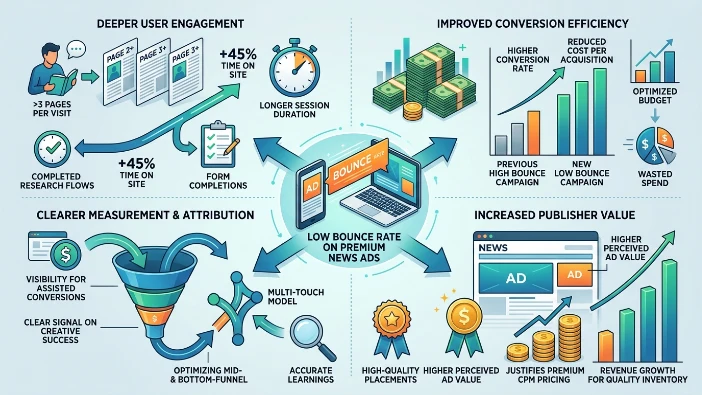
Lower bounce rates indicate stronger post-click engagement, which improves conversion efficiency, reduces wasted ad spend, and yields clearer attribution for longer customer journeys.
When bounce rates fall, campaigns show more second-page views and longer sessions, which increases the chance of conversions tied to research processes, form completions, or multi-step purchase flows. Advertisers gain clearer signal about which creatives and contextual alignments work for audience segments. This clarity supports efficient budget allocation because media buyers can scale placements that generate durable engagement rather than short, single-page visits. For publishers, lower bounce rates increase perceived ad value and justify premium CPM pricing for high-quality placements.
Lower bounce rates also support better measurement of assisted conversions. Campaigns that generate multi-page sessions are more visible in multi-touch attribution models. That visibility helps marketers optimize mid- and bottom-funnel activities based on real engagement patterns rather than isolated clicks.
When should advertisers choose premium news site banner placements instead of social display?
Advertisers should choose premium news site banners when the campaign goal is user education, research-stage consideration, or multi-step conversion processes that require longer sessions.
Use premium placements when the target audience requires informational context, when the product or service involves deliberation, or when the campaign aims to build credibility through association with editorial authority. Examples include thought-leadership content, whitepaper downloads, regulatory updates, or industry reports. Campaigns that need measurable downstream effects such as lead generation or subscription sign-ups benefit from the sustained sessions typical of premium placements.
Social display remains effective for awareness that targets broad reach, rapid creative testing, or social proof objectives. Choose the channel that matches campaign intent: premium news for depth, social for scale.
Read More for Better Understanding:
Retargeting vs Contextual Placement: UK B2B Banner Performance Data Compared
Premium news site banner ads show lower bounce rates because readers on those sites exhibit task-driven intent, higher viewability, editorial relevance, and more reliable measurement. Ad placements that align creative, context, and landing experience on these sites produce longer sessions and deeper navigation after clicks. Advertisers focused on research-driven or multi-step conversions should prioritise premium editorial environments for banner placements to capture durable post-click engagement.
Complete Details Available Here:
Why Running Banners Alongside Sponsored Content Lifts UK Conversion Rates by 34%