
Ultra-short banner ad copy is a concise headline of nine words or fewer designed to grab attention and prompt a single action. In UK news environments it increases viewability, reduces cognitive load, and fits editorial constraints for mobile and desktop readers.
Ultra-short banner ad copy defines a single message in a compact form. It limits the creative to a core value proposition, action, or emotional trigger. UK news sites display banners in mixed editorial flows, breaking stories, and homepage modules. Those environments reward clarity and immediacy. Readers scan headlines fast; short copy matches that speed. Short copy also improves legibility on mobile, where 60–70% of UK news traffic arrives. Shorter text reduces truncation risk in programmatic placements and preserves the call-to-action (CTA) within visible safe zones.
How do you choose a single, convertible message for under-10-word copy?
Pick one clear benefit or action, use active verbs, and remove modifiers; test three variants (benefit, offer, and curiosity) across placements.

Start by identifying one measurable outcome the ad delivers: save money, get a free trial, join an event, or read exclusive analysis. Translate that outcome into a short benefit phrase: “Save 20% on Winter Energy Bills” or “Join Free Local Health Webinar.” Use an active verb first when space allows: “Claim”, “Save”, “Join”, “Read”, “Book”. Remove adjectives that do not change the promise. For UK news audiences, use topical or local signals when relevant: include city names, currency symbols, or date markers (for example, “London”, “£”, “June 24”). Build three concise variants and run a lightweight A/B test for at least 7 days or 50,000 impressions per creative to identify the best performer.
Which linguistic structures work best under 10 words?
Commands, numeric offers, and tightly framed questions convert well; use exact numbers, timeframes, and proper nouns when space permits.
Commands with a direct verb prioritise action “Claim £10 Credit Now” or “Read Exclusive NHS Analysis.” Numeric offers anchor value: “Save 30% This Weekend” or “2-Week Free Trial.” Tight questions spark curiosity if they reference a topical news item: “Worried About Energy Bills?” Avoid compound clauses. Keep subject and predicate compact. When using modifiers, prefer numerals and symbols: “£”, “%”, “1-2 weeks.” For UK readers, include local spelling and terminology (for example, “cancel anytime” and “freephone” where relevant).
What design and placement constraints affect under-10-word copy in UK news environments?
Safe margins, font size, and programmatic truncation dictate short copy; reserve 30–40% of creative for legibility and place the CTA in the final visible words.
News publishers set strict safe zones to prevent editorial overlap. Programmatic placement can inject creatives into several formats simultaneously; platforms may crop text. Set font sizes to ensure legibility at 320px width and assume 30% of horizontal space is taken by logos or images. Place the CTA or action phrase at the end of the copy so it remains visible if cropping occurs. Use high-contrast color pairs that follow publisher contrast guidelines to pass accessibility checks. For animated banners, limit motion to 1–2 transitions and keep the final frame static for at least 700 milliseconds to allow reading.
How do contextual signals change copy choices for different UK news categories?
Align copy with the article topic and reader intent: finance needs numeric claims, politics needs specificity, local news needs place names and dates.
Contextual targeting pairs ads with article content. For finance sections, use precise savings, rates, or deadlines: “Lock 1.99% Now” or “Switch and Save £300.” For politics or public affairs, use specific facts or exclusive access: “Read the Full Briefing” or “MPs Debate Tonight.” For local news pages, include locality: “Manchester Flood Aid: Donate Now” or “London Jobs Fair, 10 July.” Match tone to section: neutral and factual for news, urgent and practical for breaking stories. Maintain strict factual accuracy; do not overpromise.
What testing framework suits ultra-short copy in news placements?
Use an experiment with three copy types, measure CTR and post-click conversion, and segment by section and device for 14 days.
Run three creative groups: Benefit-first, Offer-first, and Curiosity-first. Keep imagery and color constant to isolate copy. Track click-through rate (CTR), view-through rate (VTR) for animated creatives, and landing-page conversion rate. Segment results by news section (national, finance, local), device (mobile, desktop), and time of day. Aim for a statistical confidence level of 95% before selecting a winner. Use at least 50,000 impressions per variant for reliable results in UK news inventory.
Which landing page elements must match ultra-short banner copy?
Landing pages must repeat the exact value proposition, show the same offer prominently, and minimise friction with one clear CTA above the fold.
Consistency between ad and landing page preserves conversion intent. The landing headline should reuse the ad’s core phrase verbatim when possible. Show the numeric offer, timeframe, and local details on the first visible screen. Remove extra navigation that distracts from the conversion task. Reduce form fields to the minimum: aim for three or fewer to increase form completion. For offers requiring verification, state next steps and time expectations clearly: “Verification email within 5 minutes.”
What regulatory and editorial rules affect messaging in UK news inventory?
Follow ASA advertising rules, include required disclaimers for financial or health claims, and respect publisher content policies; disclose paid placement where required.
UK advertising standards require truthful claims and clear disclosure of material connections. Financial promotions must include risk disclaimers and eligibility criteria. Health claims require NHS or MHRA-aligned statements when referencing treatments. Publishers often require “advertisement” labels for native ad units. For currency-based claims, present representative APR or cost figures. Keep legal text readable and link to full terms when space limits detail.
When should brands choose ultra-short copy versus longer formats?
Choose ultra-short copy for high-frequency, low-attention placements and mobile-first placements; use longer copy where audience dwell time and contextual depth increase.
Ultra-short copy wins on homepage tiles, in-article banners, and mobile MPUs where scanning dominates. Use 10–20 word copy or a short subhead when the placement supports an extended message or when the audience is engaged in long-read content. If the publisher offers sponsored content modules, provide a short headline supported by a concise description to balance attention and information.
Explore More Expert Insights:
Creative Testing for UK News Site Banners: A 4-Variable Framework That Reduces CPC
How to Set Frequency Caps for UK Display Campaigns That Avoid Audience Fatigue
How does contextual advertising change creative strategy compared to cookie-based retargeting?
Contextual targeting aligns the ad’s message with page content rather than user history; write copy that references the article topic and reader intent for higher relevance.
Contextual targeting places creatives next to semantically matched content. For UK news, this means customising short copy to the article’s theme. Retargeting relied on past user behaviour and allowed broader personalisation. Contextual ads require immediate relevance to the current article. Use keyword signals from the page topic, location, and named entities to craft the one-line promise. The result is a message that fits editorial tone and reduces privacy risk.
How do you scale ultra-short copy production for campaigns across UK news sites?
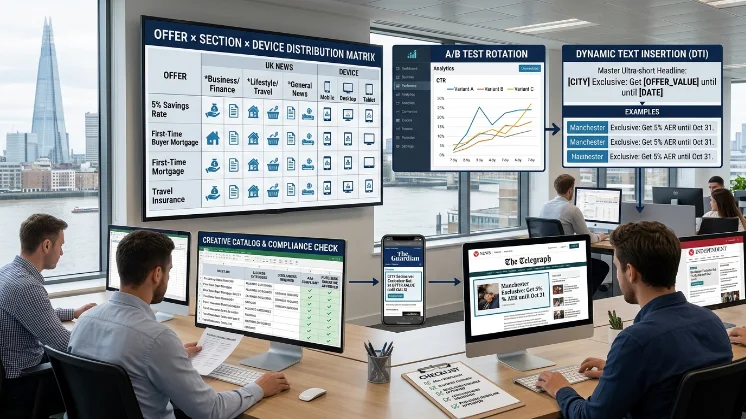
Create a matrix of offer × section × device, produce three variants per cell, and automate deployment with contextual rules and dynamic text insertion.
Define a manageable set of offers and map them to news sections. Use dynamic text insertion to swap locality, dates, or numbers. Maintain a creative catalogue of approved short headlines and tag each with allowed categories and disclaimers. Automate A/B tests and rotate top performers weekly. Enforce an approval workflow that checks ASA compliance and publisher guidelines before launch.
Discover the Full Information:
How Contextual Targeting Replaced Cookie-Based Retargeting for UK Brands in 2026
Write one crystal-clear message in nine words or fewer. Use active verbs and exact numbers. Align the phrase with the article topic and placement constraints. Test three variants per context, measure CTR and conversion, and repeat based on section and device performance. For UK news environments, prioritise legibility, regulatory compliance, and direct value communication.
Explore More Useful Information:
Banner Advertising Packages for UK Brands: Formats, Placements and Pricing Tiers