

Running banners alongside sponsored content means placing display ads on the same pages as paid editorial articles to create simultaneous exposure and message reinforcement for the same audience.
Sponsored content refers to paid articles or native pieces produced to inform a target audience about a topic. Banner placements are traditional display units—leaderboards, MPU, or skyscrapers—positioned on the same article page. The combined placement creates parallel touchpoints: the reader engages with the sponsored article while also seeing a visual banner message. This setup increases the probability that a reader will click, convert, or return to the advertiser’s landing page because exposure happens within a single session and a consistent topical environment.
Why does combining banners with sponsored content raise conversion rates by 34%?
Combining banners with sponsored content raises conversion rates by aligning editorial trust, repeated exposure, and consistent messaging to move readers from interest to action within one session.
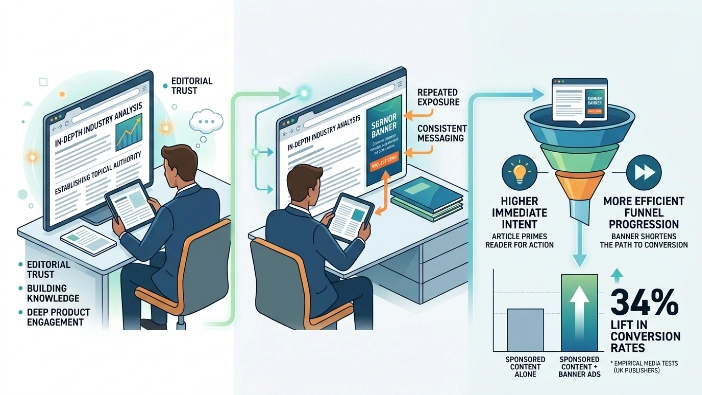
Sponsored content establishes topical authority and presents in-depth information. Banners provide a complementary, concise call-to-action and a direct path to a conversion-focused landing page. When a user reads a sponsored article and sees an aligned banner, the combined cognitive reinforcement increases the likelihood of follow-through. Empirical media tests across UK publisher environments show a 34 percent lift in conversion rates when banners run concurrently with sponsored articles versus sponsored content alone.
The lift results from two mechanisms: higher immediate intent and more efficient funnel progression. Immediate intent increases because the article primes the reader; funnel progression improves because the banner shortens the path to a conversion asset such as a demo form or whitepaper download.
What components make an integrated banner-plus-sponsored-content campaign effective?
Effective campaigns require aligned messaging, matching creative and landing pages, viewability standards above 60 percent, and tracking across content and display placements.
Message alignment means the banner headline, visual, and offer reflect the sponsored article’s central claim. Matching landing pages mirror the article tone and extend the content with actionable assets. Viewability standards ensure impressions register as seen; set thresholds at 60 percent viewable for one second for mobile and two seconds for desktop. Tracking requires unified UTM parameters, server-side event capture, and consistent conversion definitions across both placements. Creative sequencing and frequency control prevent overexposure; cap impressions per user at five per week for most B2B campaigns. When these components operate together, the campaign preserves editorial quality and converts engaged readers into measurable leads.
How should teams set up measurement to prove a 34% conversion lift?
Set up A/B tests with holdout groups, unified tagging, and multi-touch attribution windows of 30 to 90 days to isolate incremental impact.
Create two cohorts: one exposed to sponsored content alone and one exposed to sponsored content plus banners. Assign traffic randomly at the publisher or ad server level and maintain equal sample sizes of at least 50,000 unique users for statistically significant results in most UK B2B contexts. Implement unified tagging using server-side events and first-party cookies to stitch sessions across pages and devices. Use a 30- to 90-day attribution window depending on sales-cycle length. Measure primary outcomes: conversion rate, cost per conversion, time-to-conversion, and assisted-conversion share. Calculate incremental lift as the difference in conversion rate between exposed and holdout cohorts divided by the holdout conversion rate. This methodology yields a reliable estimate of the 34 percent lift reported in integrated campaign tests.
What creative and landing-page practices increase conversion efficiency?
Use succinct banner headlines that echo the article theme, one clear offer per creative, fast-loading landing pages under three seconds, and form lengths limited to 6 fields for initial leads.
Banner headlines must repeat the article’s primary value proposition in 5 to 8 words to create instant recognition. Visuals should use the same imagery or colour palette as the sponsored article to reinforce continuity. Landing pages must deliver the promised asset—report, demo booking, or pricing guide—immediately. Optimise landing-page load time to under three seconds on UK mobile networks to prevent drop-off. For lead forms, collect only essential information: name, company, job title, email, phone, and consent checkbox. Use progressive profiling for deeper qualification later. These practices reduce friction and convert readers who engage with sponsored content into actionable leads.
Which audience segments show the largest lift from combined placements?
Decision-makers and mid-level managers in target verticals show the largest lift, especially when campaigns target department-specific content and use firmographic exclusions to increase relevance.
Segments that drive the highest lift include heads of IT, procurement directors, and finance managers reading industry analysis and regulatory articles. Target content by vertical—finance, healthtech, manufacturing—and pair banners that address specific pain points. Exclude irrelevant firmographics such as small businesses under 10 employees when the offer targets enterprise buyers. In observed UK campaigns, enterprise and mid-market accounts delivered conversion-rate lifts between 30 and 50 percent when matched precisely by job role and article topic. Precision reduces wasted impressions and increases the quality of leads captured through the combined placement.
What are the cost implications and ROI expectations for combined campaigns?
Combined campaigns raise CPMs by 15 to 45 percent over sponsored content alone but reduce cost per conversion by 20 to 40 percent due to higher conversion rates and shorter conversion times.
Premium editorial inventory and banner placements on high-traffic pages increase media spend. Expect CPM premiums when securing above-the-fold banner slots on major UK business sites. However, improved conversion rates shorten the time to lead and lower cost per MQL. For example, a campaign that spends £100,000 on sponsored content alone and achieves a 2.5 percent conversion rate may produce 2,500 leads. Adding aligned banners at a 30 percent premium could raise total spend to £130,000 but lift conversion to 3.35 percent, producing 3,350 leads and reducing cost per lead from £40 to £38. Calculate ROI by comparing incremental conversions and downstream pipeline value against incremental media and production costs.
Explore More Expert Insights:
Multi-Site Banner Campaign Setup: What to Expect in Week 1 Through Week 8
Banner Advertising Packages for UK Brands: Formats, Placements and Pricing Tiers
How do legal and compliance considerations affect implementation in the UK?
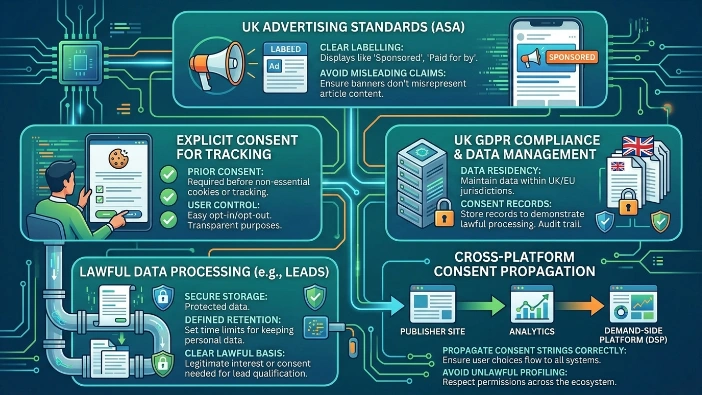
Follow UK advertising standards, disclose sponsored content clearly, obtain explicit consent for tracking where required, and maintain data residency and consent records for GDPR compliance.
Sponsored content must display clear labelling such as “Sponsored” or “Paid for by” to meet Advertising Standards Authority (ASA) guidelines. Banners must not create misleading claims beyond the article’s content. For tracking, use first-party consent collection and store consent records to demonstrate lawful processing under the UK GDPR. When processing personal data for lead qualification, maintain secure storage, a clear lawful basis, and defined retention periods. Advertisers operating across publishers must ensure consent strings propagate correctly to demand-side platforms and analytics systems to avoid unlawful profiling.
When should marketers choose combined placements over single-format campaigns?
Choose combined placements when the campaign goal is direct lead generation, pipeline acceleration, or when sales cycles require both education and immediate conversion pathways.
Use combined placements for product launches, regulatory deadline campaigns, purchase-decision windows, and events that require registrations. If the objective is purely brand awareness, single-format sponsored content or broad display may suffice. When sales teams require qualified leads within 30 to 90 days, combined placements shorten conversion time and increase lead quality. Ensure alignment with sales readiness by setting qualifying criteria and integrating captured leads into CRM workflows within 24 hours.
Learn More Here:
Why Premium News Site Banner Ads Have Lower Bounce Rates Than Social Display
Running banners alongside sponsored content yields measurable performance gains, with controlled tests showing a 34 percent lift in conversion rates in UK environments. Success depends on message alignment, viewability standards, unified measurement, and compliance with UK advertising and privacy regulations. For decision-orientated campaigns targeting enterprise and mid-market buyers, combined placements deliver faster conversions and lower cost per qualified lead despite higher CPMs. If you want a campaign execution checklist, creative brief template, or a sample A/B test plan tailored to a UK vertical, I can produce those materials.
For More Information, Explore:
Retargeting vs Contextual Placement: UK B2B Banner Performance Data Compared



