
Banner advertising is a digital display ad format that uses images or HTML creatives placed on web pages to drive visibility, traffic, or conversions. Banner ads run across desktop, tablet, and mobile inventory in sizes defined by industry standards and target audiences by context, placement, and pricing tier.
Banner advertising consists of image files (JPEG, PNG), animated GIFs, and HTML5 creatives. Standard sizes follow IAB guidelines: 300×250 (medium rectangle), 728×90 (leaderboard), 160×600 (wide skyscraper), 320×50 (mobile leaderboard), and 300×600 (half page). UK brands use banner ads on premium news sites, niche publishers, programmatic exchanges, and ad networks. Inventory types include reserved (direct-sold), private marketplace (PMP), and open exchange.
How does contextual targeting work compared with cookie-based retargeting?
Contextual targeting matches ads to page content using keywords, topics, and semantic analysis; cookie-based retargeting identifies users via browser cookies and serves ads based on past behaviour. Contextual systems analyse page text, metadata, and visual signals in real time. They map taxonomy labels (for example, “finance > mortgages”, “sports > cricket”) to ad campaigns. Cookie retargeting stores user identifiers in third-party cookies and triggers creatives when those identifiers appear on publisher inventory.
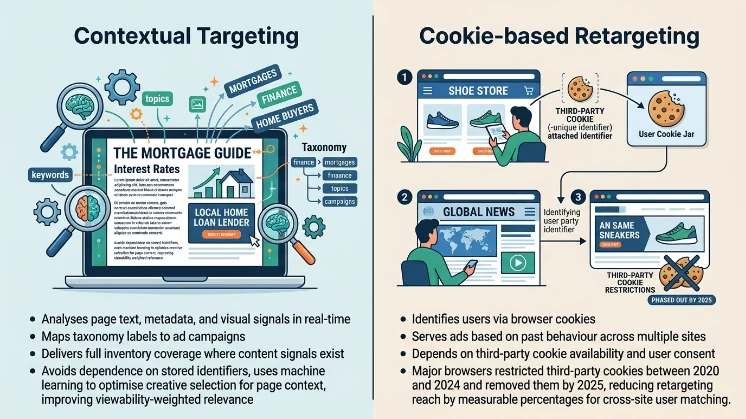
Cookie-based retargeting depends on third-party cookie availability and user consent. Major browsers restricted third-party cookies between 2020 and 2024 and removed them by 2025, reducing retargeting reach by measurable percentages for cross-site user matching. Contextual targeting delivers full inventory coverage where content signals exist and avoids dependence on stored identifiers. Contextual systems use machine learning to infer relevance and to optimise creative selection for page context, improving viewability-weighted relevance.
What formats and creative specifications exist for UK banner campaigns?
Formats include static images, animated GIFs, HTML5 rich media, and video banners; each format has precise file-size, dimension, and runtime rules enforced by publishers. Static images require standard file types and sizes under 150 KB for fast load. Animated GIFs must loop no more than three times in many premium publishers. HTML5 creatives require validated click tags and asynchronous loading. Video banners typically use MP4, H.264 codec, and must contain a visible mute state by default on page load.
Creative sizes align with IAB Universal Ad Package. Desktop common sizes: 300×250, 728×90, 970×250. Mobile common sizes: 320×50, 300×250, 300×600. Rich media may include expandable panels (max expansion 400 px beyond creative) and require user-initiated expansion on desktop. File weight caps vary: 150 KB for static, 200 KB for animated, 500 KB for HTML5 initial load with additional assets loaded async. Publishers specify click-through URL, backup image, and third-party tracking pixels. Accessibility requirements include readable contrast, clear close buttons for overlays, and no auto-play audio.
What placements and inventory types affect pricing tiers?
Placements vary by page position (above the fold, below the fold, in-article, header), and inventory types include reserved, PMP, and open exchange; reserved inventory commands the highest rates. Reserved placements sell via direct deals with CPM or flat-fee guarantees. Above-the-fold placements, header strips, and homepage takeovers cost more due to high viewability and daily unique reach. Private marketplace deals offer curated premium inventory to invited buyers via deal IDs; PMPs cost 20%–60% less than direct reservations but 30%–120% more than open exchange baseline CPMs. Open exchange uses real-time bidding (RTB) and yields the lowest headline CPM but includes variable viewability and fraud risk.
Example: a national UK news site direct-reserved 300×250 above-the-fold CPM range: £10–£40. Same size in PMP: £6–£20. Open exchange average for that trait: £1–£5. Video-rich or homepage module placements show higher multipliers: homepage takeover CPMs track from £50 to £300 depending on daypart and audience.
How do pricing tiers work for banner advertising packages?
Pricing tiers group inventory by reach, viewability, and exclusivity and use CPM, CPC, or flat-fee models with volume discounts and minimum commitments. Tier 1 covers premium reserved placements on top-tier publishers with guaranteed viewability >70% and audience exclusivity; pricing uses higher CPMs and minimum spend thresholds (for example, £25,000 campaign minimum). Tier 2 covers curated PMP inventory with viewability targets 50%–70% and mid-range CPMs; typical minimums: £5,000–£25,000. Tier 3 covers open exchange and remnant inventory with no guaranteed viewability and low CPMs; minimum spends from £500 to £5,000.
Pricing models include CPM for awareness campaigns, CPC for direct-response in some networks, and flat-fee sponsorship buys for packages like newsletter + site takeover. Volume-based pricing applies: a 4-week reserved campaign often reduces headline CPM by 10%–30% relative to a 1-week buy. Dayparting and run-of-site vs targeted section buys change effective CPMs. Additional line items: creative production fees, trafficking/setup fees (commonly £250–£1,000), and verification/reporting fees for third-party measurement.
Which metrics define performance and package value?
Impressions, viewable impressions, view-through rate (VTR), click-through rate (CTR), cost per thousand viewable impressions (vCPM), and post-view conversions measured by attribution windows. Impressions count total served ads. Viewable impressions follow the Media Rating Council standard: 50% of pixels in view for at least one second for display, two seconds for video. CTR equals clicks divided by impressions. VTR measures actions after seeing the ad without clicking. vCPM equals cost divided by viewable thousands and replaces CPM for quality pricing. Attribution windows common in UK banner campaigns include 1-day click, 7-day view, and 30-day view for brand measurement.
Advertisers use measurement tags from verification vendors to record viewability, brand safety, and fraud rates. Good package value shows viewability above 50%, CTR above 0.05% for generic banners, and post-view conversion lift validated by incrementality studies where feasible.
How to structure a banner advertising package for UK brands?
Structure packages by objective, inventory tier, creative format, targeting layer, and reporting cadence; each package states guarantees and price tiers clearly. Brand awareness, consideration, or direct response. Map objectives to formats: large display and video for awareness, in-article and native-style banners for consideration, and highly targeted PMP or retargeting equivalents for response. Define inventory tier and placements, then set measurement KPIs and verification standards. Include production timeline, creative specifications, trafficking details, and reconciliation terms. State pricing as headline CPMs and provide clear volume discounts and minimum spend. Offer reporting cadence: daily for active trafficking, weekly performance summaries, and a post-campaign measurement report.
Example package options: Awareness Package (Tier 1 reserved homepage modules, 4-week run, guaranteed 70% viewability, headline CPM £35); Consideration Package (Tier 2 in-article + mobile MPU, 6-week run, target audience segments, headline CPM £12); Efficiency Package (Tier 3 open-exchange RTB, month-to-month, headline CPM £2).
What targeting options complement contextual approaches in the UK?
Targeting options include contextual taxonomy layers, geo-targeting (postcode and NUTS regions), device targeting, dayparting, and first-party audience segments; these combine with contextual signals to refine reach. Contextual taxonomy maps page categories and subcategories to campaign segments. Geo-targeting allows UK brands to target by postcode districts, counties, or NUTS level 1–3. Device targeting distinguishes desktop, tablet, and mobile app inventory. Dayparting restricts impressions to specific hours or weekdays. First-party segments use site visitor data for newsletter subscribers or logged-in users and enrich contextual rules without third-party cookies. Frequency caps limit exposures per user per day to control ad fatigue.
Use-case example: a UK regional tourism board uses contextual targeting for “travel > local attractions” combined with postcode targeting limited to Greater London and dayparting to evening hours to reach planners after work.
Explore More Expert Insights:
Direct Buy vs Programmatic: Why UK Brands Spending £5K+ Choose Direct Placements
Banner Advertising Across 10 UK News Sites: Combined Reach and CPM Figures
How does compliance and privacy shape banner packaging in the UK?
Compliance requires GDPR-aligned consent for personal data processing, publishers’ transparency on advertiser IDs, and adherence to the UK Advertising Standards Authority rules on truth in advertising. Campaigns using first-party data include documented lawful basis and clear opt-out mechanisms.
Contextual campaigns that do not rely on personal identifiers avoid consent burdens for targeting but still require cookie banners for analytics and measurement tags where those tags set cookies. Publishers enforce brand safety categories and blocklists. Advertisers must keep creative claims verifiable and avoid misleading health or financial claims.
Dive Deeper Into This Topic:
How Contextual Targeting Replaced Cookie-Based Retargeting for UK Brands in 2026
What final checklist ensures a campaign-ready banner package?
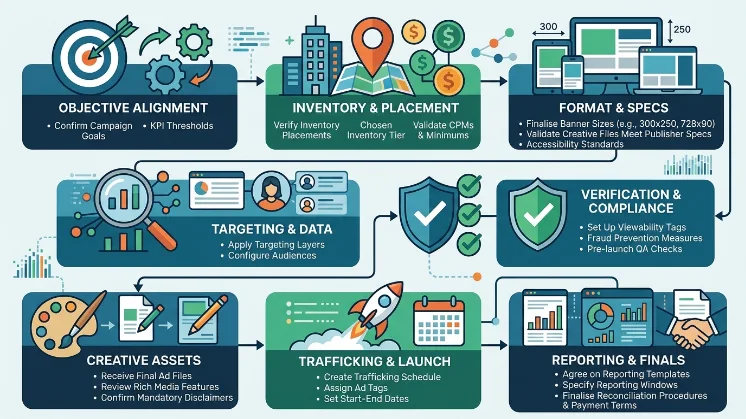
Objective alignment, chosen inventory tier, format specs, targeting layers, pricing and minimums, viewability and fraud verification, creative assets, trafficking schedule, and reporting windows. Confirm campaign goals and KPI thresholds. Verify inventory placements and CPMs. Validate creative files meet publisher specs and accessibility standards. Set up verification tags and schedule pre-launch QA. Agree on reporting templates and reconciliation procedures. Finalise payment terms and campaign start-end dates.
For related guidance on campaign structures and pricing tiers, review:
How to Write Banner Ad Copy Under 10 Words That Converts in a UK News Context