
Banner advertising across multiple UK news sites is the placement of display ads on news publisher pages, measured by reach (unique users exposed) and CPM (cost per 1,000 impressions).
Banner advertising refers to visual display inventory on publisher websites. Inventory formats include leaderboard (728×90 or responsive full-width), MPU (300×250), half-page (300×600), and site skin (background takeover). Reach equals the number of unique users who see at least one impression across selected sites during a campaign period. CPM equals the advertiser cost divided by impressions then multiplied by 1,000.
Campaign reporting includes impressions, unique reach, frequency, viewability rate, click-through rate (CTR), and effective CPM (eCPM). Publishers use tag-based measurement and identity graphs to deduplicate users across domains. Third-party panels and analytics platforms validate reach and viewability.
How large is the combined audience across 10 major UK news sites?
The combined audience equals the sum of unique monthly users across the selected 10 news sites, after deduplication, typically ranging from 15 million to 35 million unique users per month depending on site selection.
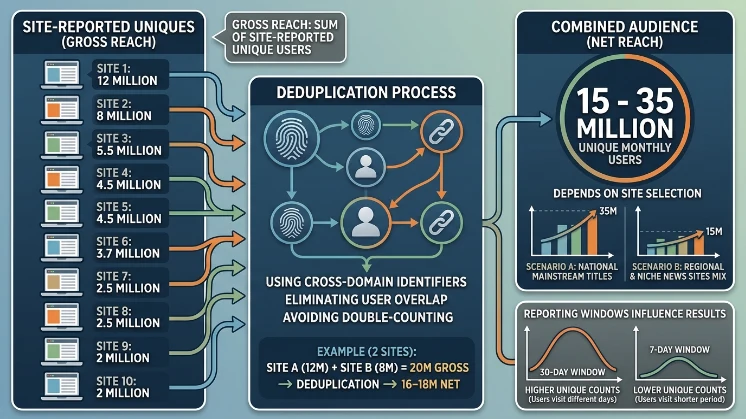
Audience size depends on which 10 sites are chosen. National mainstream titles yield higher combined reach. Regional and niche news sites reduce scale. Deduplicated reach uses cross-domain identifiers to avoid double-counting users who visit multiple sites. For example, if Site A reports 12 million uniques and Site B reports 8 million, deduplication could lower the combined total to 16–18 million rather than 20 million. Campaign planners report both gross (sum of site-reported uniques) and net (deduplicated) reach. Reporting windows influence results: 30-day windows produce higher unique counts than 7-day windows because users visit different days.
What are typical CPM figures for banner formats on UK news sites?
Typical CPM figures vary by format and placement: leaderboard £4–£12, MPU £6–£18, half-page £12–£35, skin £20–£60 per 1,000 viewable impressions.
CPM depends on factors including placement prominence, audience quality, viewability guarantees, time of year, and targeting. Leaderboard inventory sells at lower CPMs due to horizontal placement and lower viewability on mobile. MPU inventory commands mid-range CPMs due to consistent visibility within article content. Half-page inventory receives higher CPMs for larger creative visibility and better engagement. Skins and takeover formats attract the highest CPMs through dominance and impact. Premium editorial environments with verified brand-safety and first-party audience data push CPMs to the top of these ranges. Campaigns with audience targeting by demographics or interest often add 10–40% to baseline CPMs.
How does reach interact with CPM to determine total campaign cost?
Total campaign cost equals CPM divided by 1,000 multiplied by target impressions; reach informs frequency and impressions needed to achieve campaign goals.
Advertisers set target reach and desired frequency. If the target is 10 million unique users with average frequency 3 impressions, required impressions equal 30 million. At an average CPM of £15, total media cost equals (£15/1,000) * 30,000,000 = £450,000. If planners accept lower frequency, required impressions drop and cost falls. Reach efficiency improves when publishers use programmatic deals with audience deduplication to avoid serving duplicate impressions to the same users. Effective CPM (eCPM) after paid media fees and viewability adjustments provides the real cost basis for campaign ROI calculations.
Which banner formats deliver the highest engagement on UK news sites?
Half-page and skin formats deliver the highest engagement measured by viewability and time-on-ad, while MPU and leaderboard deliver higher impression volume at lower unit cost.
Engagement metrics include viewability rate (percentage of impressions meeting viewability standards), dwell time on ad creatives with rich media, and CTR. Half-page formats show viewability rates above 60% and higher interaction rates when creatives include interactive elements. Skin formats generate sustained attention as they occupy the page background and yield higher brand recall in independent studies. MPUs provide contextual exposure within article text and produce consistent CTRs for direct-response messages. Leaderboards result in high impression counts on desktop but lower mobile visibility without responsive design. Publishers report format-level benchmarks to guide media planning.
What is the expected performance difference between UK news site banner ads and LinkedIn Sponsored Posts for B2B intent?
Banner ads on UK news sites deliver broader reach and lower CPMs for top- and mid-funnel intent, while LinkedIn Sponsored Posts deliver narrower reach with higher audience intent but higher CPMs.
LinkedIn focuses on professional intent signals such as job title and company. CPMs on LinkedIn typically range from £15 to £60 for sponsored content targeted by job function and seniority. LinkedIn produces stronger lead-quality signals for direct B2B conversion because of explicit professional targeting. News site banners, combined across multiple publishers, reach a larger qualified audience at lower CPMs and support upper-funnel brand and awareness outcomes. When paired with contextual targeting and publisher first-party data, banner campaigns achieve measurable uplift in site visits and assisted conversions for B2B campaigns. Advertisers balance cost per lead versus net reach when selecting channels.
Check Out the Full Article:
Why B2B Banner Ads on UK News Sites Outperform LinkedIn Sponsored Posts for Intent
How do publishers report combined reach and CPM figures for a multi-site buy?
Publishers or agency trading desks report a consolidated media plan that lists site-level CPMs, total forecast impressions, deduplicated unique reach, average frequency, and expected viewability.
Consolidated reporting includes a media schedule with site-specific line items and an aggregated summary. Each line item records site-level CPM, guaranteed impressions, and delivery performance. Aggregation uses deterministic or probabilistic identity resolution to estimate deduplicated reach. Report outputs show gross impressions, net impressions after invalid traffic filtering, viewable impressions, and final billed CPM. Auditable logs and third-party verification (for viewability and fraud) are typical for enterprise buys. Agencies reconcile forecasted CPMs with actual delivered eCPMs to present final campaign economics.
What components make up the pricing for a 10-site banner campaign?
Pricing components include media CPM, ad ops fees, creative production costs, data targeting premiums, verification fees, and programmatic platform fees.
Media CPM represents the base cost for impressions. Ad operations fees cover trafficking, monitoring, and optimisation. Creative production includes design and rich-media development. Data targeting premiums attach when using publisher first-party segments, third-party segments, or deterministic audience overlays. Verification fees pay for viewability, fraud, and brand safety vendors. Programmatic platform fees apply if using DSPs or SSPs; these fees are usually 10–20% of media. VAT and agency margins add to total cost in final billing.
What use cases suit a buyer choosing banner campaigns on UK news sites?
Buyers use multi-site banner campaigns for demand capture, retargeting, account-based marketing (ABM) reinforcement, and driving late-stage consideration with high-visibility formats.
For demand capture, buyers retarget users who visited product pages with MPU ads across publisher inventory. For ABM, buyers create deterministic cohorts from CRM match lists and serve half-page or skin creatives to target accounts as they browse news sites. For late-stage consideration, buyers use high-impact formats to increase ad recall before direct outreach or conversion events. Measurement ties to backend conversions using attribution windows, server-to-server tracking, and incrementality testing to validate lift from publisher placements.
Explore More Expert Insights:
Entertainment Retargeting Ads That Turn Engagement Into Subscription Conversions
Music Platform Ads That Convert Listening Interest Into Premium Users
How to decide the mix of formats and sites for a highest-efficiency campaign?
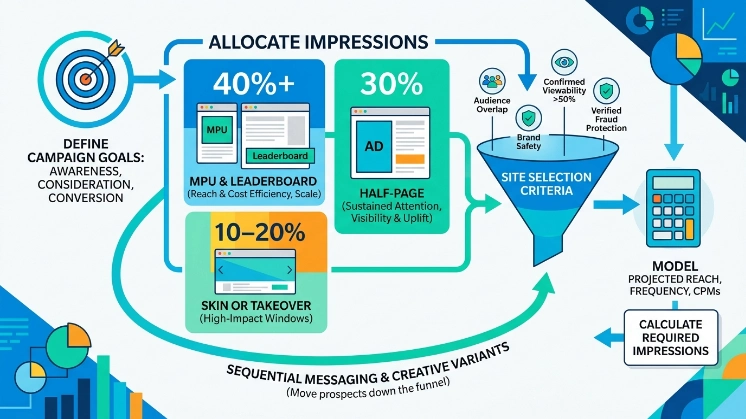
Decide format mix by aligning campaign goals to metrics: use leaderboard and MPU for reach and cost efficiency, half-page and skin for visibility and conversion uplift, and select sites based on audience overlap, brand safety, and viewability.
Start with goal definition: brand awareness, consideration, or conversion. Allocate at least 40% of impressions to MPU and leaderboard to secure scale. Allocate 30% to half-page for sustained attention. Reserve 10–20% for skin or takeover in high-impact windows. Choose sites with confirmed viewability above 50% and verified fraud protection. Model projected reach, frequency, and CPMs to calculate required impressions. Use sequential messaging and creative variants to move prospects down the funnel.
What decision-orientated actions should a buyer take after receiving combined reach and CPM data?
Buyers should validate deduplicated reach, confirm viewability and fraud verification, compare forecasted eCPM to historical benchmarks, and approve a media schedule with explicit guarantees.
Require publishers or the trading desk to provide deduplication methodology and verification reports. Compare promised CPMs with delivered eCPMs after two weeks of flight and request makegoods if under-delivery occurs. Negotiate frequency caps to control wasted impressions. Confirm creative trafficking specifications and templates to avoid rendering errors. Set attribution windows and post-campaign measurement plans, including lift testing or matched-conversion analysis. These steps finalise the buy and move campaigns from planning to live delivery.
Explore the Complete Guide:
UK Banner Ad Formats Ranked by Engagement: Leaderboard, MPU, Half-Page and Skin