
Direct buy is the negotiated purchase of specific ad inventory from a publisher for fixed dates, placements, and prices; programmatic buying uses automated systems and algorithms to buy inventory in real time across many publishers.
Direct buy involves an advertiser or agency contracting with a publisher to reserve ad space on defined pages, sections, or placements. Contracts specify creative sizes, start and end dates, pricing (CPM or flat fee), viewability targets, and reporting cadence.
Programmatic buying uses demand-side platforms (DSPs), supply-side platforms (SSPs), and ad exchanges to bid on impressions in milliseconds. Programmatic offers audience targeting, real-time bidding (RTB), and dynamic creative insertion. Key entities: publisher (sells inventory), advertiser (buys inventory), DSP (buys on behalf of advertisers), SSP (manages publisher inventory), and ad exchange (matches supply and demand).
Why do UK brands with monthly display budgets above £5,000 prefer direct placements?
Brands with budgets over £5,000 choose direct placements for guaranteed inventory control, fixed pricing, higher viewability, and tailored editorial context that supports brand safety and performance predictability.
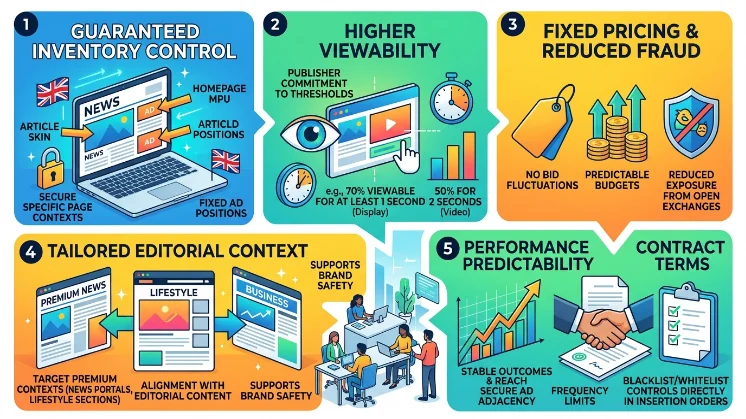
Direct placements guarantee specific page contexts and positions, such as homepage MPU or article skin. Guarantees remove bid fluctuation and reduce fraud exposure from open exchanges. Visibility improves because publishers can commit to viewability thresholds, for example, 70% viewable for at least 1 second for display ads and 50% for 2 seconds for video. Brands targeting premium contexts, news portals, lifestyle sections, or specific category pages achieve predictable reach and alignment with editorial content. Contract terms let buyers secure ad adjacency, frequency limits, and blacklist/whitelist controls directly in insertion orders.
Explore the Advanced Guide:
Generative AI Is Pushing Search Budgets to Display: What UK Advertisers Need to Know
What performance differences should advertisers expect between direct and programmatic buys?
Direct buys deliver predictable CPMs, higher average viewability, and lower invalid traffic rates; programmatic delivers broader reach, granular audience targeting, and lower CPAs for performance-focused goals.
Direct CPMs are typically 10–40% higher than open-exchange CPMs for premium placements. Viewability for direct placements often reports 60–80% depending on format and position, while programmatic open-exchange viewability averages 40–60% across comparable formats. Invalid traffic rates on direct placements fall below 1.5% when publishers use third-party verification (e.g., IAB sellers.json and TAG). Programmatic campaigns reduce cost per acquisition (CPA) for conversion-driven goals by using audience signals and retargeting. Measurement parity requires consistent third-party verification across buying methods to compare like-for-like metrics.
How do brands measure ROI for direct placements?
Brands measure ROI for direct placements through a mix of viewable CPM, click-through rate, post-impression conversions, and incrementality tests tied to first-party conversion data and tagged measurement pixels.
Measurement starts with deterministic attribution via click tracking and pixel-based conversion tracking. Brands then layer viewability and engagement metrics from verification vendors to calculate viewable CPM and view-to-conversion ratios. Incrementality testing uses holdout groups or geo-split experiments where one cohort sees the direct placements and a control cohort does not. Return on ad spend (ROAS) equals revenue attributed to the direct campaign divided by media spend; advertisers set target ROAS such as 400% and track performance weekly. Use standard reporting windows (7-, 14-, 30-day post-impression) for consistent comparisons.
What contract terms and controls do direct buys include?
Direct buy contracts specify placement, dates, impressions or guarantee, CPM or flat fee, creative specifications, viewability targets, reporting cadence, cancellation terms, and brand-safety clauses.
Insertion orders list exact placements (for example homepage banner position A), impression guarantees (100,000 guaranteed impressions), and pricing (£12 CPM or £1,200 flat). Creative delivery specs include file types (PNG, JPG, HTML5), maximum file size (150 KB for rich media), and accepted dimensions. Viewability targets can require 70% viewable for 1 second (display) or 50% viewable for 2 seconds (video). Reporting cadence typically replicates daily or weekly log-level reporting with CSV or API access. Cancellation clauses define penalties for early termination and remedies for underdelivery, including makegoods or credit.
How do brands integrate direct placements with programmatic strategies?
Brands integrate direct placements with programmatic by using programmatic guaranteed or private marketplaces for premium inventory, synchronising frequency caps, and consolidating measurement via common analytics and tag management.
Programmatic guaranteed allows advertisers to buy specific inventory programmatically with fixed price and reserved impressions. Private marketplaces (PMPs) pool selected publisher inventory behind deals with deal IDs and floor prices. Brands set the same frequency caps across direct and programmatic buys to prevent overexposure; for example, a global cap of 3 impressions per user per day with creative sequencing rules. Centralise reporting through a unified data warehouse or tag management system to merge publisher-supplied logs with DSP data. Use common KPIs such as viewable CPM, view-to-conversion rate, and net-new reach to evaluate combined performance.
What creative and placement strategies maximise results for direct buys?
Maximise results by matching creative format to placement, using high-resolution assets, applying clear branding in the first 400 milliseconds, and testing two creative variants per flight.
Select formats aligned with placement: leaderboard for top-visibility header slots, MPU for in-article units, and large rectangle for editorial sidebars. Use HTML5 for rich media to support interactivity and cross-device responsiveness. Ensure primary brand elements appear within the top-left quadrant of the creative and include a concise value proposition in 6–8 words. Run A/B tests with two creative versions that vary by headline or call-to-action for a minimum of 100,000 impressions per variant to reach statistical relevance for engagement metrics. Optimise based on view-to-conversion rate rather than clicks alone.
What controls limit audience fatigue and frequency in direct buys?
Control audience fatigue by applying explicit frequency caps in insertion orders, rotating creative sets, scheduling dayparting windows, and monitoring engagement decay weekly.
Insert frequency caps such as 3 impressions per user per 24 hours in the IO. Rotate at least three creatives across a four-week flight to reduce ad wear. Use dayparting to concentrate exposure during peak performance hours (for example 07:00–11:00 and 18:00–22:00 local time) to match audience behaviour. Monitor engagement decay by tracking view-to-conversion rate over successive impression exposures; drop frequency when marginal conversion benefit falls below acquisition cost thresholds.
When are direct placements the best choice for UK advertisers?
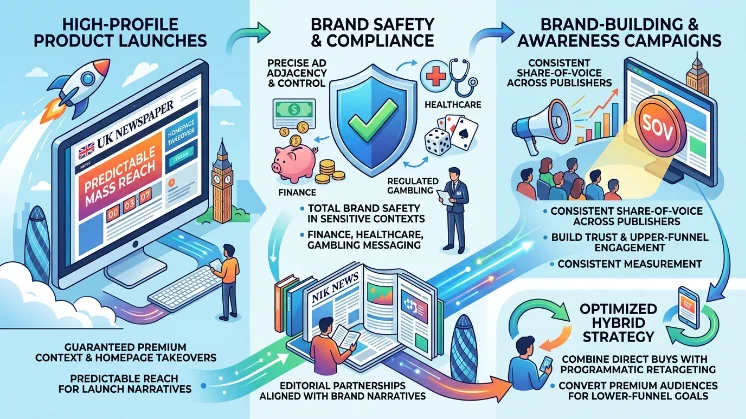
Direct placements are best when brands need guaranteed premium context, predictable reach for product launches, control for brand safety, and consistent measurement for upper-funnel or awareness-driven campaigns.
Use direct buys for new product launches that require homepage visibility or editorial partnerships aligned with launch narratives. Choose direct placements where regulatory or compliance context demands precise adjacency, such as finance, healthcare, or regulated gambling messaging. Use them for brand-awareness budgets where consistent share-of-voice across a publisher’s environment is essential. Combine direct buys with programmatic retargeting to convert audiences exposed in premium contexts.
Explore More Expert Insights:
Banner Advertising Across 10 UK News Sites: Combined Reach and CPM Figures
Entertainment Retargeting Ads That Turn Engagement Into Subscription Conversions
How do procurement and finance handle direct buying at £5K+ spend levels?
Procurement requires signed insertion orders, proof of inventory (placement screenshots or ad tags), VAT-compliant invoices, and reconciliation reports; finance tracks delivery against guarantees and issues payment on agreed terms, commonly 30 days net.
Buyers request publisher traffic verification documents such as comScore or SimilarWeb reports during negotiations. The publisher supplies ad tags and creatives in advance for QA. Finance confirms impression delivery versus guaranteed impressions; underdelivery triggers makegoods or credits per the IO. Standard payment terms for UK publishers are 30 days net after invoice receipt. Include VAT handling according to UK tax law and cross-border supply rules when applicable.
What are practical next steps for agencies and in-house teams deciding between direct and programmatic?
Evaluate campaign objectives, map inventory needs to audience signals, request publisher verification, and run side-by-side tests with consistent KPIs over at least one 30-day flight.
Awareness, consideration, or conversions. If awareness with premium context is main objective, prioritise direct placements. If broad reach and lower CPA are the main objectives, prioritise programmatic. Request publisher verification reports and IO terms before committing. Run a 30-day A/B pilot: direct placements on a set of matched publishers versus programmatic buys targeting the same audience segments. Use identical KPIs and a consistent attribution window to compare viewability, cost per viewable thousand (vCPM), and view-to-conversion rates.
Discover the Full Information:
How to Set Frequency Caps for UK Display Campaigns That Avoid Audience Fatigue