
Launching a token marks the beginning of a project’s public visibility, not its conclusion. Every tokenomics announcement creates searchable content that influences how investors, developers, journalists, regulators, and potential partners discover information over time. A structured post-launch public relations strategy transforms a single announcement into long-tail search traffic by expanding authoritative content, answering audience questions, and maintaining consistent media visibility.
Why does tokenomics PR generate long-tail search traffic?
Tokenomics public relations generates long-tail search traffic by publishing authoritative information that answers specific search queries over extended periods. Structured announcements, supporting articles, expert commentary, and follow-up media coverage create indexed content that remains discoverable months after the initial token launch.
Tokenomics refers to the economic design of a cryptocurrency token. It includes supply, allocation, emissions, vesting schedules, governance rights, staking rewards, and utility.
Public relations distributes verified information through news platforms, trade publications, interviews, and industry media. Search engines index this content and connect it to user searches.
Long-tail search traffic consists of highly specific searches. Examples include:
- “token vesting schedule explained”
- “staking rewards for payment tokens”
- “governance token allocation breakdown”
- “utility token compliance UK”
These searches attract users with defined informational needs instead of broad interest.
Unlike launch-day publicity, long-tail search traffic grows through cumulative visibility. Every additional authoritative publication increases search relevance across related topics.
How does post-launch PR extend the lifespan of token announcements?
Post-launch public relations extends announcement visibility by creating continuous newsworthy updates. Product milestones, governance changes, ecosystem partnerships, exchange listings, compliance developments, and technical improvements provide fresh content that reinforces search authority across multiple related topics over time.
Many projects concentrate media activity around launch week. Search demand continues long after initial distribution.
A structured post-launch schedule includes recurring announcements such as:
Product development updates
Development milestones generate fresh media coverage.
Examples include:
- Mainnet upgrades
- Wallet integrations
- Developer tools
- Smart contract audits
Each update targets different search intent.
Governance developments
Governance proposals generate ongoing discussion.
Examples include:
- Voting frameworks
- Treasury management
- Community proposals
- Validator participation
These subjects attract governance-related searches.
Partnership announcements
Strategic partnerships introduce new keyword opportunities.
Examples include:
- Payment providers
- Blockchain infrastructure firms
- DeFi protocols
- Enterprise software vendors
Each partnership expands topical authority.
Projects seeking a structured communication framework can also explore:
Continuous Media PR to understand how ongoing media activity supports sustained visibility.
Which content assets strengthen tokenomics search performance?
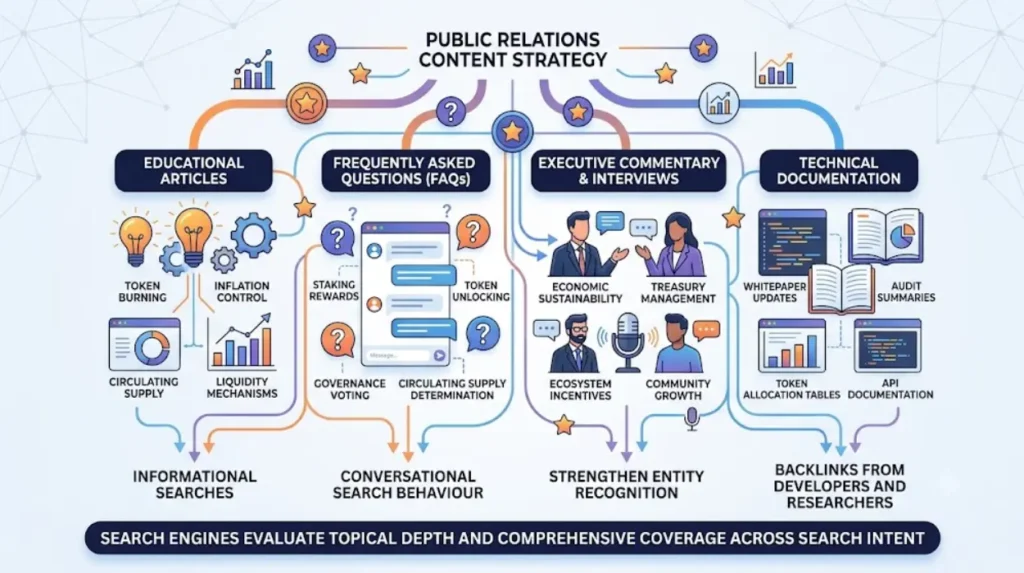
Search performance improves when public relations supports multiple complementary content assets. Press releases, technical explainers, FAQs, executive interviews, case studies, educational articles, and media commentary collectively increase topical relevance and answer diverse search queries with authoritative information.
Search engines evaluate topical depth instead of isolated articles.
Creating multiple content formats improves coverage across search intent.
Educational articles
Educational content explains technical concepts.
Examples include:
- Token burning
- Inflation control
- Circulating supply
- Liquidity mechanisms
These pages attract informational searches.
Frequently asked questions
FAQ content answers precise user questions.
Examples include:
- How are staking rewards calculated?
- What is token unlocking?
- How does governance voting work?
- What determines circulating supply?
FAQ pages often align with conversational search behaviour.
Executive commentary
Leadership interviews explain strategic decisions.
Examples include:
- Economic sustainability
- Treasury management
- Ecosystem incentives
- Community growth
These articles strengthen entity recognition.
Technical documentation
Documentation supports credibility.
Examples include:
- Whitepaper updates
- Token allocation tables
- Audit summaries
- API documentation
Technical resources generate backlinks from developers and researchers.
What role does search intent play in tokenomics PR?
Search intent determines the type of content users expect to find. Matching informational, navigational, commercial, and transactional intent improves search relevance while increasing engagement across investor research, developer education, media reporting, and ecosystem participation.
Every search reflects a specific objective.
Understanding search intent improves content planning.
Informational intent
Users seek explanations.
Examples include:
- What is token inflation?
- How does staking work?
- Why are vesting schedules important?
Educational articles perform well here.
Navigational intent
Users search for a specific project.
Examples include:
- Project tokenomics
- Official whitepaper
- Governance portal
Consistent branding improves discoverability.
Commercial investigation
Users compare projects before making decisions.
Examples include:
- Tokenomics comparison
- Utility token features
- Governance token models
Independent media coverage increases credibility.
Transactional intent
Users seek practical actions.
Examples include:
- Buy supported token
- Join staking programme
- Access developer portal
Clear supporting content improves user experience.
How does entity-based SEO improve tokenomics visibility?
Entity-based SEO improves visibility by clearly defining organisations, technologies, products, founders, protocols, and blockchain ecosystems. Search engines understand relationships between recognised entities, strengthening contextual relevance across multiple related searches and improving citation opportunities.
Entities represent identifiable concepts.
Examples include:
- Blockchain networks
- Payment protocols
- Stablecoins
- Smart contracts
Every article benefits from clear definitions.
Instead of repeating keywords, entity optimisation builds semantic relationships.
For example, an article discussing tokenomics naturally references:
- blockchain governance
- decentralised finance
- staking
- validator networks
- smart contracts
- digital assets
- treasury management
This contextual language strengthens topical authority.
Search engines increasingly evaluate relationships between entities rather than keyword frequency alone.
How can media coverage continue attracting visitors after launch?
Media coverage remains valuable because authoritative publications stay indexed for extended periods. Journalists, researchers, investors, and developers continue discovering referenced articles, creating ongoing referral traffic, backlinks, and search visibility long after publication.
News distribution creates independent sources.
Each publication expands digital visibility.
Examples include:
- cryptocurrency news websites
- fintech publications
- blockchain magazines
- technology journals
- business media
Every publication creates another searchable reference.
Media citations also encourage secondary coverage.
Industry newsletters, podcasts, analyst reports, and educational blogs frequently reference earlier announcements when discussing sector developments.
This extends the visibility lifecycle significantly.
Which metrics measure successful post-launch PR performance?
Successful post-launch public relations combines search visibility, audience engagement, media coverage, and authority indicators. Monitoring multiple performance metrics provides a complete picture of long-term communication effectiveness rather than relying solely on publication numbers.
Meaningful measurement extends beyond impressions.
Useful performance indicators include:
- Organic search traffic
- Indexed pages
- Keyword rankings
- Branded search growth
- Backlink acquisition
- Referral traffic
- Media mentions
- Average session duration
- Returning visitors
- Content engagement
Each metric reflects a different aspect of long-term visibility.
Search Console data identifies growing search demand.
Analytics platforms measure user engagement.
Media monitoring platforms identify publication reach.
Combining these datasets produces more accurate performance evaluation.
What common mistakes reduce long-tail search potential?

Long-tail search performance declines when projects publish isolated announcements without follow-up content, ignore educational resources, duplicate messaging, neglect technical accuracy, or fail to align public relations with ongoing product development and search intent.
Several recurring issues reduce search visibility.
Publishing only one announcement
Single announcements lose momentum quickly.
Continuous publication expands searchable content.
Ignoring educational content
Technical audiences require detailed explanations.
Educational articles improve topical authority.
Repeating identical messaging
Duplicate content reduces search diversity.
Fresh perspectives create broader keyword coverage.
Missing structured updates
Regular announcements strengthen search freshness.
Examples include:
- quarterly ecosystem reports
- governance updates
- staking statistics
- partnership announcements
Weak technical accuracy
Accurate terminology improves credibility.
Developers, journalists, and institutional audiences rely on precise language.
Projects evaluating professional distribution options after establishing a content strategy can compare:
Press Release Distribution Networks when selecting suitable publication channels.
How can organisations build a sustainable tokenomics PR strategy?
A sustainable tokenomics public relations strategy combines editorial planning, technical expertise, educational content, media outreach, and search optimisation into a continuous communication programme that expands authority, supports stakeholder understanding, and generates lasting organic visibility.
Sustainability depends on consistency.
A practical strategy includes:
- Publish an authoritative tokenomics announcement.
- Create educational follow-up articles.
- Release governance updates regularly.
- Share ecosystem milestones.
- Publish technical documentation updates.
- Participate in expert interviews.
- Expand FAQ resources.
- Monitor search performance.
- Refresh existing content.
- Align communications with product development.
This structured approach builds topical authority over time.
Instead of relying on a single launch event, organisations establish a growing knowledge base that answers evolving audience questions and strengthens long-term search relevance.
Explore More Expert Insights:
Designing an Omnichannel PR Strategy for Underfunded Blockchain and Token Launches
Timing Your Disclosure: Synchronizing Crypto Press Releases with Crucial Regulatory Filings
Token launches generate immediate attention, but long-term visibility depends on sustained communication. Tokenomics PR becomes significantly more valuable when it evolves into an ongoing content strategy that supports search intent, explains technical concepts, defines important entities, and documents ecosystem progress. Consistent post-launch updates, educational resources, and authoritative media coverage create durable search assets that continue attracting investors, developers, journalists, and industry researchers long after the initial announcement, transforming short-term publicity into measurable long-tail organic traffic.