
Banner ads attract travelers by delivering visually compelling destination messages to targeted audiences at scale, using data-driven placement, device-specific creative, and sequential messaging across sites and apps to move users from awareness to consideration.
Banner ads are digital display creatives static images, HTML5, or animated GIFs placed on websites, apps, and ad networks to present destination visuals and short messaging to prospective travellers.
Banner ads function as visual exposure units that deliver a destination concept quickly. They include defined dimensions (e.g., 300×250, 728×90, 320×50) and file-size rules to meet publisher standards. Banner formats include standard display, rich media (interactive), and programmatic placements that purchase impressions in real time.
How do tourism brands use banner ads to build awareness?
Tourism brands run broad-reach banner campaigns on high-traffic travel and lifestyle sites, use audience targeting by interest and geography, and prioritise high-quality imagery and concise value statements to create initial destination awareness.
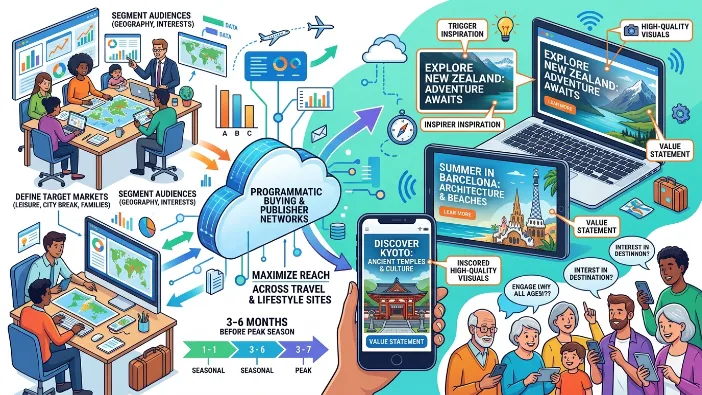
Campaigns start by defining top-priority markets and audience segments such as leisure travellers, city-break seekers, or family vacation planners. Brands buy impressions across publisher networks and programmatic exchanges to maximise reach during peak planning windows, for example 3–6 months before typical travel seasons. Creative focuses on one clear proposition per banner (destination highlight, event, season), and uses bold imagery with readable text to trigger inspiration.
What targeting methods do tourism advertisers use with banner ads?
Advertisers use geographic, demographic, behavioural, contextual, and retargeting signals, plus device and time-of-day rules, to reach travellers showing relevant intent or matching audience profiles.
Geographic targeting restricts delivery to source markets such as the United Kingdom or specific UK regions. Behavioural and interest targeting uses online behaviour search and site visits to find users who viewed travel articles or related pages. Contextual targeting places banners beside travel editorial or weather content to capture receptive audiences. Retargeting shows sequential banners to users who previously visited a destination page, increasing recall and consideration.
How do brands measure banner ad performance?
Brands measure impressions, viewable rate, click-through rate (CTR), engagement metrics, time on site after click, and downstream metrics like search lift and bookings attributed via last-click or multi-touch models.
Key performance indicators start with delivery metrics: impressions and viewability. CTR and engagement on rich media indicate creative effectiveness. Attribution links display exposure to later actions: organic search increases, direct site visits, newsletter sign-ups, and ultimately bookings. Measurement often combines platform analytics, pixels, and third-party lift studies to quantify awareness and demand generation.
What creative elements increase banner ad effectiveness?
Effective banners use large, high-resolution destination images, a single focused headline, short supporting text, a clear visual hierarchy, device-optimized layouts, and optional interactive features for engagement.
Image choice matters: scenic landmarks or authentic activities resonate with leisure audiences. Headlines use 3–6 words that highlight a unique aspect: season, event, or experience. Creative should be tested in multiple sizes and formats to match desktop and mobile consumption patterns; mobile-first designs use legible type at small sizes.
How does programmatic buying improve banner campaigns?
Programmatic buying automates ad placement in real time across exchanges, allowing audience-level targeting, frequency control, and optimisation using performance signals to maximise reach and efficiency.
Programmatic enables precise budget allocation to high-value inventory and dynamic bidding based on user signals. It supports frequency capping to avoid overexposure and sequential creative delivery to guide users through inspiration to consideration. Data signals from DSPs inform creatives shown to users who have expressed travel interest.
What is the role of sequential messaging and retargeting?
Sequential messaging delivers staged banners—introductory visuals then experience details while retargeting shows follow-up creatives to users who engaged previously, increasing conversion likelihood through reinforced messaging.
An awareness banner introduces the destination with a hero image. A mid-funnel banner emphasizes experiences, events, or itineraries. A retargeting banner can highlight practical next steps such as visitor guides or travel-planning pages to encourage deeper exploration. Sequential messaging improves memory encoding and motivates users to progress in planning.
What data sources support targeting and optimisation?
Data sources include first-party site analytics, CRM lists, on-site behaviour (pages viewed), third-party audience segments, search-query trends, and tourism board insights used to refine targeting and timing.
First-party data identifies users who visited destination pages and signed up for content. Third-party segments supply interest-based cohorts like “city-break seekers.” Search trend data reveals seasonal intent windows, for example spikes in “summer UK breaks” in March–April. Combining these data sources enables campaign optimisation for reach and relevance.
What benefits do banner campaigns deliver for destinations?
Banner campaigns generate wide awareness, increase search and site traffic, improve brand recall, support seasonal demand shaping, and feed audiences into later-stage remarketing and email funnels.
Campaigns create measurable uplifts in online searches for destination keywords after exposure. They support seasonal distribution by promoting off-peak experiences and events to target audiences. Capture of engaged users into owned channels enables longer-term nurturing toward booking.
What are common use cases for banner ads in tourism?
Use cases include launching seasonal campaigns, promoting events or festivals, boosting awareness for new routes or attractions, driving traffic to visitor guides, and supporting crisis-response messaging for safety updates.
Seasonal campaigns highlight shoulder-season offers to rebalance visitor flows. Event banners target relevant audiences weeks before an event to stimulate planning. Crisis or advisory banners provide situational updates and direct travellers to official guidance pages when required.
Explore More Expert Insights:
How Travel Agencies Increase Bookings Using Banner Advertising
How Airlines Drive Ticket Sales Using Display Campaigns
How do UK-focused tourism campaigns differ in approach?
UK-focused campaigns align creative and timing with UK travel behaviour, domestic travel peaks, and regional source markets, and they use local publisher partnerships and UK audience segments for relevance.
VisitBritain coordinates messaging across nations and seasons to position Britain for UK and inbound audiences. Campaigns use UK media inventory and cultural cues in imagery and copy to increase resonance with British travellers. Local publisher placements help reach high-value domestic and nearby international prospects.
What are practical steps to plan a banner campaign for a destination?
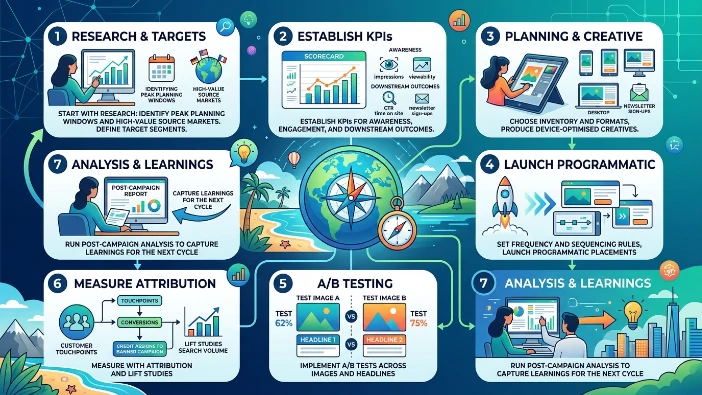
Define target segments and KPIs, choose inventory and formats, produce device-optimised creatives, set frequency and sequencing rules, launch programmatic placements, and measure with attribution and lift studies.
Start with research: identify peak planning windows and high-value source markets. Establish KPIs for awareness (impressions, viewability), engagement (CTR, time on site), and downstream outcomes (search lift, newsletter sign-ups). Implement A/B tests across images and headlines and run post-campaign analysis to capture learnings for the next cycle.
How Tourism Brands Build Destination Interest Using Banner Campaigns to explore how campaigns deepen destination interest.
Banner ads serve as the first visible touchpoint that creates destination awareness and seeds future planning behaviours.
Get the Full Insights Here:
Destination Campaign Ads That Convert Interest Into Travel Itineraries