
Travel retargeting advertising is a digital marketing tactic that shows ads to users who previously interacted with travel content, using cookie or device signals to deliver tailored creative that drives conversions.
Travel retargeting uses tracking pixels, mobile device IDs, or hashed emails to link a user’s prior activity to ad delivery. Agencies and advertisers place a pixel on booking pages, search-result pages, and itinerary pages to collect identifiers. Platforms match those identifiers to ad inventories on display networks, social platforms, and programmatic exchanges. Ads then show product-specific creative room types, flight routes, or package prices—across websites and apps the user visits.
Key technologies include server-side tracking for first-party data, client-side cookies for website events, and privacy-safe identifiers (e.g., hashed contact lists). Campaigns segment audiences by behaviour: page viewers, cart abandoners, and past bookers. Each segment receives different messaging and creative. Campaigns measure success with deterministic events: completed bookings, revenue per user, and return-on-ad-spend (ROAS).
How do travel retargeting campaigns convert consideration into bookings?
Retargeting converts consideration into bookings by matching user intent signals with product-specific offers and frequency-controlled ad delivery that reduces friction toward purchase.
Conversion starts with intent capture: search queries, property page views, and date checks. Campaigns then prioritise users who viewed high-intent pages availability calendars, checkout pages, or price comparisons. Creative shows the exact property or flight, dates, and price savings to lower cognitive load and accelerate booking decisions.
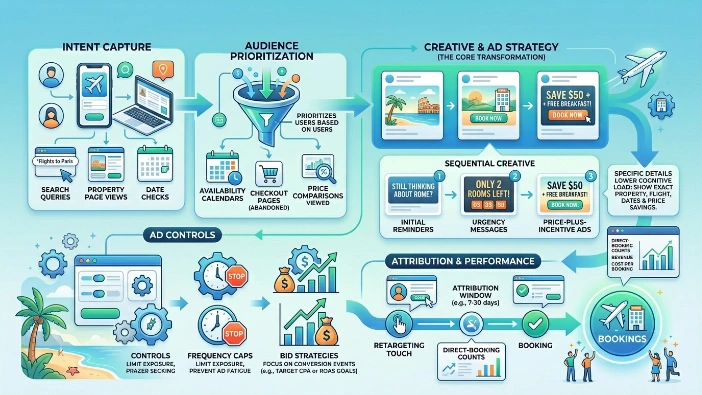
Campaigns use sequential creative: initial reminders, then urgency messages, finally price-plus-incentive ads. Frequency caps limit ad exposure to prevent ad fatigue. Bid strategies focus on conversion events using target CPA or ROAS goals. Attribution models attribute conversions to the retargeting touch when it precedes a booking within the chosen lookback window (commonly 7–30 days). Performance reporting uses direct-booking counts, revenue, and cost per booking to guide optimisation.
What audience segments do advertisers use for retargeting in travel?
Advertisers segment audiences by behaviour: general site visitors, product viewers, cart abandoners, past bookers, and lookalikes derived from high-value bookers.
Product viewers include those who open specific hotel or flight pages. Cart abandoners add users who reached the booking form but left before payment. Past bookers include travellers who completed transactions historically; advertisers use them for cross-sell and upsell. Lookalike audiences derive from top-converting users to scale reach.
Segmentation rules set minimum thresholds: e.g., include users who viewed a property page for 30+ seconds or visited at least two product pages. Use separate campaigns and creative for each segment. Example: a hotel targets cart abandoners with a 10% limited-time discount; a flight seller retargets product viewers who selected travel dates within 90 days.
Which ad formats and placements perform best for travel retargeting?
High-performing formats include dynamic display banners, responsive native ads, and social-feed ads that show personalised itineraries, dates, and price information.
Dynamic display banners render product-level details in real time. Responsive native ads blend into publisher content while presenting trip-specific copy. Social-feed ads provide visual context and are effective for mobile-first audiences. Video retargeting works for long-consideration products such as multi-city itineraries.
Placements span open web display networks, travel comparison sites, and social platforms with high travel intent. Programmatic private marketplaces (PMPs) deliver brand-safe inventory with viewability guarantees. Mobile in-app placements capture users who plan travel via mobile apps. Use contextual constraints to avoid irrelevant inventory and set viewability thresholds (e.g., 50% viewable for one second minimum).
What creative elements increase booking intent in retargeting ads?
Effective creative uses product-specific images, exact dates or price ranges, clear booking benefits, and a direct call-to-action that aligns with the user’s last action.
Include the exact hotel image or flight route the user viewed. Display the same dates or a close alternative. Show price or a discount percentage as a numeric value. Highlight benefits: free cancellation, secure payment, or included breakfast. Use a CTA that matches the behaviour: “Complete booking,” “See price for your dates,” or “Return to itinerary.”
Personalise copy with the user’s last-seen destination name and visitation window. Use urgency indicators with defined timelines: “Ends in 48 hours.” Use alternate creative for users who previously viewed multiple properties: “3 properties you viewed” with thumbnails. Test variants with A/B experiments to identify highest-converting combinations.
Complete Details Available Here:
How Travel Agencies Increase Bookings Using Banner Advertising
How do advertisers measure and attribute retargeting performance?
Advertisers measure success with conversion metrics completed bookings, revenue, cost per booking, and ROAS and use event-based attribution within a specified lookback window.
Primary KPIs: bookings attributed to retargeting, revenue from those bookings, cost per acquisition, and conversion rate for each audience segment. Use server-side conversion tracking to capture checkout completions reliably. Set lookback windows that match booking behaviour: 7 days for short-haul trips, 30 days for long-haul or packages.
Attribution models include last-click, last-ad-touch, and multi-touch algorithms. For cleaner measurement, implement deterministic matching (hashed emails or CRM uploads) to link ad exposure with booking records. Cross-device stitching is essential when users research on desktop and book on mobile. Report cohort-level performance by channel, creative, and segment.
What privacy and compliance factors affect travel retargeting campaigns in the UK?
UK retargeting campaigns must follow data protection rules: lawful basis for processing, clear cookie consent, and secure handling of personal data.
Collect first-party data under a lawful basis such as consent. Implement a cookie banner that documents purpose and vendor list at initial visit. Store hashed emails and identifiers securely and limit retention to a defined period (commonly 12–24 months for travel marketing). Honour user opt-outs and use consent management platforms to synchronise preferences across vendors.
Comply with the Privacy and Electronic Communications Regulations (PECR) and the UK General Data Protection Regulation (UK GDPR). Maintain records of processing activities and conduct data protection impact assessments for large-scale profiling. Use privacy-preserving methods—server-side matching or aggregated reporting when possible.
What budget and bidding strategies optimise booking-focused retargeting?
Optimise budgets by prioritising high-intent segments and use conversion-optimised bidding (target CPA or ROAS) with daily or campaign-level spend caps.
Allocate a higher share of budget to cart abandoners and product viewers with date-selected intent. Use automated bidding that targets CPA aligned to business goals. Set bid multipliers for device and time-of-day when conversions spike e.g., increase bids for mobile searches between 19:00–22:00 local time. Implement pacing to avoid overspending early in the campaign day.
Monitor overlap across platforms and reduce redundant bidding with negative audience lists. Reallocate budget weekly based on observed cost per booking and conversion rate. Example: allocate 40% to cart abandoners, 30% to recent product viewers, 20% to lookalikes, and 10% to past bookers for cross-sell tests.
Explore More Expert Insights:
Hotel Experience Ads That Turn Stay Interest Into Direct Reservations
Travel Banner Ads That Convert Trip Interest Into Confirmed Bookings
What use cases show clear ROI from travel retargeting?
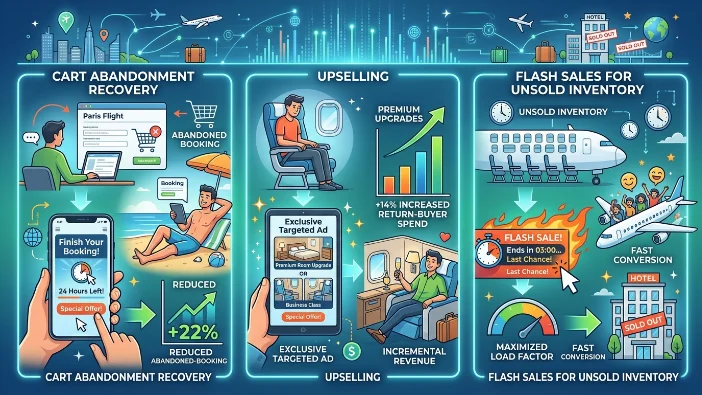
Use cases with measurable ROI include cart abandonment recovery, upsell to higher-room categories, and flash-sale conversion for unsold inventory.
Cart abandonment recovery returns users to incomplete bookings by offering limited-time discounts or simplified booking links. Upsell campaigns target past bookers with premium room or seat upgrades and show incremental revenue per user. Flash-sale campaigns target recent site visitors for unsold inventory and convert quickly with countdown pricing.
Examples: a UK regional hotel reduced abandoned-booking rate by 22% after a targeted retargeting sequence; a low-cost carrier increased return-buyer spend by 14% through upsell creative. Use cohort analysis to isolate incremental bookings driven by retargeting versus organic demand.
How do travel businesses scale retargeting while maintaining performance?
Scale by expanding lookback windows, using lookalike audiences from high-value bookers, and adding programmatic inventory with strict controls on frequency and viewability.
Increase lookback windows progressively from 7 to 30 days for audiences that show steady interest. Generate lookalike audiences from the top 5% of historical bookers to reach similar travellers at scale. Add high-quality programmatic deals and native placements to broaden reach while preserving viewability and contextual relevance.
Maintain segmentation and creative personalisation as audience sizes grow. Use automated rules to pause low-performing segments and reallocate budget. Continuously monitor CPA and ROAS and tighten targeting if cost per booking increases.
Click Here to Explore More:
How Travel Agencies Increase Trip Consideration Using Display Ads
Travel retargeting converts trip consideration into bookings by matching intent signals to product-specific creative, precise audience segmentation, and conversion-focused bidding. Campaigns require privacy-compliant data handling in the UK, clear measurement frameworks, and creative that reduces booking friction. For decision-stage advertisers, align budget to high-intent segments, use deterministic tracking where possible, and test sequential creative to shorten the path from consideration to completed booking.