Destination campaign ads are targeted digital advertisements designed to move users from interest to a booked travel itinerary by promoting a specific location, experience, or travel package. Destination campaign ads define the travel product, target audience, delivery channels, and a measurable conversion goal.
Destination campaign ads use creative assets that highlight the destination’s key entities: attractions, accommodations, experiences, transportation, and seasonal timing. They run on channels such as search, display, social, video, and connected TV. Campaign structure links creative and audience segments to conversion events such as booking, enquiry, or itinerary build. Campaigns require defined KPIs: cost per booking, return on ad spend (ROAS), booking conversion rate, and average booking value.
How do destination campaign ads fit into a strategy?
Destination campaign ads focus on final decision signals and conversion mechanics to turn interested users into paying customers. The ads use conversion-optimised creatives, direct booking pathways, and scarcity or timing signals to close sales.

Recent site visitors, cart abandoners, lead form submitters, or users who viewed specific accommodation or itinerary pages. Ads retarget these audiences with precise offers: fixed-price packages, limited-availability dates, or segmented bundles (family, couples, adventure). Campaign settings include event-based optimisation (hotel booking complete, checkout), value-based bidding, and lookback windows of 7–30 days for recent intent. Measurement uses first-party data and server-to-server event capture to track bookings across devices.
Which components must a destination campaign ad include?
A destination campaign ad must include a clear offer, a defined conversion action, relevant creative assets, audience targeting, and measurement tags. Price, dates, inclusions, and cancellation policy. Define the conversion action: book, request a quote, or add itinerary to account. Creative assets include hero images, short video (15–30 seconds), concise headlines, and a clear call-to-action. Audience targeting uses CRM lists, website retargeting events, and lookalike audiences derived from converters. Measurement requires pixel or server events for view, click, add-to-cart, initiate-checkout, and purchase; include UTM parameters for analytics.
Select conversion windows, bidding strategy (target CPA, target ROAS), and attribution model. Implement server-side tracking if platform restrictions apply. Map product taxonomy so analytics record destination, package type, travel dates, and booking value.
Use resolution and aspect ratios matching each placement: 16:9 for video, 1.91:1 for feeds, 4:5 for mobile vertical. Use text overlays under 20% of image area for some platforms. Include price or discount in headline when allowed.
How do you structure targeting and audience segments?
Structure audiences into high-intent converters, warm engagers, and lookalikes to prioritise spend toward users nearest to booking. High-intent converters: users who visited checkout or pricing pages in past 30 days. Warm engagers: users who viewed destination pages or downloaded itineraries in past 90 days. Lookalikes: top 1%–5% of users matched from converters. Use exclusion lists for recent converters to avoid wasted spend. Use frequency caps to avoid ad fatigue.
Use onsite events (viewed itinerary, pricing page, started booking), CRM events (email opens, last purchase date), and behavioural data (search queries containing dates or “book”, “availability”, “last minute”). Combine signals into custom audiences for precision.
Allocate 60% of budget to high-intent converters, 30% to warm engagers, 10% to lookalikes for scaling. Use automated bidding with target CPA derived from historical booking cost and average booking value.
What creative elements increase conversion rates?
Creative elements that increase conversion rates include clear price or package information, real user reviews, availability cues, and a single, trackable CTA. Display the total price or starting price, list exact inclusions (flight, hotel nights, meals), and state cancellation terms. Include at least one verified review snippet or rating (e.g., 4.6/5 from 2,400 reviews). Show availability indicators: “3 rooms left” or specific travel dates. Use one primary CTA: “Book Now,” “Check Availability,” or “Add to Itinerary.”
A/B test 2–3 headlines, 2 images, and 1 video per ad set. Run tests for 7–10 days or until 1,000 impressions to reach statistical clarity for platform metrics.
How do measurement and attribution work for these campaigns?
Measurement uses event-level tracking for price-sensitive KPIs and a last-click or data-driven attribution model to assign conversions to ads. View, click, add-to-cart, initiate-checkout, purchase. Use server-to-server conversion reporting for cross-device accuracy. Define KPIs: booking conversion rate (bookings / clicks), cost per booking (ad spend / bookings), ROAS (revenue / ad spend), and average booking value. Use a 28-day click and 1-day view attribution window for most managed campaigns, unless platform defaults differ.
Report daily on spend and 7-day rolling for conversion trends. Report weekly on cohort performance by acquisition channel and destination. Report monthly on lifetime value per customer and repeat booking rates.
Upload offline bookings to ad platforms with hashed identifiers. Reconcile ad-reported conversions with booking system monthly to adjust cost per acquisition and bidding rules.
Dive Deeper Into This Topic:
How Tourism Brands Attract Travelers Using Banner Ads
What are the common compliance and legal requirements in the UK?
Compliance requires transparent pricing, accurate terms, GDPR-compliant data processing, and marketing opt-in management. Show total price including mandatory fees and taxes where required. Present cancellation, refund, and travel insurance information clearly. Process personal data with legal basis under UK GDPR; obtain consent for marketing emails and allow easy opt-out. Retain proof of consent for 3 years or per internal retention policies. Display required consumer rights information when relevant to the booking.
Avoid misleading statements about availability or pricing. Use factual claims backed by booking system data. Keep promotional timelines and scarcity claims accurate.
What benefits do destination campaign ads deliver?
Destination campaign ads deliver measurable bookings, higher conversion rates, predictable ROAS, and shorter purchase cycles when optimised for intent and tracking. Optimised campaigns reduce cost per booking by up to 40% versus broad awareness tactics, based on intent-based audience targeting. Returning customers booked via retargeting show 10% higher average booking value in many measured programs. Campaigns that include dynamic pricing and availability tend to increase click-to-book rates by 15%–25%.
Primary outcomes: increased confirmed bookings, higher revenue per campaign, improved attribution of ad spend. Higher customer lifetime value and clearer audience segments for future campaigns.
Explore More Expert Insights:
Travel Retargeting Ads That Turn Trip Consideration Into Final Bookings
Airline Fare Ads That Convert Searchers Into Ticket Purchases
How should travel brands implement a destination campaign that converts?
Define conversion events and offers, set up tracking and audiences, then launch optimised creative and bidding with continuous measurement.
Ensure pixel or server events validate purchases, confirm audiences exclude converters, apply correct UTM tagging, and set clear CPA targets tied to profit margins.
Starting price £199 per person, travel May–September, free cancellation 14 days prior. Build audiences: site visitors past 30 days who viewed package. Launch creatives: hero photo of beach, 15-second video of cliff walk, headline with price. Optimise: increase bids on audiences with initiate-checkout events.
Where should marketers go next with campaign data?
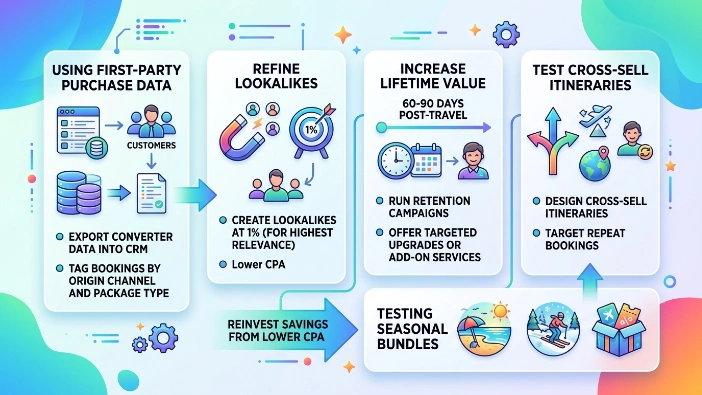
Marketers should use first-party purchase data to refine lookalikes, increase lifetime value tracking, and test cross-sell itineraries for repeat bookings. Export converter data into CRM, tag bookings by origin channel and package type, and create lookalikes at 1% for highest relevance. Run retention campaigns 60–90 days after travel with targeted offers for upgrade or add-on services. Reinvest savings from lower CPA into testing seasonal bundles.
Explore the Complete Guide:
How Tourism Brands Build Destination Interest Using Banner Campaigns
Execute with precise tracking, defined offers, and audience prioritisation to convert destination interest into confirmed itineraries.