
Banner advertising serves as a foundational digital marketing tactic that travel agencies use to generate initial trip awareness and drive website traffic. Travel agencies increase bookings using banner advertising by placing visually compelling ads on high-traffic websites, targeting specific audience segments based on browsing behavior and demographics, and directing users to optimised landing pages with clear calls to action. These display ads appear across news sites, travel blogs, and search engine results pages, reaching potential travelers at the top of the purchase funnel when they are first researching destinations.
What Is Banner Advertising in the Travel Industry
Banner advertising refers to graphic display ads that appear on websites, apps, and social media platforms to promote travel products and services. These ads use images, text, and sometimes interactive elements to capture attention and encourage clicks. The travel industry relies heavily on banner advertising because vacation planning begins with visual inspiration and destination discovery.
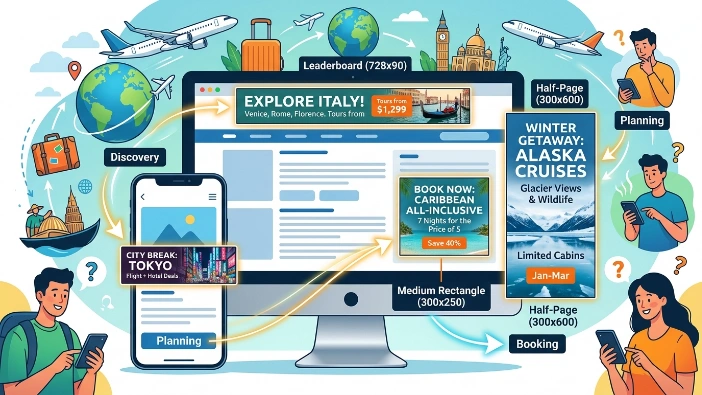
Travel banner ads display destination photos, package prices, travel dates, and special offers. They appear in standard sizes such as 300×250 pixels (medium rectangle), 728×90 pixels (leaderboard), and 300×600 pixels (half-page). These formats work across desktop and mobile devices, ensuring consistent visibility regardless of how users browse the internet.
The primary purpose of banner advertising in travel is top-of-funnel awareness. These ads introduce destinations and packages to travelers who have not yet decided where to go or when to book. They plant the initial seed of interest that leads to further research and eventual booking.
How Do Travel Agencies Target the Right Audience With Banner Ads
Travel agencies use audience targeting to ensure banner ads reach people most likely to book trips. Targeting relies on data points including browsing history, search queries, location, demographics, and past travel behavior. This precision prevents wasted ad spend on users with no interest in travel.
Audience Segmentation Based on Browsing Behavior
Agencies target users who have visited travel websites, searched for flights, or viewed destination guides. These users demonstrate active interest in travel and represent warm leads. Korean Air uses audience targeting to reach viewers at key moments during the buyer journey, particularly when they need more information or are ready to purchase.
Dynamic display ads show personalised offers based on this browsing data. If a user searches for flights to Barcelona, the next banner ad they see might feature Barcelona vacation packages with specific flight times and hotel options. This relevance increases click-through rates significantly.
Geographic and Demographic Targeting
Travel agencies target users by location to promote destination-specific deals. A UK-based agency might show Mediterranean cruise ads to users in colder northern cities during winter months. Demographic targeting filters by age, income level, and family status to match appropriate travel products.
Families with children receive ads for all-inclusive resorts with kids’ clubs. Solo travelers see adventure tour packages. Luxury travelers encounter first-class flight and five-star hotel offers. This segmentation ensures ads match user needs and budget levels.
Retargeting for Users Who Visited Without Booking
Retargeting displays banner ads to users who visited the agency website but did not complete a booking. These ads remind users of destinations they viewed and sometimes include limited-time discounts to encourage return visits. GetYourGuide saw conversion rates lift from 0.21% to just over 4% after adding dynamic elements to banner ads.
Retargeting campaigns typically run for 30 to 90 days after the initial website visit. The frequency decreases over time to avoid ad fatigue. Users see the ad 3 to 5 times per week initially, then once or twice weekly as the campaign progresses.
What Components Make Up an Effective Travel Banner Ad
Effective travel banner ads contain specific elements that work together to capture attention and drive clicks. Each component serves a distinct purpose in the conversion process.
High-Quality Destination Imagery
Visual appeal determines whether users notice and engage with banner ads. Professional photographs of beaches, landmarks, hotels, and activities create emotional connection. Images must be high-resolution and accurately represent the destination. Blurry or stock-looking photos reduce credibility and click-through rates.
Destination images should show recognisable landmarks or unique experiences. A Paris ad features the Eiffel Tower. A Maldives ad shows overwater bungalows with turquoise water. Specificity helps users immediately identify the destination and imagine themselves there.
Clear Value Proposition and Pricing
Banner ads state concrete benefits such as price, savings, or exclusive features. “Flights from £299” or “Save 30% on Mediterranean Cruises” provides immediate value. Vague phrases like “Great Deals” fail to capture attention because they offer no concrete information.
Dynamic pricing in banner ads shows the best available prices to individual consumers. This automation works particularly well for airlines and package deals. Real-time pricing updates ensure ads never display outdated or unavailable offers.
Compelling Call-to-Action Button
Every banner ad includes a call-to-action (CTA) button that tells users what to do next. Common CTAs include “Book Now,” “Get Quote,” “View Package,” and “Learn More.” The button uses contrasting colors to stand out from the rest of the ad design.
CTA buttons use action verbs that create urgency. “Book Now” performs better than “Click Here.” Limited-time offers paired with CTAs increase conversion rates. “Book by Friday and Save 20%” creates time pressure that motivates immediate action.
Landing Page Alignment
The landing page users reach after clicking must match the banner ad’s message and design. If the ad promotes Barcelona packages, the landing page shows Barcelona packages immediately. Mixed messaging causes users to leave within seconds.
Landing pages include the same imagery, pricing, and CTAs as the banner ad. This continuity builds trust and reduces bounce rates. GetYourGuide’s HTML5 widget integration in banner ads created seamless transitions to search functionality, driving the 4% conversion rate.
Why Does Banner Advertising Increase Travel Bookings
Banner advertising increases bookings through multiple mechanisms that work together throughout the customer journey. The cumulative effect of repeated exposure and targeted messaging drives measurable booking growth.
Increased Brand Visibility and Top-of-Mind Awareness
Repeated banner ad exposure builds brand recognition. When users eventually decide to book travel, they recall brands they have seen multiple times. This familiarity reduces purchase anxiety and increases trust.
Studies show users need 7 to 12 exposures to a brand before taking action. Banner ads deliver this frequency efficiently across multiple websites. A user might see the same travel agency ad on a news site, a weather portal, and a sports website throughout one week.
Driving Qualified Traffic to Agency Websites
Banner ads generate website visits from users who have demonstrated interest in travel. This traffic converts at higher rates than untargeted visitors. Agencies track click-through rates and cost-per-click to measure traffic quality.
Average click-through rates for travel banner ads range from 0.3% to 0.8%, depending on targeting precision and ad creative quality. Well-targeted campaigns with personalised messaging achieve rates above 1%. These clicks represent users actively considering travel options.
Supporting the Complete Buyer Journey
Banner advertising works across all stages of the travel booking process. Top-of-funnel ads create awareness. Middle-of-funnel ads build consideration. Bottom-of-funnel ads drive final bookings through retargeting. For travellers in the consideration stage exploring trip options, display ads deepen interest and provide additional information.
Readers exploring:
How travel agencies increase trip consideration using display ads
This educational content supports users who have moved past initial awareness but have not yet decided to book.
What Are Real Examples of Travel Banner Ad Success
Travel brands demonstrate measurable results from banner advertising campaigns through concrete metrics and documented case studies.
Airline Dynamic Advertising Campaigns
Airlines lead in dynamic banner advertising sophistication. They leverage data to produce personalized ads showing relevant offers and dynamic pricing. Korean Air targets audiences based on flight history and loyalty program membership.
When a frequent flyer searches for business class flights, the airline shows premium cabin options with loyalty point redemption offers. This personalization increases conversion rates compared to generic ads. Airlines target consumers based on flight history and loyalty programmes for example.
Interactive Booking Widget Integration
GetYourGuide integrated HTML5 widgets into banner ads, enabling in-ad searches without leaving the page. This innovation allowed users to search for activities and check availability directly within the banner. The conversion rate for searches increased from 0.21% to just over 4%.
The widget displays real-time availability and pricing. Users enter dates and party size, then see matching experiences instantly. This frictionless experience removes barriers between interest and booking.
Seasonal Destination Campaigns
Travel agencies run seasonal banner campaigns promoting destinations during optimal travel windows. Winter campaigns feature Caribbean beaches and ski resorts. Summer campaigns highlight European cities and Mediterranean cruises.
These campaigns align with natural travel planning cycles. UK travelers research Mediterranean destinations in January and February for summer holidays. Banner ads capitalise on this timing by appearing when search volume peaks. Seasonal promotions optimise Google Ads campaigns with targeted keywords and geo-targeting.
How Does Banner Advertising Fit Into Overall Travel Marketing Strategy
Banner advertising functions as one component within a comprehensive digital marketing strategy for travel agencies. It works alongside search engine optimisation, content marketing, email campaigns, and social media advertising.
Explore More Expert Insights:
How Airlines Drive Ticket Sales Using Display Campaigns
How Hotels Increase Reservations Using Banner Ads
Integration With Search Engine Marketing
Banner ads complement search engine marketing by reaching users who are not actively searching. Search ads capture users with explicit intent. Banner ads capture users with latent interest who are browsing related content.
Agencies optimise Google Ads campaigns with targeted keywords, geo-targeting, and seasonal promotions to boost bookings. Banner ads extend reach beyond search results to display networks covering millions of websites.
Data Collection for Future Campaigns

Banner advertising generates valuable data about user behavior and preferences. Click-through rates indicate which destinations attract attention. Landing page engagement shows which offers resonate. Retargeting pools build from banner ad visitors.
This data informs future marketing decisions. Agencies allocate more budget to high-performing destinations and adjust creative based on performance metrics. Continuous optimisation improves return on ad spend over time.
Supporting Retargeting Campaigns
Banner ad visitors enter retargeting pools for follow-up campaigns. Users who click but do not book receive targeted retargeting ads. These ads appear across the same display networks where initial banner ads appeared.
Travel retargeting ads turn trip consideration into final bookings by reminding users of destinations they viewed and offering incentives to complete purchases.
For those ready to convert:
Travel retargeting ads that turn trip consideration into final bookings provide the final push needed to complete reservations
This progression from awareness to conversion demonstrates the full funnel impact of banner advertising. Banner advertising remains essential for travel agencies seeking to increase bookings through systematic audience targeting, compelling creative design, and strategic placement across the internet. The approach generates awareness, drives traffic, and supports the complete booking journey from initial destination discovery to final reservation confirmation.