
Display ads are visual digital creatives placed on websites and apps to generate awareness and consideration; travel agencies use them to show destinations, prices, and offers to targeted audiences across the open web.
Display ads are image or video creatives in standard formats (300×250, 728×90, 160×600, 300×600). Agencies upload creatives and metadata to advertising platforms or demand-side platforms (DSPs). Platforms deliver impressions on publisher sites via ad exchanges using programmatic bidding or direct buys. Agencies select targeting signals such as location, device, browsing context, and interest segments to reach travellers in the United Kingdom. Real examples: a 300×250 image promoting UK staycations on news sites, a 728×90 video promoting Greek island packages on travel blogs.
How do display ads drive trip consideration in the middle of the funnel?
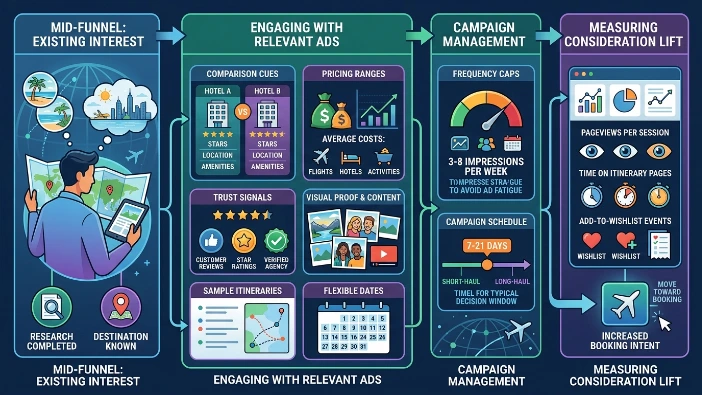
Display ads in nurture users who know the destination and compare options; they supply comparison cues, pricing ranges, and trust signals to move users toward booking intent.
Users completed basic research or saw content. Display ads provide more concrete information than awareness creatives. They present price ranges, sample itineraries, flexible dates, and visual proof (photos, short clips). Agencies set frequency caps between 3 and 8 impressions per week to balance visibility and ad fatigue. They schedule campaigns across 7–21 days, matching typical decision windows for short-haul and long-haul trips. Agencies measure site engagement metrics pageviews per session, time on itinerary pages, and add-to-wishlist events to assess consideration lift.
Which targeting strategies increase relevance for trip consideration?
Use intent and contextual targeting combined with demographic and geographic filters to place relevant display ads in front of likely bookers.
Intent targeting uses search and browsing signals to identify users who recently searched for flights, hotels, or destination guides. Contextual targeting matches creatives to page content such as airport pages, destination guides, and review sites. Demographic filters limit reach to age groups that convert higher, 25–44 for city breaks, 45–64 for longer tours. Geographic filters restrict reach to users in the UK or to specific regions such as London, Manchester, or Scotland. Agencies layer retargeting segments of users who viewed price pages within the last 14 days to reach warmer prospects.
What creative elements increase consideration in display ads?
Use clear price cues, short itinerary highlights, high-resolution images, and a visible trust signal to create persuasive creatives for travellers.
Price cues present a starting fare or a range, for example “From £149 pp.” Short itinerary highlights use three bullets in the creative metadata (not on the image) such as “3 nights, flights incl., city tour.” Use high-resolution images with focal points (landmarks, beaches) sized to the ad format to avoid cropping. Add trust signals such as review score icons or accreditation badges. Include a persistent campaign color palette and legible font sizes—minimum 16px equivalent for desktop creatives. Use animated GIFs or 6–15 second MP4 for richer storytelling on high-view contexts like travel blogs.
How do agencies measure display ad performance for goals?
Track intermediate conversion events: click-through rate, landing page engagement, wishlist adds, pricing tool uses, and assisted conversions in attribution windows.
CTR gives initial response; expected CTR benchmarks range between 0.05% and 0.25% for generic travel display ads. More meaningful signals are landing engagement metrics such as pages per session (target >2), average session duration (target >90 seconds), and wishlist or “save trip” events. Price-tool interactions measure active comparison behaviour; count distinct users who used a date picker or fare calendar. Use attribution windows of 7–30 days to capture assisted conversions from display exposures. Compare last-click bookings with assisted bookings to quantify the role of display ads in the funnel.
Which bidding and inventory tactics maximise trip consideration?
Use viewable CPM for awareness-to-consideration delivery, switch to CPC or CPA when driving deliberate actions, and prioritise high-viewability placements on travel and local news sites.
Viewable CPM (vCPM) focuses on impressions that meet viewability standards (50% in view for 1 second). For set bid floors that secure top placements on publisher pages with high editorial relevance. Move to CPC or CPA when optimising for wishlist adds or price-tool interactions; set CPA targets based on historical cost-per-wishlist (example target: £8–£25 per wishlist). Prioritise inventory on travel editorial sites, destination guides, regional news sites, and lifestyle verticals where users research trips.
Read More for Better Understanding:
How Travel Agencies Increase Bookings Using Banner Advertising
How do audience sequencing and frequency control affect consideration?
Sequence creatives to progressively increase specificity and cap frequency to 3–8 weekly impressions per user to maintain relevance without causing fatigue.
Start sequence with broader inspiration creatives (hero images, “Explore X”) for 1–3 impressions. Move to mid-funnel creatives that show prices, sample itineraries, and benefits for the next 2–4 impressions. End sequence with action-oriented mid-funnel prompts such as “Compare dates” linked to a pricing tool. Implement frequency caps per channel and per device. Reduce exposure for users who interacted with pricing tools to avoid wasted impressions. Use exclusion windows of 30 days after booking confirmation to prevent wasted spend.
How does data privacy and consent shape display ad tactics in the UK?
Implement consent management and rely on contextual and first-party signals when third-party cookies are unavailable.
Comply with UK GDPR and ICO guidance on cookies and profiling. Use consent management platforms to capture lawful basis for targeting where required. Build first-party audience signals via site logins, email lists, and on-site behaviours such as search queries. Employ contextual targeting to reach users without relying on third-party identifiers. Use hashed first-party data for upload to platforms where the platform allows secure matching under contract.
Explore More Expert Insights:
How Airlines Nurture Travelers Using Fare Awareness Banner Ads
How Hotels Build Stay Interest Using Experience-Focused Campaigns
What are proven use cases where display ads increased trip consideration?
Common use cases include seasonal promotions, abandoned price searches, multi-destination trips comparison, and geographic upsell for near-market travellers.
Seasonal promotions show early-bird pricing for summer or winter travel and increase wishlist activity by 20–60% in measured pilot campaigns. Abandoned price searches retarget users who viewed fare calendars; agencies report 10–30% higher price-tool usage after retargeting. Multi-destination comparative creatives present three itinerary options and lift pages-per-session by 15–40%. Geographic upsell targets UK audiences within 100 km of major airports to promote short-haul packages, increasing conversion-intent metrics in tracked cohorts.
How do travel agencies connect display ads to conversion paths?
Map mid-funnel events to lower-funnel triggers, such as price-tool use to email retargeting and dynamic retargeting to abandoned-cart flows.
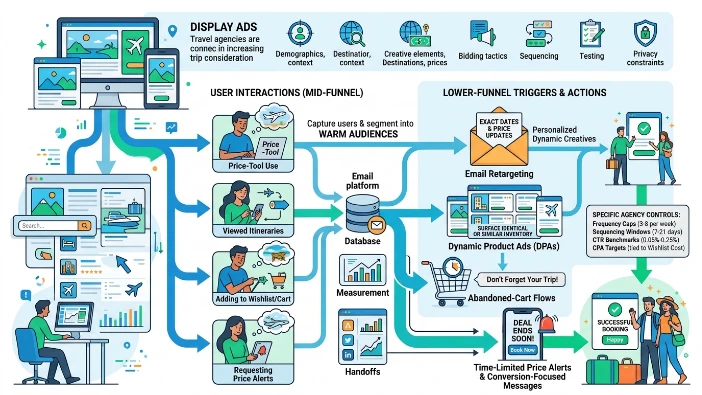
Capture users who interact with mid-funnel tools and add them to warm audiences. Export these audiences to email platforms and retarget with personalised dynamic creatives that show exact dates and price updates. Use dynamic product ads for users who viewed specific itineraries to surface identical or similar inventory during campaigns. Set time-limited price alerts for users who requested fare notifications to trigger conversion-focused messages.
This article defines display ads, explains how travel agencies use them to increase trip consideration in this stage, and describes targeting, creative elements, measurement, bidding tactics, sequencing, testing, privacy constraints, use cases, and handoffs. Agencies implement specific controls frequency caps of 3–8 impressions per week, 7–21-day sequencing windows, CTR benchmarks of 0.05%–0.25%, and CPA targets tied to wishlist cost to convert awareness into measurable consideration signals.
Must-Read Detailed Guide:
Travel Retargeting Ads That Turn Trip Consideration Into Final Bookings