Fare awareness banner ads are digital display creatives that show current or recent flight prices to targeted users and link to booking or search pages; they update dynamically using price feeds and advertising platform APIs.
Fare awareness banner ads are display advertisements that present airline fares directly in the ad creative. They use real-time price data pulled from airline inventory systems, global distribution systems (GDS), or price-aggregation APIs. Ads generate impressions on websites, mobile apps, and programmatic networks. They connect to remarketing audiences, contextual targets, and lookalike segments. When an ad renders, the creative requests the latest price for a route and formats it for the banner size. Clicks lead to a flight search or booking flow. Platforms log view and click events, then report metrics such as impressions, clicks, click-through rate (CTR), and cost per click (CPC).
Fare feeds push price updates every 15–60 minutes for high-volume routes and every 4–12 hours for low-volume routes. Ad servers cache values for 5–30 minutes to control API call volume. Creative templates include placeholder fields (origin, destination, date, fare) that the ad server fills with the latest values before delivery.
Why do airlines use fare awareness banner ads?
Airlines use fare awareness banner ads to increase purchase intent, recover abandoned searches, and influence travel windows by exposing timely prices to relevant audiences.
Fare ads influence travelers by reducing information friction. They show concrete prices early in the decision process. Airlines deploy fare banners to several objectives: increase site visits, re-engage users who viewed routes but did not buy, and stimulate demand on routes with spare inventory. Ads support bid strategies that optimise for clicks or conversions. Advertisers segment audiences by intent signals such as recent search, airport interest, past booking history, and demographic filters. Campaigns run across display, native, and rich media formats to extend reach. Measurement tracks both on-ad behavior and downstream conversions attributed via last-click, time-decay, or data-driven attribution models.
Common goals include increase in site sessions by 10–200%, conversion rate lift by 0.5–3 percentage points, and decrease in cost per acquisition (CPA) by 5–30%. Primary KPIs are CTR, view-through conversions, and incremental revenue measured against a control cohort.
Who are the target audiences for fare awareness banner ads?
Targets are high-intent and mid-intent travelers, including recent searchers for specific routes, website visitors who abandoned searches, and lookalike groups based on past passengers.
High-intent audiences include users who searched specific origin-destination pairs within the last 7 days. Mid-intent audiences include visitors who viewed route pages within 30 days or engaged with airline social or email content. Broader audiences include travellers who visited fare comparison pages or travel content sites. Targeting uses cookies and device IDs, hashed customer lists, and first-party site signals. Advertisers employ frequency caps, dayparting, and device-based bid adjustments to reach travelers at optimal moments.
A user who searched London to Manchester within 48 hours, a website visitor who viewed a route page 10 days earlier, a segment built from frequent flyer passengers in the previous 12 months.
How do advertisers build and deliver fare-aware creatives?
Advertisers build templates with dynamic fields, connect them to a price feed, and serve them via programmatic or direct ad platforms that support dynamic creative optimisation (DCO).
Creative teams design templates sized for standard banners: 300×250, 728×90, 320×50, and responsive units. Templates include flight route, travel window, fare, currency, leg count, and a timestamp. A dynamic creative engine merges the template with price data using routing rules. Delivery channels include programmatic display platforms, ad exchanges, and publisher networks. Advertisers configure rules for currency conversion, rounding, and price qualifiers (for example, “one-way from £29”). Tracking pixels and click parameters capture campaign events for analytics.
What data sources and technologies power fare-awareness banner ads?
Data sources include airline inventory systems, GDS feeds, price aggregator APIs, and first-party behavioural data; technologies include DCO, DSPs, ad servers, and tag-based analytics.
Inventory systems expose fares via APIs or batch feeds. GDS providers supply real-time availability for OTA-style flows. Price aggregators combine fares across sellers and provide normalised fields. First-party data includes site search queries, booking history, and CRM segments. Technologies: dynamic creative optimisation platforms insert live price data; demand-side platforms bid on impressions; ad servers manage creative rotation; analytics platforms attribute conversions and tie ad impressions to downstream bookings.
Advertisers set feed refresh intervals by route priority. High-priority routes refresh every 15 minutes. Mid-priority refresh every 60 minutes. Low-priority refresh every 4–12 hours. Feed quality checks validate route codes, currency, and price consistency. Systems track and flag price errors to avoid delivering stale or incorrect fares.
What pricing and messaging rules do airlines use in fare banners?
Airlines apply rules for currency display, fare qualifiers, routing accuracy, and validity windows to ensure legal compliance and clear consumer expectations.
Common rules include showing fares in the user’s local currency, adding qualifiers like “one-way” or “incl. taxes,” and including a timestamp for price validity. Ads must avoid misleading information: they display the final price or clearly state that shown fares exclude taxes or fees. Airlines also implement business rules that suppress ads when no seats are available at the displayed price. Messaging often includes travel date ranges and seat class to set expectations.
“From £39.99, one-way, economy, selected dates” and a small note “prices shown exclude baggage.” Timestamp shows “Updated 20 minutes ago.”
What are the measurement methods for fare awareness banner campaigns?
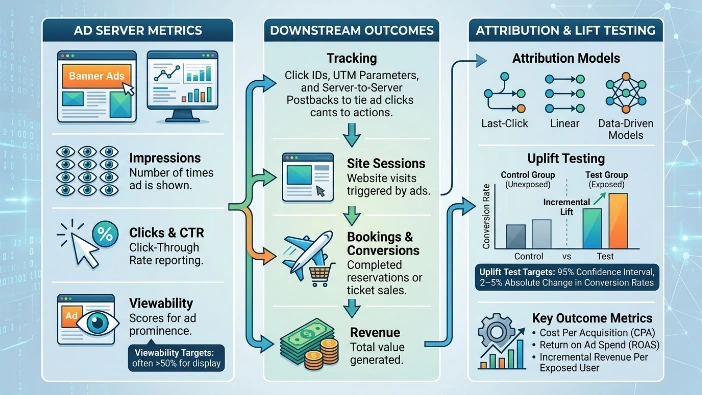
Measurement combines on-ad metrics (impressions, CTR, viewability) with downstream outcomes (site sessions, conversions, revenue) using attribution models and uplift testing.
Ad servers report impressions, clicks, CTR, and viewability scores. Analytics platforms tie ad clicks to sessions and bookings via click IDs, UTM parameters, and server-to-server postbacks. Advertisers run lift tests by holding a control group unexposed and comparing conversion rates and revenue. Attribution uses last-click, linear, or data-driven models, and advertisers cross-check results with incremental lift to isolate ad effect. Key outcome metrics include cost per acquisition (CPA), return on ad spend (ROAS), and incremental revenue per exposed user.
Viewability targets often exceed 50% for display. A meaningful uplift test aims for a 95% confidence interval and 2–5% absolute change in conversion rates for actionable results.
What are the main benefits of using fare awareness banner ads?
Benefits include faster price discovery, higher ad relevance, improved remarketing efficiency, and measurable uplifts in site traffic and bookings.
Fare banners reduce the time users need to compare prices. They present concrete costs that increase ad relevance and CTR. Remarketing with live fares re-captures users who abandoned searches. Programmatic delivery ensures audience reach across devices. Measurement captures direct and view-through conversions, enabling advertisers to quantify revenue impact. Campaigns that show live prices report higher CTR than static banners by 20–100% depending on route and timing.
Dynamic creatives lower creative refresh cycles and support rapid price changes without manual design updates. Automated feeds reduce errors and allow scaling across 100+ routes with consistent template rules.
What are common use cases and campaign setups for fare awareness banners?
Common use cases include abandoned search recovery, flash-sale amplification, route stimulation for low-demand flights, and seasonal demand capture.
Abandoned search recovery targets users who ran a search but did not book within 48 hours. Flash-sale amplification promotes discounted fares during a 24–72 hour window with higher bid aggression and site-linking to the sale landing page. Route stimulation focuses on underbooked flights with specific fare incentives and adjusted bids to achieve target load factors. Seasonal campaigns run 4–8 weeks ahead of travel peaks with travel-window messaging.
A campaign targets London–Edinburgh searchers within 7 days, shows a one-way fare in GBP, refreshes every 30 minutes, and optimises for clicks with a max CPA bid ceiling.
Explore More Expert Insights:
How Hotels Build Stay Interest Using Experience-Focused Campaigns
How Travel Brands Inspire Bookings Using Destination Banner Ads
How should airlines balance user experience and compliance?
Airlines balance user experience by ensuring price accuracy, clear qualifiers, and frequency limits while meeting advertising regulations and platform policies.
Display creatives must avoid stale or misleading fares. Advertisers implement real-time suppression when fares expire. Frequency caps prevent ad fatigue by limiting exposures to 3–7 impressions per week per user. All messaging must comply with advertising standards for clarity and pricing disclosures. Accessibility practices include legible font sizes and sufficient contrast for readable fare values.
Validate price timestamps, include currency codes (e.g., GBP), and display essential qualifiers like “one-way” or “round-trip.” Log and audit ad creatives for regulatory review.
For further reading and cross-stage context, internal resources on campaign tactics are available:
How Airlines Drive Ticket Sales Using Display Campaigns
What are practical next steps for teams planning fare-awareness display campaigns?
Start by mapping route priorities, secure reliable price feeds, design dynamic templates, define audience segments, and run a 4–6 week pilot with clear uplift tests and KPIs.
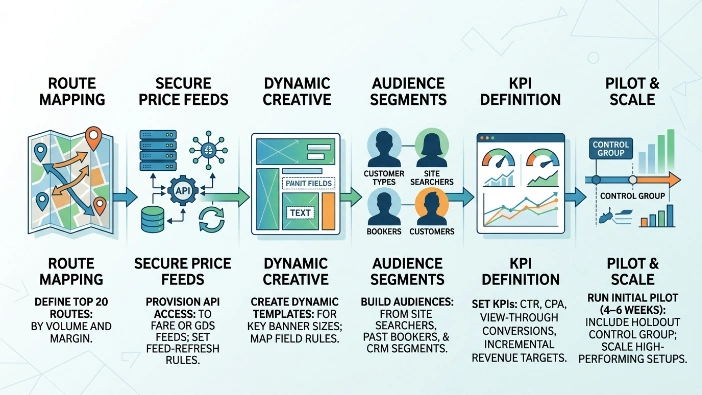
Define the top 20 routes by volume and margin. Provision API access to fare or GDS feeds and set feed-refresh rules. Create dynamic creative templates for key banner sizes and map field rules. Build audiences from site searchers, past bookers, and CRM segments. Set KPIs: CTR, CPA, view-through conversions, and incremental revenue targets. Run an initial pilot for 4–6 weeks, include a holdout control group for lift measurement, then scale high-performing setups.
For More Details, Explore:
Airline Fare Ads That Convert Searchers Into Ticket Purchases