

Digital audience behaviour in the United Kingdom has changed significantly over the last decade. Consumers no longer spend most of their time on a small number of websites, television networks, or social platforms. Instead, attention is distributed across multiple channels throughout the day.
This shift has created a phenomenon known as platform fatigue. Audiences continuously move between news sites, search engines, social networks, video platforms, messaging applications, podcasts, streaming services, retail media environments, email, and connected television. As a result, attention has become fragmented rather than concentrated.
Understanding audience fragmentation is essential for marketers, publishers, researchers, and organisations seeking to understand modern media consumption.
What is platform fatigue and why is it increasing in the UK?
Platform fatigue is the reduction of sustained audience attention on any single digital platform due to the growing number of channels competing for daily engagement. UK consumers now divide their time across numerous digital environments, creating shorter attention windows and fragmented media consumption patterns.
Platform fatigue occurs when audiences interact with many platforms instead of relying on one primary source of information or entertainment.
A typical UK consumer engages with multiple digital touchpoints during a single day. These touchpoints often include:
- Search engines
- News websites
- Social media platforms
- Video-sharing platforms
- Streaming services
- Podcasts
- Messaging applications
- Retail media networks
- Connected television
The expansion of digital media options has increased competition for attention. Every platform seeks user engagement, resulting in frequent switching between channels.
How has media consumption changed?
Traditional media consumption followed predictable patterns. Television viewing occurred at scheduled times, newspapers were read daily, and radio listening often happened during commuting hours.
Modern digital behaviour is different. Audiences consume content continuously throughout the day across multiple devices and platforms.
The result is fragmented attention rather than concentrated engagement.
How is audience attention fragmented across 10 major channels?
Audience attention is fragmented because different channels satisfy different information, entertainment, communication, and purchasing needs. UK consumers move between channels depending on context, intent, device usage, and content preferences throughout the day.
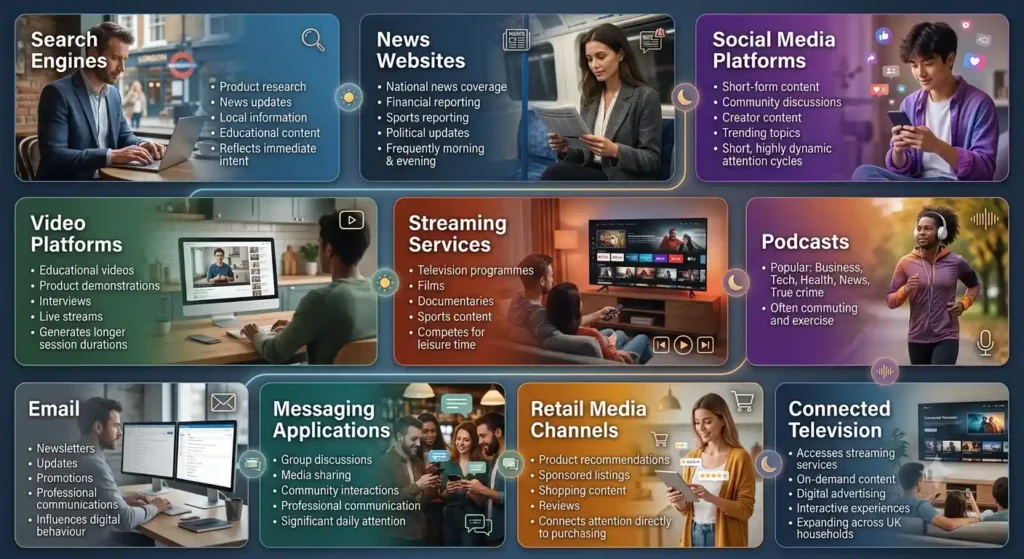
The following ten channels account for much of modern audience activity.
Search Engines
Search engines support active information discovery.
Users often search for:
- Product research
- News updates
- Local information
- Educational content
Search activity reflects immediate intent.
News Websites
News platforms provide current events, analysis, and specialist reporting.
Examples include:
- National news coverage
- Financial reporting
- Sports reporting
- Political updates
News consumption frequently occurs during morning and evening periods.
Social Media Platforms
Social networks support content discovery, communication, and entertainment.
Users engage with:
- Short-form content
- Community discussions
- Creator content
- Trending topics
Attention cycles are often short and highly dynamic.
Video Platforms
Video environments attract audiences seeking visual information and entertainment.
Examples include:
- Educational videos
- Product demonstrations
- Interviews
- Live streams
Video often generates longer session durations than text content.
Streaming Services
Streaming platforms provide on-demand entertainment.
Consumers access:
- Television programmes
- Films
- Documentaries
- Sports content
These platforms compete directly for leisure time.
Podcasts
Podcast consumption continues to grow across the UK.
Popular categories include:
- Business
- Technology
- Health
- News
- True crime
Podcast listening often occurs during commuting and exercise periods.
Email remains a major communication and content channel.
Users receive:
- Newsletters
- Updates
- Promotions
- Professional communications
Email continues to influence digital behaviour despite the growth of newer channels.
Messaging Applications
Messaging platforms support direct communication and content sharing.
Examples include:
- Group discussions
- Media sharing
- Community interactions
- Professional communication
These environments capture significant daily attention.
Retail Media Channels
Retail environments increasingly function as media platforms.
Consumers engage with:
- Product recommendations
- Sponsored listings
- Shopping content
- Reviews
Retail media connects attention directly to purchasing behaviour.
Connected Television
Connected television combines traditional viewing with internet-based delivery.
Users access:
- Streaming services
- On-demand content
- Digital advertising
- Interactive experiences
Connected television continues expanding across UK households.
Why does fragmented attention matter for audience understanding?
Fragmented attention changes how audiences discover information, consume content, and interact with media. Understanding these behavioural shifts provides a more accurate picture of consumer journeys, engagement patterns, and decision-making processes across digital environments.
Audience behaviour no longer follows a linear path.
A user may begin with a search engine, visit a news website, watch a video, read email content, engage on social media, and complete a purchase through a retail platform.
Each interaction contributes to a broader audience journey.
What is a fragmented audience journey?
A fragmented audience journey occurs when users move between multiple channels before reaching an objective.
Examples include:
- Researching products
- Comparing services
- Consuming news
- Learning new skills
Multiple touchpoints influence decisions.
Why are single-channel insights limited?
Single-channel measurement captures only part of audience behaviour.
For example:
- Website analytics measure website activity
- Social analytics measure platform engagement
- Email analytics measure subscriber interactions
Each dataset represents only one section of the overall journey.
Readers seeking deeper insight into audience unification methods can explore:
Cross-Platform Audience Matching.
What factors are driving platform fragmentation?
Platform fragmentation is driven by technological expansion, mobile device adoption, content diversification, algorithmic recommendations, and changing consumer expectations. These factors continuously increase the number of environments competing for audience attention across the United Kingdom.
Several major forces contribute to fragmentation.
Mobile-first behaviour
Smartphones allow constant access to digital content.
Users can switch platforms within seconds, increasing channel diversity throughout the day.
Content abundance
Digital publishing has dramatically increased content availability.
Consumers now choose from:
- Articles
- Videos
- Podcasts
- Live streams
- Short-form content
More content options create more platform choices.
Algorithmic distribution
Recommendation systems expose audiences to content from many sources.
Users frequently discover content outside their usual platforms.
Multi-device usage
Many consumers use:
- Smartphones
- Laptops
- Tablets
- Connected televisions
Different devices encourage different consumption behaviours.
How does platform fatigue affect engagement patterns?
Platform fatigue reduces sustained attention, increases channel switching, shortens engagement windows, and creates more complex audience journeys. Users interact with larger numbers of content sources while spending less focused time within individual environments.
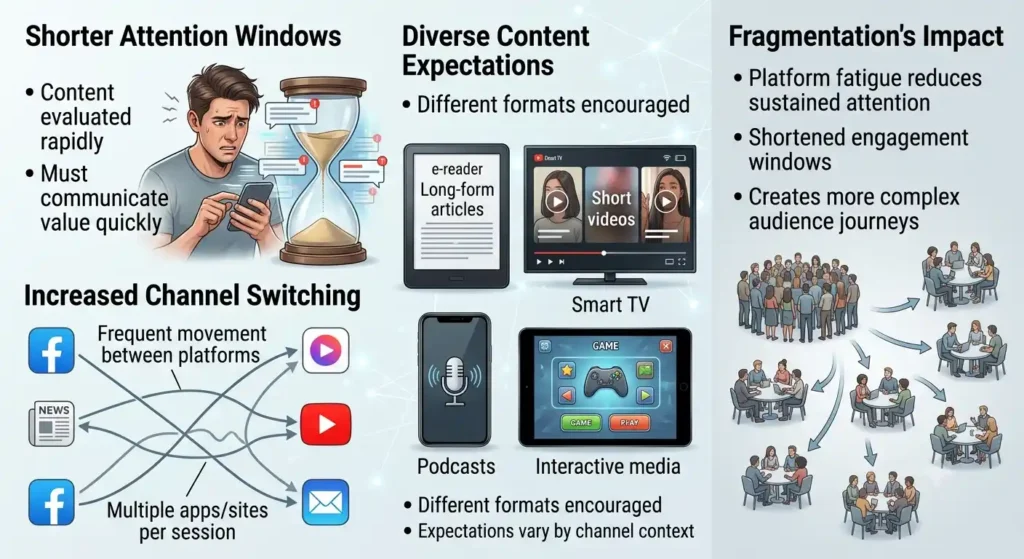
Engagement quality changes as fragmentation increases.
Shorter attention windows
Users often evaluate content rapidly.
Competition for attention means content must communicate value quickly.
Increased channel switching
Consumers frequently move between platforms.
A single media session may involve multiple applications and websites.
Diverse content expectations
Different platforms encourage different content formats.
Examples include:
- Long-form articles
- Short videos
- Podcasts
- Interactive media
Audience expectations vary according to channel context.
How can audience fragmentation be measured?
Audience fragmentation can be measured by analysing channel distribution, cross-platform behaviour, session frequency, content consumption patterns, device usage, and audience movement between digital environments over time.
Measurement focuses on understanding audience distribution rather than individual platform performance.
Key metrics used in fragmentation analysis
Common metrics include:
- Channel reach
- Frequency of visits
- Session duration
- Cross-device activity
- Audience overlap
- Content consumption volume
These indicators reveal how attention is distributed.
Why is cross-platform analysis important?
Cross-platform analysis connects isolated behavioural signals.
Instead of viewing audiences through one channel, researchers evaluate behaviour across multiple environments.
This approach creates a more complete audience picture.
Readers interested in advanced reporting methodologies can explore:
Custom Audience Insight Reports.
What does the future of audience attention look like in the UK?
Audience attention will continue fragmenting as new platforms, content formats, and digital experiences emerge. The number of channels competing for engagement will increase, making audience journeys more distributed and complex across the digital ecosystem.
Several trends are shaping future behaviour.
Expansion of creator-driven content
Independent creators continue attracting audiences across multiple platforms.
This increases content diversity and platform choice.
Growth of connected media ecosystems
Digital experiences increasingly connect:
- Video
- Audio
- Commerce
- Community interaction
These ecosystems create additional audience touchpoints.
Increased personalisation
Content recommendations become more tailored to individual preferences.
Personalisation influences where audiences spend attention and how they discover information.
Dive Deeper With Our Expert Guides:
How Gen Z in the UK Searches for Brands Completely Differently Than Millennials
Why Your Google Analytics Is Hiding 60% of What UK Readers Actually Do
Platform fatigue reflects a fundamental shift in how UK audiences consume media. Attention is no longer concentrated within a small number of dominant environments. Instead, it is distributed across search engines, news websites, social platforms, video services, podcasts, email, messaging applications, retail media networks, streaming services, and connected television.
This fragmentation changes audience journeys, engagement patterns, and media consumption behaviour. Understanding how attention moves across channels provides a clearer view of modern digital audiences and the evolving structure of the UK media landscape.



