

The way people discover brands in the United Kingdom has changed significantly over the last decade. Search behaviour is no longer defined by a single search engine query followed by a website visit. Younger consumers use social platforms, video content, online communities, and recommendation-driven discovery methods before making decisions.
The largest difference appears between Generation Z and Millennials. Both groups are digitally connected, but they use different search paths, trust different information sources, and engage with brands in different ways.
Understanding these behavioural differences helps marketers, publishers, researchers, and businesses analyse audience trends more accurately.
Why do Gen Z and Millennials search for brands differently?
Gen Z and Millennials grew up during different stages of internet development. Millennials adopted search engines as their primary discovery tool, while Gen Z grew up with social media, mobile-first experiences, video platforms, and algorithm-driven content discovery.
Millennials experienced the rise of desktop internet usage. Search engines became the default starting point for information gathering. Typing a keyword into a search engine remains a common habit for this group.
Gen Z entered the digital world during the smartphone era. Social feeds, short-form videos, creator content, and personalised recommendations became central to information discovery.
As a result, the search journey differs significantly between generations.
How did technology shape each generation?
Millennials were introduced to:
- Desktop web browsing
- Search engines
- Blogs
- Forums
- Email newsletters
Gen Z was introduced to:
- Smartphones
- Video-first platforms
- Social search
- Influencer recommendations
- AI-assisted discovery
These different environments created different information habits.
How does Gen Z start a brand search journey?
Gen Z often begins brand discovery through social content, creator recommendations, short videos, and platform search functions rather than traditional search engines. Discovery happens inside content environments where information and entertainment exist together.
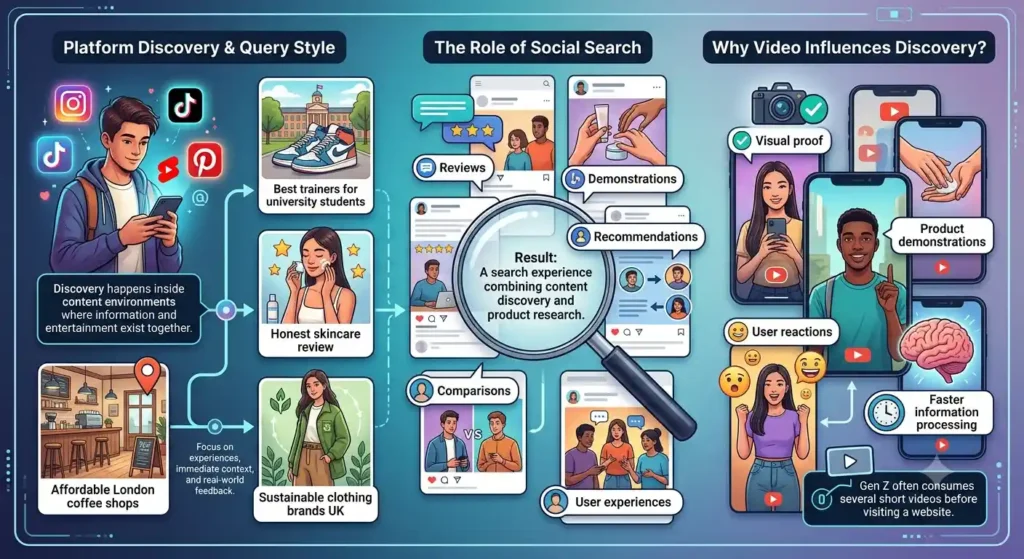
A Gen Z consumer looking for trainers, skincare products, or travel destinations often starts by searching within social platforms.
The search query focuses on experiences rather than product descriptions.
Examples include:
- Best trainers for university students
- Honest skincare review
- Affordable London coffee shops
- Sustainable clothing brands UK
The goal is immediate context and real-world feedback.
What role does social search play?
Social search refers to using social platforms as information sources.
Users search for:
- Reviews
- Demonstrations
- Recommendations
- Comparisons
- User experiences
The result is a search experience that combines content discovery and product research.
Why does video influence discovery?
Video provides:
- Visual proof
- Product demonstrations
- User reactions
- Faster information processing
Gen Z often consumes several short videos before visiting a website.
How do Millennials search for brands?
Millennials continue to rely heavily on traditional search engines, review websites, comparison pages, expert content, and long-form information sources when researching brands and products.
Millennials often begin with specific keyword searches.
Examples include:
- Best mortgage providers UK
- Laptop comparison 2026
- Family holiday packages Spain
- Energy supplier reviews
The search process often follows a structured path.
What does a typical Millennial search journey look like?
A common journey includes:
- Search engine query
- Reading articles
- Visiting review websites
- Comparing options
- Checking ratings
- Making a purchase decision
This behaviour reflects a stronger preference for detailed research.
Why is long-form content important to Millennials?
Long-form content provides:
- Detailed explanations
- Product comparisons
- Expert analysis
- Decision-making support
Millennials frequently consume information-rich content before taking action.
What sources does Gen Z trust when evaluating brands?
Gen Z places significant trust in creators, peers, community discussions, user-generated content, and authentic customer experiences. Trust is often built through multiple independent sources rather than official brand communications alone.
Trust develops through observation of real experiences.
Gen Z consumers frequently evaluate:
- Customer comments
- Community discussions
- Video reviews
- User-generated content
- Creator recommendations
Why is authenticity important?
Authenticity refers to content that appears genuine, transparent, and experience-based.
Consumers often compare:
- Sponsored content
- Independent reviews
- Community opinions
- Customer experiences
Consistency across sources increases credibility.
How do online communities influence decisions?
Online communities provide:
- Questions and answers
- Experience sharing
- Product discussions
- Problem-solving information
These discussions help consumers validate information before making decisions.
What sources do Millennials trust when evaluating brands?
Millennials often trust expert reviews, established publishers, comparison platforms, verified ratings, and detailed informational content that provides evidence and analysis.

Trust is often built through authority and expertise.
Millennials commonly consult:
- Industry publications
- Product review websites
- Consumer reports
- Comparison portals
- Specialist blogs
Why do expert reviews remain influential?
Expert reviews provide:
- Technical analysis
- Structured evaluations
- Feature comparisons
- Performance testing
This information supports rational decision-making.
How does comparison research affect purchases?
Comparison research helps users evaluate:
- Price
- Features
- Quality
- Value
- Reliability
Many purchasing decisions involve multiple comparison stages.
How does mobile behaviour differ between Gen Z and Millennials?
Gen Z displays stronger mobile-first behaviour and frequently switches between apps during the search process, while Millennials use both mobile and desktop devices depending on research complexity.
Device preference influences search behaviour.
Gen Z often remains within mobile ecosystems throughout the entire discovery process.
Millennials are more likely to transition between devices.
How does app switching affect searches?
A Gen Z consumer might:
- Discover a product in a video
- Search social comments
- Visit a website
- Check reviews
- Return to social content
This creates a fragmented but highly connected journey.
Why do Millennials still use desktop research?
Desktop environments provide:
- Larger screens
- Easier comparisons
- Multiple open tabs
- Detailed research capabilities
Complex purchasing decisions often encourage desktop usage.
Dive Deeper With Our Expert Guides:
Why Your Google Analytics Is Hiding 60% of What UK Readers Actually Do
What 39.7M Social Posts Reveal About UK Audience Behaviour in 2026
How do search keywords differ between Gen Z and Millennials?
Gen Z uses conversational, experience-focused, and recommendation-oriented searches, while Millennials frequently use descriptive, category-focused, and comparison-driven keywords.
Search language reflects user intent.
Gen Z examples include:
- Is this worth buying
- Honest review
- Best budget option
- What everyone is using
Millennial examples include:
- Product comparison
- Best provider UK
- Features and pricing
- Customer satisfaction ratings
What does this reveal about intent?
Gen Z searches often seek:
- Validation
- Social proof
- Experiences
Millennial searches often seek:
- Information
- Evaluation
- Comparison
Both approaches support decision-making through different pathways.
How does audience intent shape brand discovery?
Audience intent determines where users search, what information they trust, and how quickly they move through the decision process. Search behaviour reflects underlying motivations rather than age alone.
Intent categories include:
- Awareness
- Consideration
- Purchase
- Loyalty
Different generations express these intents differently.
For a deeper understanding of intent signals and audience behaviour, see:
What happens during the awareness stage?
Users seek:
- Education
- Inspiration
- Discovery
Searches are broad and exploratory.
What happens during the consideration stage?
Users seek:
- Reviews
- Comparisons
- Recommendations
Research becomes more focused and detailed.
What does this mean for understanding UK audiences?
UK audience behaviour continues to evolve as new technologies, platforms, and content formats reshape discovery patterns. Gen Z and Millennials follow different search journeys, but both groups seek trustworthy information that supports informed decisions.
Gen Z increasingly discovers brands through social content, video experiences, and community-driven recommendations.
Millennials continue to rely on search engines, detailed research, expert reviews, and structured comparison processes.
These differences influence:
- Brand visibility
- Content strategy
- Audience research
- Consumer behaviour analysis
Understanding these patterns provides a clearer view of how digital discovery works across generations in the United Kingdom.
For examples of how audience segments differ across industries and intent stages, explore:
Gen Z and Millennials search for brands through different digital pathways shaped by technology, platform preferences, trust signals, and content consumption habits. Understanding these behavioural differences provides valuable insight into modern audience discovery patterns in the UK.
Gen Z relies heavily on social search, creator content, video discovery, and community validation. Millennials continue to favour search engines, detailed comparisons, expert analysis, and structured research journeys.
Both generations remain active digital consumers, but their methods for finding, evaluating, and trusting brands reflect distinct approaches to information gathering. As digital platforms continue to evolve, understanding these search behaviours remains essential for accurately analysing audience trends and consumer decision-making.



