

The modern UK audience interacts with content across multiple platforms every day. A single consumer can read news on a publisher’s website, watch videos on social media, open marketing emails, search on Google, and use mobile apps within the same purchasing journey. This behaviour creates fragmented audience data. Cross-platform audience matching solves this challenge by connecting audience signals from different channels into a unified view.
As audience attention becomes increasingly distributed across digital environments, understanding how data fragmentation occurs is essential.
Businesses seeking context on this shift can explore:
Using the keyword Platform Fatigue.
What is cross-platform audience matching?
Cross-platform audience matching is the process of identifying and connecting audience interactions across multiple digital channels to create a unified customer profile. It combines data from websites, mobile applications, social platforms, email campaigns, and advertising environments into a single audience view.
Cross-platform audience matching enables organisations to understand how people interact with content throughout their journey. Instead of analysing channels separately, marketers connect behavioural signals into one framework.
A fragmented audience profile often contains disconnected records. One platform identifies a visitor through a website cookie. Another identifies the same person through an email address. A third platform records mobile app activity. Audience matching links these records together.
Which data sources are commonly matched?
Cross-platform audience matching often combines:
- Website analytics data
- Mobile application usage data
- CRM records
- Email engagement data
- Publisher audience data
- Advertising platform data
- Subscription information
- Customer transaction records
For example, a UK retailer can connect website browsing behaviour, newsletter engagement, and purchase history into one audience profile.
Why has audience fragmentation increased?
Audience fragmentation has increased because users consume content across more channels than ever before.
Examples include:
- News websites
- YouTube
- TikTok
- Podcasts
- Mobile apps
- Streaming platforms
- Email newsletters
- Search engines
- Online communities
Each platform captures different behavioural signals, creating separate datasets that require matching and reconciliation.
How does cross-platform audience matching work?
Cross-platform audience matching works by collecting audience identifiers from different sources, validating those identifiers, and linking records through deterministic or probabilistic matching methods. The resulting profile provides a consolidated representation of audience behaviour across digital touchpoints and devices.
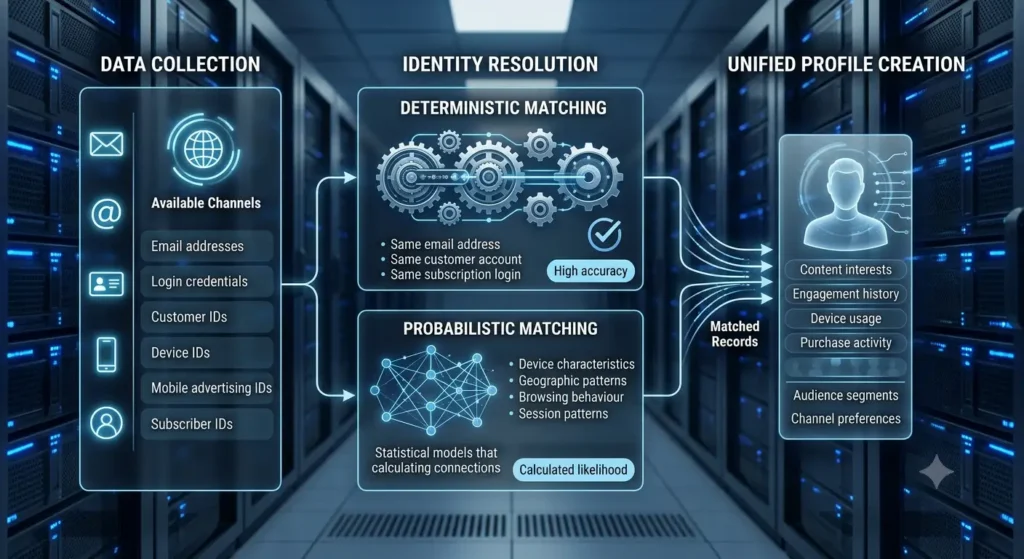
The matching process follows a structured workflow designed to maintain consistency and accuracy.
Data collection
The first stage gathers audience information from available channels.
Common identifiers include:
- Email addresses
- Login credentials
- Customer IDs
- Device IDs
- Mobile advertising IDs
- Subscriber IDs
These identifiers create reference points for audience recognition.
Identity resolution
Identity resolution determines whether records belong to the same individual.
Two primary approaches are used.
Deterministic matching
Deterministic matching uses exact identifiers.
Examples include:
- Same email address
- Same customer account
- Same subscription login
This method produces high accuracy because the identifiers match directly.
Probabilistic matching
Probabilistic matching uses behavioural and technical signals.
Examples include:
- Device characteristics
- Geographic patterns
- Browsing behaviour
- Session patterns
Statistical models calculate the likelihood that records belong to the same person.
Unified profile creation
After matching occurs, data is consolidated into a single profile.
The unified profile can contain:
- Content interests
- Engagement history
- Device usage
- Purchase activity
- Audience segments
- Channel preferences
This profile becomes the foundation for audience analysis and campaign planning.
What technologies support audience matching?
Cross-platform audience matching relies on identity resolution systems, customer data platforms, data management technologies, analytics systems, and privacy-compliant data infrastructures. These technologies organise audience signals, standardise identifiers, and maintain consistent audience records across multiple environments.
Technology plays a critical role in large-scale audience integration.
Customer Data Platforms (CDPs)
Customer Data Platforms centralise audience information from multiple sources.
Their functions include:
- Data collection
- Profile unification
- Audience segmentation
- Activation workflows
A CDP acts as the central repository for audience intelligence.
Identity Graphs
Identity graphs store relationships between audience identifiers.
For example, one identity graph can connect:
- Customer ID
- Email address
- Mobile device
- Browser session
This structure enables accurate audience recognition across channels.
Data Clean Rooms
Data clean rooms support privacy-compliant collaboration between organisations.
These environments allow data comparison without directly sharing personal information.
UK publishers and advertisers increasingly use clean rooms to improve audience analysis while maintaining regulatory compliance.
Analytics Platforms
Analytics platforms measure audience interactions after matching occurs.
They provide insights into:
- Engagement behaviour
- Conversion pathways
- Audience overlap
- Channel performance
These measurements help refine targeting strategies.
What benefits does cross-platform audience matching provide?
Cross-platform audience matching provides a more accurate understanding of audience behaviour, improves campaign measurement, reduces duplicated targeting, strengthens segmentation quality, and enables better allocation of marketing resources across channels.
Audience unification creates measurable operational advantages.
Improved audience understanding
A unified profile reveals complete audience journeys.
Instead of viewing separate interactions, organisations see:
- First engagement
- Content consumption
- Product research
- Conversion activity
This visibility supports stronger decision-making.
Reduced audience duplication
Many campaigns reach the same individual multiple times across different platforms.
Audience matching identifies overlap and reduces duplication.
Benefits include:
- Lower advertising waste
- More efficient reach
- Better frequency control
Better segmentation
Unified datasets improve audience segmentation.
Examples include:
- High-engagement readers
- Frequent purchasers
- Newsletter subscribers
- Returning visitors
More accurate segments improve campaign relevance.
Enhanced measurement
Cross-platform matching improves attribution accuracy.
Organisations gain visibility into:
- Channel influence
- Multi-touch journeys
- Conversion paths
- Engagement sequences
This creates more reliable performance reporting.
How do UK brands use audience matching in practice?
UK brands use cross-platform audience matching to understand customer journeys, improve advertising efficiency, personalise content experiences, enhance audience targeting, and measure performance across multiple digital environments using integrated audience datasets.
Audience matching supports several practical applications.
Publisher audience intelligence
News publishers collect audience data across websites, newsletters, mobile applications, and subscriptions.
Matching these datasets creates richer audience profiles.
Publishers can identify:
- Loyal readers
- Topic interests
- Subscription propensity
- Content engagement trends
Advertising optimisation
Brands use matched audiences to improve campaign performance.
Examples include:
- Retargeting engaged readers
- Suppressing converted users
- Building lookalike audiences
- Personalising messaging
These actions improve targeting precision.
Customer journey analysis
Audience matching reveals how people move between channels before conversion.
For example:
- Read a news article
- Click a social media advertisement
- Visit a product page
- Subscribe to a newsletter
- Complete a purchase
This sequence provides actionable behavioural insights.
Audience expansion strategies
Matched audience datasets help identify new audience opportunities.
Brands can discover:
- Similar audience groups
- High-value segments
- Emerging interest categories
These insights support strategic growth initiatives.
Dive Deeper With Our Expert Guides:
How to Use Audience Intent Data to Cut UK Campaign Waste by Up to 40%
Building an Audience Persona From News Site Data: A Step-by-Step UK Framework
What challenges must UK brands address?
Cross-platform audience matching requires strong data governance, identity accuracy, privacy compliance, platform integration, and consistent measurement standards. Organisations that address these challenges build more reliable audience intelligence frameworks and achieve stronger analytical outcomes.

Audience matching is effective when supported by robust processes.
Privacy compliance requirements
UK organisations operate within strict privacy frameworks.
Key considerations include:
- User consent
- Data transparency
- Data minimisation
- Security controls
Compliance remains a foundational requirement.
Data quality management
Poor-quality data reduces matching accuracy.
Common issues include:
- Duplicate records
- Missing identifiers
- Inconsistent formatting
- Outdated information
Regular validation improves reliability.
Platform interoperability
Different platforms store information differently.
Successful audience matching requires:
- Standardised data structures
- Consistent identifiers
- Integration workflows
These requirements support accurate profile creation.
Measurement consistency
Organisations must align reporting methodologies across platforms.
Consistent measurement enables:
- Reliable attribution
- Accurate comparisons
- Improved forecasting
Without standardisation, audience insights become fragmented again.
For businesses evaluating advanced audience intelligence approaches, additional operational details can be explored through:
Custom Audience Insight Reports.
Cross-platform audience matching enables UK brands to unify fragmented reader data into a single audience view. By connecting identifiers, resolving identities, integrating datasets, and maintaining privacy-compliant processes, organisations gain a clearer understanding of audience behaviour across multiple digital channels.
As audience attention continues to spread across websites, social platforms, apps, newsletters, and streaming environments, fragmented datasets become increasingly difficult to interpret independently. Cross-platform audience matching provides the framework that transforms disconnected signals into actionable audience intelligence, supporting better segmentation, measurement, targeting, and strategic decision-making across the entire customer journey.



