
Understanding audience behaviour has become a core requirement for modern marketing. UK brands operate across multiple channels, including news websites, social platforms, search engines, streaming services, and mobile applications. This creates large volumes of fragmented audience data. Custom audience insight reports transform that data into structured intelligence that supports campaign planning, audience targeting, and media investment decisions.
Businesses that already understand audience fragmentation through:
Cross-Platform Audience Matching: How UK Brands Unify Fragmented Reader Data and the broader impact of
Platform Fatigue often move to custom audience insight reporting as the next step in audience intelligence.
What is a custom audience insight report?
A custom audience insight report is a structured analysis of audience behaviour, demographics, interests, content consumption patterns, and purchase intent. It combines multiple data sources into a single intelligence framework that helps brands make evidence-based marketing decisions.
A custom audience insight report is a research document built specifically for a brand, campaign, product category, or target market.
Unlike standard analytics dashboards, the report focuses on audience understanding rather than raw performance metrics.
The report typically answers questions such as:
- Who is the audience?
- What content do they consume?
- Which platforms do they use?
- What topics influence their decisions?
- Where do they sit in the buying journey?
- Which channels drive engagement?
The objective is to convert audience data into actionable business intelligence.
What information does the report contain?
Most reports include:
- Demographic analysis
- Geographic distribution
- Device usage
- Content interests
- Search behaviour
- Platform preferences
- Purchase intent signals
- Audience segmentation
- Competitor audience overlap
- Campaign recommendations
These components create a comprehensive audience profile.
How are custom audience insight reports built?
Custom audience insight reports are built through data collection, audience identification, segmentation, behavioural analysis, validation, and reporting. Each stage transforms raw audience signals into structured findings that support marketing, advertising, and strategic planning.
The process follows a defined methodology.
Data collection
The first stage gathers audience data from relevant sources.
Common sources include:
- Publisher networks
- Website analytics
- CRM databases
- Advertising platforms
- Survey responses
- Search behaviour datasets
- Content engagement records
Data quality controls remove duplicates and invalid records.
Audience identification
Analysts identify the audience group relevant to the project.
Examples include:
- UK automotive buyers
- Healthcare decision-makers
- Financial services customers
- Technology professionals
- Luxury travel consumers
The audience definition determines the report scope.
Audience segmentation
The audience is divided into meaningful groups.
Examples include:
- Age groups
- Income brackets
- Job functions
- Geographic regions
- Purchase intent levels
- Content consumption patterns
Segmentation reveals differences that broad audience analysis often misses.
Behavioural analysis
Analysts evaluate audience actions across channels.
Areas examined include:
- Article readership
- Search activity
- Video consumption
- Email engagement
- Website behaviour
- Mobile usage
Patterns are identified and quantified.
Report generation
The findings are organised into a structured report.
Visualisations often include:
- Audience profiles
- Trend charts
- Channel comparisons
- Intent maps
- Segment breakdowns
The final document focuses on decision-making outcomes.
What data sources are used in audience insight reports?
Audience insight reports use first-party, second-party, and third-party data sources. Combining multiple sources improves accuracy, expands audience visibility, and creates a broader understanding of consumer behaviour across digital environments.
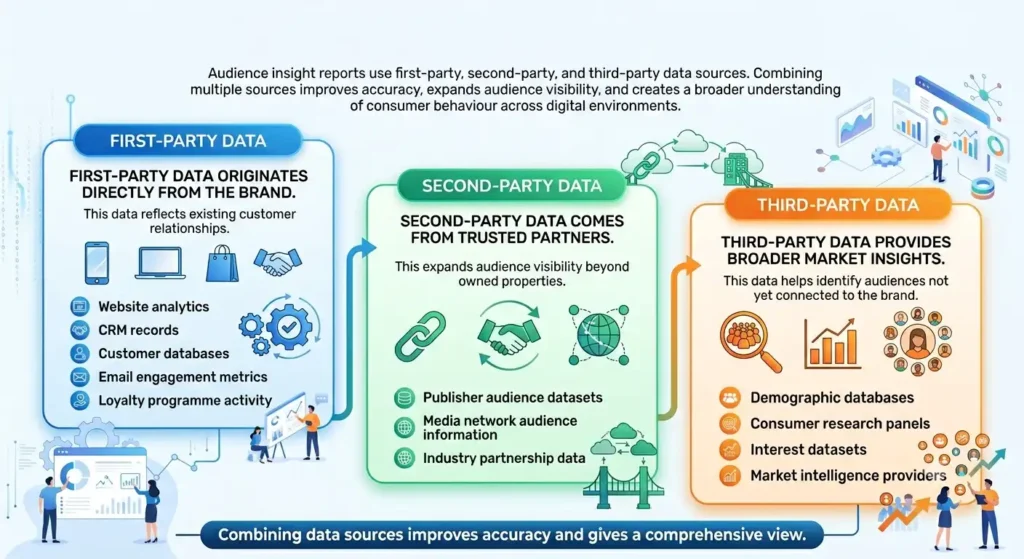
Different data sources contribute different forms of intelligence.
First-party data
First-party data originates directly from the brand.
Examples include:
- Website analytics
- CRM records
- Customer databases
- Email engagement metrics
- Loyalty programme activity
This data reflects existing customer relationships.
Second-party data
Second-party data comes from trusted partners.
Examples include:
- Publisher audience datasets
- Media network audience information
- Industry partnership data
This expands audience visibility beyond owned properties.
Third-party data
Third-party data provides broader market insights.
Examples include:
- Demographic databases
- Consumer research panels
- Interest datasets
- Market intelligence providers
This data helps identify audiences not yet connected to the brand.
What do brands receive in a custom audience insight report?
Brands receive audience profiles, behavioural findings, segmentation models, intent analysis, channel recommendations, and strategic conclusions. The report converts large datasets into practical intelligence that marketing teams, agencies, and executives can apply immediately.
Deliverables vary depending on project scope.
Audience profile section
This section defines the audience.
Typical elements include:
- Age distribution
- Gender breakdown
- Occupation data
- Household characteristics
- Regional concentration
These insights establish audience identity.
Interest and content analysis
This section examines what audiences consume.
Examples include:
- News categories
- Industry topics
- Lifestyle interests
- Entertainment preferences
- Professional content engagement
Content affinity helps brands align messaging with audience interests.
Intent analysis
Intent analysis identifies audience readiness to act.
Examples include:
- Awareness stage audiences
- Research stage audiences
- Consideration stage audiences
- Purchase-ready audiences
This information supports campaign targeting.
Channel intelligence
This section identifies where audiences spend attention.
Examples include:
- News websites
- Search engines
- Social platforms
- Video platforms
- Mobile applications
Brands use this intelligence to optimise media planning.
Why do UK brands invest in custom audience insight reports?
UK brands invest in audience insight reports because they improve targeting accuracy, reduce campaign waste, strengthen audience understanding, and increase marketing efficiency. Better audience intelligence supports stronger commercial outcomes across digital channels.
Marketing budgets require accountability.
Audience intelligence improves resource allocation.
Improved targeting
Better audience understanding leads to better targeting.
Brands can focus campaigns on:
- High-intent audiences
- Relevant demographics
- Specific geographic regions
- Qualified prospects
This improves efficiency.
Reduced media waste
Audience insights help eliminate irrelevant impressions.
Benefits include:
- Lower acquisition costs
- Better audience reach
- Improved engagement rates
- Stronger campaign relevance
Marketing spend becomes more effective.
Stronger campaign planning
Planning improves when audience behaviour is understood.
Teams gain clarity on:
- Message development
- Channel selection
- Audience priorities
- Content strategy
This reduces uncertainty during campaign execution.
How are audience insight reports used in marketing decisions?
Audience insight reports support media planning, content strategy, audience targeting, product positioning, and campaign optimisation. The findings guide decisions across multiple departments and improve alignment between business objectives and audience needs.
The reports influence both strategic and operational activities.
Media planning
Media teams use insights to identify effective channels.
This supports:
- Budget allocation
- Audience reach forecasting
- Cross-channel planning
- Campaign scheduling
Media decisions become data-driven.
Content development
Content teams use insights to understand audience interests.
Examples include:
- Topic selection
- Editorial planning
- Creative messaging
- Audience engagement strategies
Content relevance improves significantly.
Product positioning
Audience intelligence reveals market expectations.
Brands gain visibility into:
- Customer priorities
- Purchase drivers
- Decision factors
- Competitive perceptions
This supports stronger positioning strategies.
What should brands look for when choosing a custom audience insight provider?
Brands should evaluate data quality, audience coverage, methodology transparency, reporting depth, segmentation capabilities, and actionable recommendations. Reliable providers deliver validated insights that support measurable marketing and business outcomes.
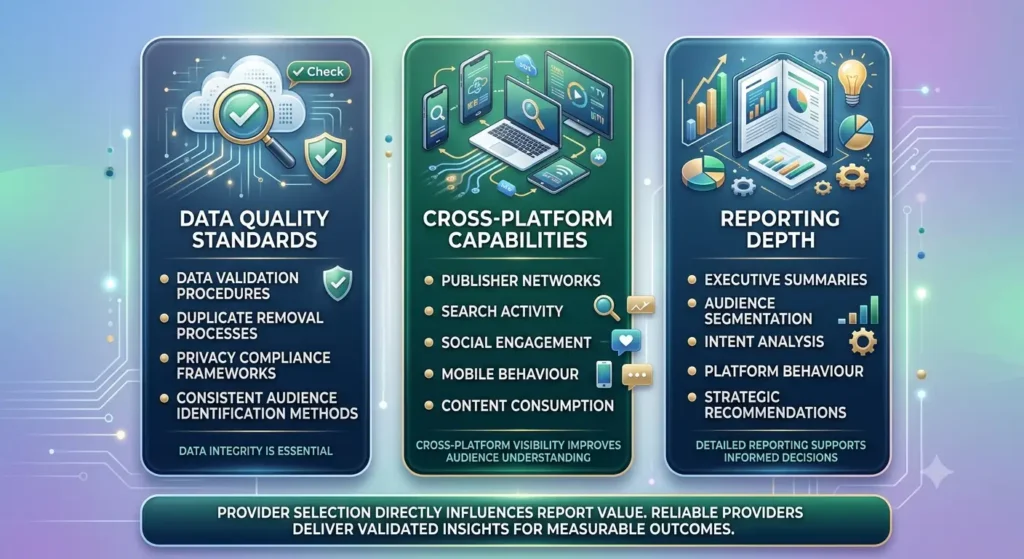
Provider selection directly influences report value.
Data quality standards
High-quality providers maintain:
- Data validation procedures
- Duplicate removal processes
- Privacy compliance frameworks
- Consistent audience identification methods
Data integrity is essential.
Reporting depth
Comprehensive reports include:
- Executive summaries
- Audience segmentation
- Intent analysis
- Platform behaviour
- Strategic recommendations
Detailed reporting supports informed decisions.
Cross-platform capabilities
Audience behaviour spans multiple environments.
Providers should analyse:
- Publisher networks
- Search activity
- Social engagement
- Mobile behaviour
- Content consumption
Cross-platform visibility improves audience understanding.
How can brands turn audience insight reports into measurable results?
Brands achieve measurable results by applying audience findings to targeting, content creation, media planning, and campaign optimisation. Successful implementation converts audience intelligence into improved engagement, stronger conversion performance, and more efficient marketing investment.
Insight without execution creates limited value.
Implementation requires structured action.
Apply audience segments
Use audience segments to create targeted campaigns.
Different audience groups require:
- Different messages
- Different channels
- Different content formats
Segmentation increases relevance.
Align content with interests
Content should reflect identified audience preferences.
Examples include:
- Industry-specific articles
- Educational resources
- Product comparisons
- Purchase guidance
Relevant content improves engagement.
Optimise channel selection
Invest in channels where audiences actively engage.
This improves:
- Reach quality
- Campaign efficiency
- Conversion opportunities
- Return on investment
Audience intelligence becomes a measurable competitive advantage.
Dive Deeper With Our Expert Guides:
What 10 UK News Site Audiences Look Like by Industry, Age and Intent Stage
News Site Audience Data vs DMP Platforms: A Head-to-Head UK Comparison
Custom audience insight reports transform fragmented audience data into structured business intelligence. They combine demographic information, behavioural analysis, content preferences, intent signals, and channel activity into a single decision-making framework. For UK brands operating in complex digital environments, these reports support more accurate targeting, stronger media planning, reduced campaign waste, and better marketing performance. Organisations that understand audience behaviour at a detailed level gain a significant advantage when planning campaigns, allocating budgets, and engaging high-value audiences.